
Microscope Sourcing FAQ: Long-Term Partnership, Acceptance Criteria & After-Sales Support
Microscope Sourcing FAQ: Long-Term Partnership, Acceptance Criteria & After-Sales Support
Buying a microscope is a capital decision. Buying it from a supplier you will rely on for years is a relationship decision, and the two require different questions. This FAQ is written for laboratory, hospital, and industrial buyers who are comparing long-term microscope supply relationships rather than placing a single order. It addresses the questions that usually decide the outcome: what acceptance criteria should include, how to match an instrument family to an application, what after-sales support should actually look like, and how to compare total cost instead of sticker price.
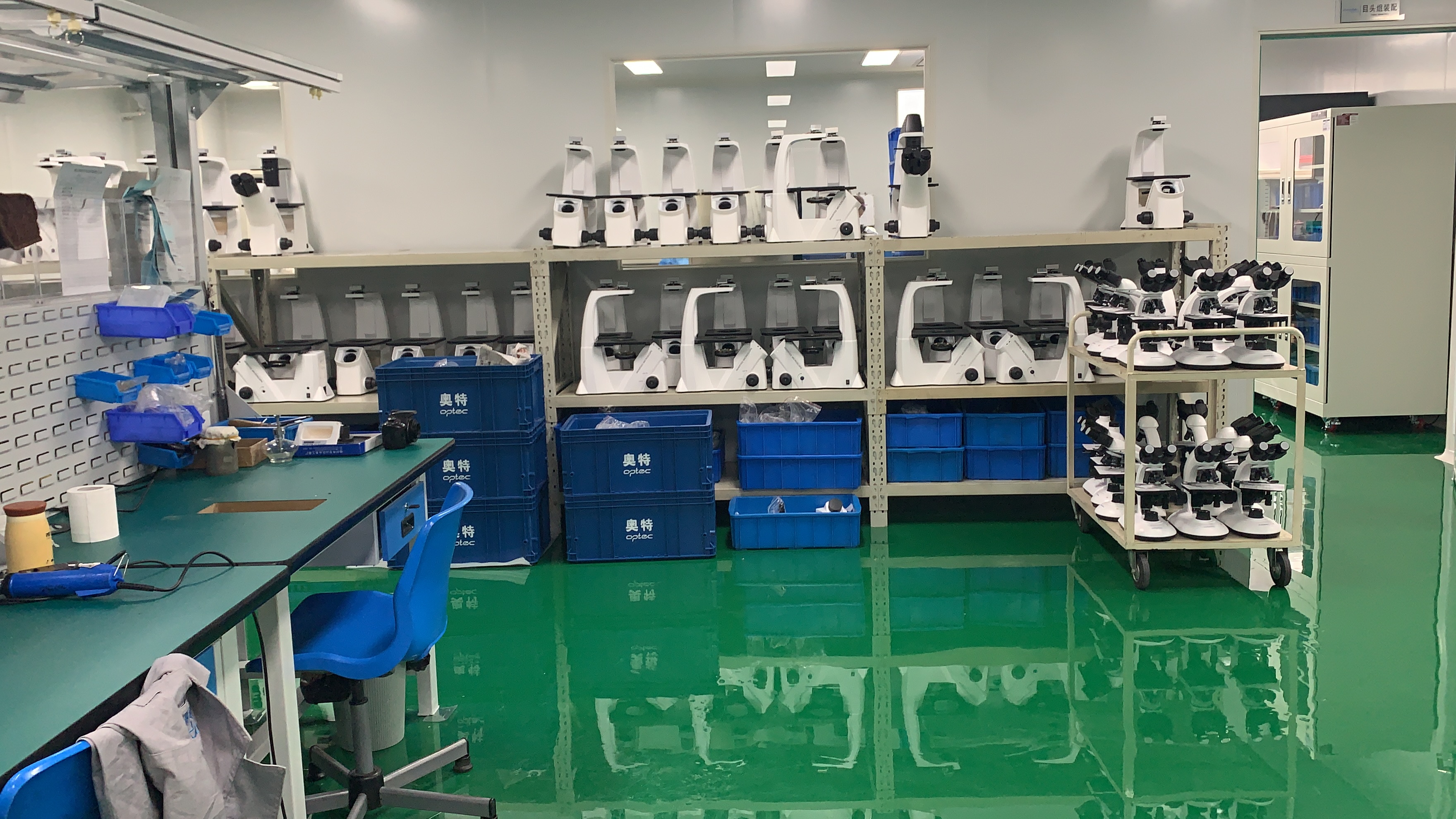
Optical assembly and testing take place in a dust-free, humidity-controlled workshop - one of the process controls that supports consistent output across repeat orders.
Why One-Off Microscope Purchasing Fails
One-off purchasing logic fails in microscope procurement for four reasons.
Acceptance ambiguity. When a purchase order lists only a model name, both sides can walk away with different expectations about objectives, condensers, illumination, camera interfaces, and documentation. Disputes surface at delivery, when correction is expensive.
Application mismatch. A biological microscope configured for bright field will not deliver the contrast a live-cell workflow needs, and a metallurgical instrument will not substitute for a polarizing microscope in mineralogy. The instrument family has to follow the application, not the other way around.
Support discontinuity. Microscopes are long-life instruments. Bulbs degrade, accessories wear, optical paths collect dust, and optics can fog or develop mold in humid storage. A supplier who disappears after delivery leaves the buyer holding those risks.
Underestimated total cost of ownership. The purchase price is only the first cost. Maintenance, parts replacement, calibration, downtime, and the labor cost of image capture all sit downstream of the invoice.
A long-term supply relationship addresses these risks jointly. That is why the questions below are framed around the relationship rather than the transaction.
The Market Context for Long-Term Sourcing
The global microscope market reached a valuation of approximately USD 11.9 billion in 2025, according to Market Research Future. Optical microscopes accounted for approximately 37% of that market in the same year. The optical share matters for procurement because it means the buyer's decision is usually about configuration and support, not about whether optical microscopy remains relevant.
Trade data reinforces the point. Global trade in microscopes under HS 9011 reached USD 3.36 billion in 2024, with China as the third-largest exporter at approximately USD 430 million, according to the Observatory of Economic Complexity. A buyer sourcing from Chinese manufacturers is therefore participating in a mature, high-volume supply chain, not an experimental one.
What that supply chain does not automatically provide is consistency between suppliers. Two factories can both list biological, inverted, and fluorescence microscopes and still differ in optical assembly discipline, documentation completeness, and after-sales responsiveness. For long-term buyers, the differentiator is rarely the catalogue; it is the operating discipline behind the catalogue.
Microscope Sourcing Questions Buyers Ask Most
1. What should purchasing terms and acceptance criteria cover?
Configuration. The agreement should name the model, the objective set, the condenser type, the illumination type, the stage, and the camera interface. For example, an inverted microscope order should specify whether the phase contrast condenser is the 4-hole rotating disc type used on the BDS500, or whether the configuration relies on LWD infinity phase contrast objectives as on the BDS400. Those are different optical paths and should not be left to interpretation.
Optical acceptance. At a minimum, the buyer should define a visual and functional check: image clarity across the agreed magnification range, parfocality between objectives, even illumination across the field, and correct alignment of phase contrast, dark field, or fluorescence components where fitted. The agreement should state who performs the check, at which site, and against which reference sample.
Mechanical and electrical acceptance. Stage travel, focus smoothness, and illumination stability should be verified against the agreed configuration.
Packaging and documentation.Chongqing Scope prepares export packaging as neutral packaging in cardboard boxes or wooden cases, in line with export standards. The buyer should confirm the packaging type, the labeling requirement, and the document set. Certificates such as ISO9001, ISO14001, ISO45001, ISO13485, CE, and RoHS are listed by the supplier; customs documents such as CO, Form E, and Form F can also be provided on request.
Non-conformance handling. The agreement should define how a failed acceptance item is corrected, who bears freight, and what the replacement timeline is.
2. How do you match a microscope model to an application?
Chongqing Scope lists biological, metallurgical, inverted, fluorescence, polarizing, stereo, and digital microscopes among its product categories. The practical matching logic below reflects those categories and the configurations used in the company's model range.
Biological and routine bright field. Upright biological microscopes are the default for histology, cytology, and general laboratory observation. A binocular or trinocular head is chosen according to whether a camera will be used.
Inverted and live-cell work. Inverted microscopes keep the objective below the stage, which suits culture vessels and live-cell workflows. The BDS500 inverted microscope uses a 4-hole rotating disc phase contrast condenser, which allows the user to switch phase contrast rings to match different objectives. The BDS400 uses LWD infinity phase contrast objectives, which provide the longer working distance that thick-walled vessels and plastic-bottom dishes require.
Phase contrast. Phase contrast converts refractive index differences into contrast, which is why it is used for unstained living cells. It should be specified as a configuration, not assumed.
Dark field and bright field for industrial samples. Metallurgical microscopes such as the MIT300D are supplied with bright field and dark field objectives, which allow the same instrument to show surface topography and inclusions under different illumination modes.
Fluorescence. Fluorescence microscopes such as the BK5000-FL use multiple fluorescence filters, so the buyer should confirm which filter cubes match the fluorophores in use rather than ordering a generic fluorescence configuration.
Polarizing and petrographic. Polarizing microscopes are used for mineral, crystal, and polymer analysis, where birefringence and extinction behavior carry the information.
Stereo. Stereo microscopes provide depth perception for dissection, soldering, and industrial inspection.
3. How should buyers evaluate total cost of ownership?
Three mechanisms drive that gap.
Maintenance load. Traditional microscopes require frequent professional calibration and cleaning. The current-generation design is described as needing only simple post-use care, with parts replacement that users can perform without professional support.
Image capture efficiency. When connected to a digital camera, the current-generation microscope reduces image capture time by 40%. In a laboratory that captures images daily, that is a recurring labor saving, not a one-time feature.
Configuration flexibility. The same comparison records 10+ optional lighting configurations against 2-3 options on traditional models, and a low-voltage design that supports 8+ hours of outdoor use with a power bank. For field, teaching, or multi-site use, that flexibility reduces the need for a second instrument.
The buyer's task is to model these three lines over the expected service life, not to compare unit prices in isolation.
4. How should a sample be validated before a long-term commitment?
Recommended sample checks:
- Image clarity and parfocality across the agreed objective set
- Illumination uniformity across the field
- Stage travel and focus smoothness
- Camera integration and image capture workflow
- Phase contrast, dark field, or fluorescence alignment where fitted
- Packaging condition on arrival
- Documentation completeness
A sample that differs from the ordered configuration validates the supplier's capability, not the specific instrument. The closer the sample is to the production build, the more useful the result.
5. What does after-sales support look like after delivery?
The corresponding controls are practical rather than theoretical. Manual power outage protects illumination life. An instruction manual covers routine operation and care. A dust cover protects the optical path between sessions. Anti-mildew and anti-fog treatment addresses humid storage.
The supplier-side measures are online after-sales repair service, including operation videos, and a supply of replacement accessories. Because parts replacement can be performed by users without professional support on the current-generation design, the buyer is not dependent on a service visit for routine maintenance.
For a long-term relationship, the buyer should confirm three things in writing: the spare parts list and availability, the response path for technical questions, and the documentation that ships with each unit.
A Step-by-Step Evaluation Path
A practical evaluation path runs in six steps.
- Define the application. Name the sample type, the observation mode, and the output (visual, image, measurement). This determines the instrument family before any model is discussed.
- Shortlist instrument families. Match the application to biological, inverted, phase contrast, dark field, metallurgical, polarizing, fluorescence, or stereo families. Confirm that the supplier actually covers the family rather than reselling it.
- Agree acceptance criteria. Convert the application requirements into acceptance items: configuration, optical performance, mechanical and electrical checks, packaging, and documentation. Write them into the agreement.
- Validate with a sample. Test the sample against the acceptance items. Record results. Resolve gaps before the production order.
- Confirm commercial and compliance terms. Confirm the certificate package and its scope, the customs documents required, the packaging type, and the payment and delivery terms.
- Establish the after-sales plan. Confirm spare parts, the technical response path, and the documentation set. Assign an internal owner for the relationship.
The sequence matters because each step reduces the uncertainty that the next step depends on.
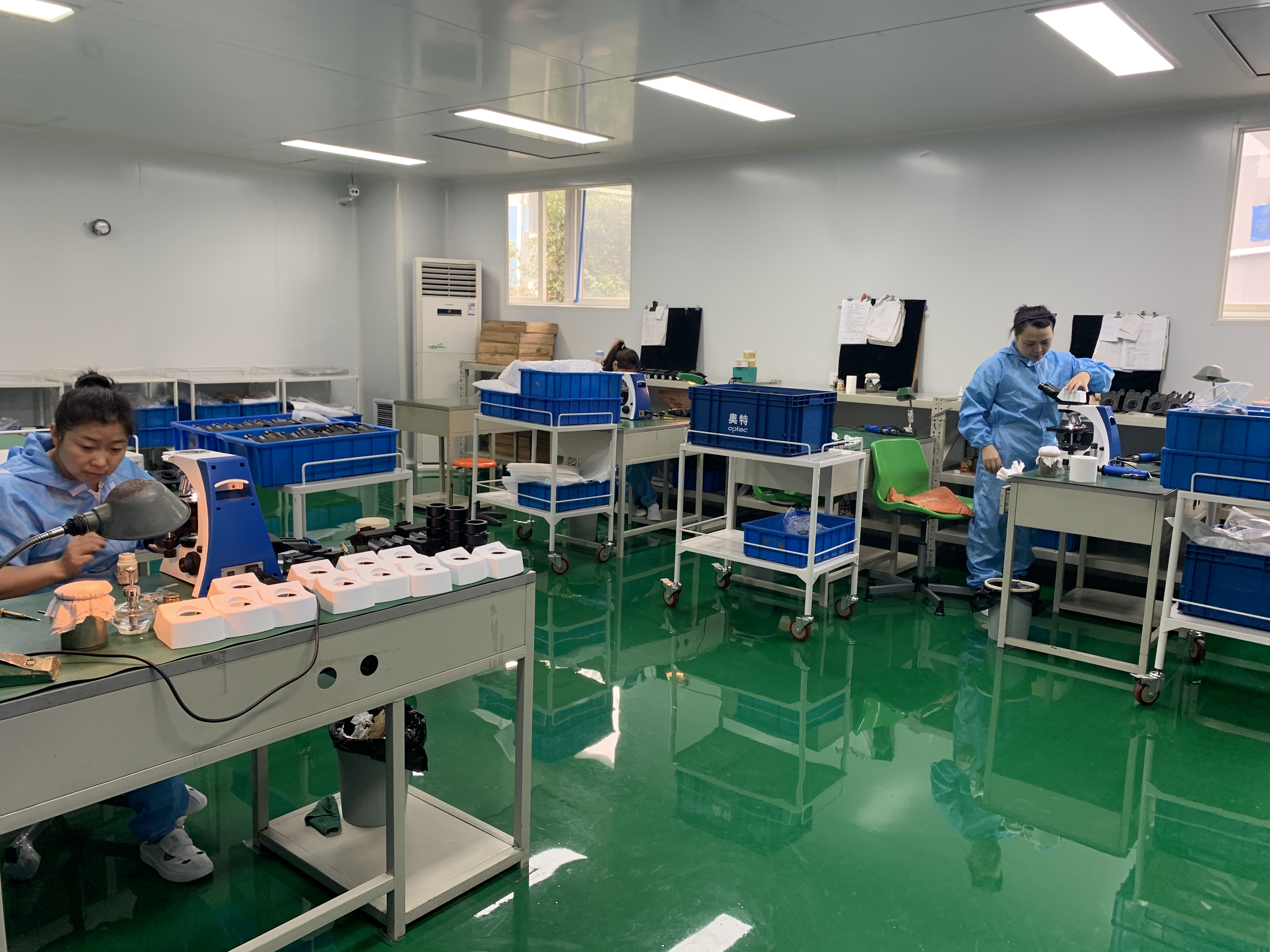
Component production, optical installation, and testing sit inside the same factory - the basis for repeat-order consistency.
Where These Instruments Fit
Cell culture and live-cell imaging. Inverted microscopes with phase contrast are the working configuration. The BDS500's 4-hole rotating disc phase contrast condenser and the BDS400's LWD infinity phase contrast objectives address the two common constraints: matching phase rings to objectives, and working through thick-walled vessels.
Clinical and hospital laboratories. Upright biological microscopes in binocular or trinocular configuration cover routine bright field work. The trinocular head is specified when documentation or telepathology images are required.
Materials and metallurgical laboratories. Metallurgical microscopes such as the MIT300D, with bright field and dark field objectives, support surface inspection, coating evaluation, and inclusion analysis.
Fluorescence research. The BK5000-FL, with multiple fluorescence filters, supports multi-channel fluorescence work where the filter set has to match the fluorophores.
Geological and mineralogical analysis. Polarizing microscopes support thin-section petrography and crystal identification.
Teaching and industrial inspection. Stereo microscopes provide depth perception for dissection and assembly inspection, while monocular and binocular biological microscopes cover classroom use.
Application-to-Instrument Matching
| Application | Recommended family | Configuration focus | Model reference |
|---|---|---|---|
| Routine histology, cytology | Biological (upright) | Bright field; binocular or trinocular head | - |
| Live-cell, culture vessels | Inverted | Phase contrast; long working distance | BDS500, BDS400 |
| Unstained living cells | Phase contrast | Phase rings matched to objectives | BDS500, BDS400 |
| Surface and inclusion analysis | Metallurgical | Bright field / dark field objectives | MIT300D |
| Multi-channel fluorescence | Fluorescence | Filter cubes matched to fluorophores | BK5000-FL |
| Mineral and crystal analysis | Polarizing | Strain-free optics; analyzer | - |
| Dissection, assembly inspection | Stereo | Depth perception; working distance | - |
Traditional vs. Current-Generation Microscopes
| Factor | Traditional microscope | Current-generation (supplier-stated) |
|---|---|---|
| Optical system | Baseline | Superior optical system |
| Body | - | Metal body |
| Parts replacement rate | - | Low |
| Service life | - | Long |
| Image capture with digital camera | Baseline | 40% reduction in capture time |
| Lighting configurations | 2-3 options | 10+ options |
| Field use | - | Low-voltage design; 8+ hours with a power bank |
| Initial purchase price | Lower | Slightly higher |
| Total cost of ownership | Higher | 25% lower |
| Maintenance | Frequent professional calibration and cleaning | Simple post-use care; user-replaceable parts |
| Typical setting | - | Laboratory, university, hospital |
A dash indicates the supplier's comparison does not state a value for that cell. Figures are supplier-stated and should be validated against the buyer's own application and acceptance criteria.
Frequently Asked Questions
Which certifications should a long-term microscope supplier provide?
The certificate package should be reviewed as documents, not as logos. Chongqing Scope lists ISO9001, ISO14001, ISO45001, ISO13485, CE, and RoHS among its certificates, and can provide customs documents such as CO, Form E, and Form F. Buyers should confirm the scope and model mapping of each certificate at the quotation stage, because a management-system certificate and a product conformity marking answer different questions.
Can one supplier cover biological, industrial, and fluorescence needs?
Product-category coverage is not the same as configuration depth. Chongqing Scope lists biological, metallurgical, inverted, fluorescence, polarizing, stereo, and digital microscopes. The practical test is whether the supplier can configure each family to the buyer's application, for example a 4-hole rotating disc phase contrast condenser on an inverted model or multiple fluorescence filters on a fluorescence model.
How should buyers compare quotes beyond unit price?
Compare the configuration, the acceptance criteria, the certificate package, the spare parts list, and the after-sales response path. A lower unit price with a narrower objective set, thinner documentation, or no spare parts availability is not a lower total cost.
What is the first step to request a sample or quote?
Define the application and the configuration first, then request a quotation against that specification and a sample configured as closely as possible to the production order. Chongqing Scope's product catalogue is available as a PDF, and the company can be reached at [email protected] or +86 15223521781 for sample and quotation requests.
Conclusion
A long-term microscope supply relationship is built on five commitments: a configuration that matches the application, acceptance criteria that are written down before delivery, a sample that is validated against those criteria, a total-cost model that includes maintenance and image capture, and an after-sales plan that names the failure modes and the response path.
Chongqing Scope Instrument Co., Ltd. supports these commitments through a microscope range that covers biological, metallurgical, inverted, fluorescence, polarizing, and stereo families, OEM and ODM services, a certificate package that includes ISO9001, ISO14001, ISO45001, ISO13485, CE, and RoHS, neutral export packaging, and online after-sales support with operation videos and replacement accessories.
Buyers who treat the first order as the start of a relationship, rather than the end of a search, get more value from the same instrument.
Next step: request the catalogue, a sample, or a quotation.
Share your application and configuration requirements, and the supplier can respond against a defined specification rather than a generic list.
Download the product catalogue (PDF) | Email: [email protected] | WhatsApp: +86 15223521781 | Web: www.cqscopelab.com
Have Questions or Need More Details?
Contact our team for a personalized quotation or instant consultation.
Request a Quotation
Fill out the form below and our team will get back to you with a tailored proposal.
WhatsApp Direct Chat
Prefer to chat in real-time? Message us on WhatsApp for instant assistance & quick answers.
- Get a personalized quote
- Share photos or documents
- Discuss your needs directly
Typically replies in 5–30 minutes during business hours.