
Navigating Microscope Compliance: Key Certifications and Standards
A microscope is compliant when four things line up: the certificate number, the standard that certificate cites, the scope it actually covers, and the model printed on your purchase order. When any one of those four fails to match, the document in front of you is still a genuine certificate — it simply does not apply to the instrument you are buying.
This guide is written for laboratory managers, school procurement officers, industrial quality teams, and distributors assessing optical microscopes in 2026. It examines the evidence chain presented by Chongqing Scope Instrument Co., Ltd. — a supplier of laboratory and medical training instruments and metallographic equipment based in Chongqing, China — and shows how to interrogate that evidence at model level rather than at brand level. The examples used throughout are biological, metallurgical, polarizing, inverted, and stereo models, because those are the categories where laboratory and industrial buyers most often inherit a supplier's compliance claim without checking what it covers.
- Compliance is a per-model, per-market, per-standard property, never a company-wide badge.
- Safety, EMC, hazardous-substance restriction, and management-system certification are four different documents and cannot substitute for one another.
- Certificate scope is written in model-family prefixes; a prefix outside the scope means the certificate does not cover that instrument.
- Build materials and optical configuration are compliance-relevant, because they determine whether the instrument can hold the performance the specification promises.
The Compliance Gap: Why One Certificate Does Not Protect a Buyer
The most common procurement error in microscopy is treating a certificate as a property of the supplier rather than a property of the product. A supplier may legitimately hold a conformity document while a specific catalogue model, a newer revision, or a customised build sits outside the listed scope. The buyer then receives a valid PDF and an instrument that was never inside the approval.
Four document types are routinely mixed together, and each answers a different question:
- Management-system certification (ISO 9001, ISO 14001, ISO 45001, ISO 13485) describes how the organisation runs quality, environment, safety, and medical-device-related processes. Chongqing Scope states that these certificates can be provided for export orders. None of them is an approval of an individual microscope.
- Product safety conformity answers whether the instrument is electrically safe under normal and single-fault conditions. For the models discussed here, this is the CE documentation citing EN 61010-1.
- Electromagnetic compatibility answers whether the instrument emits and tolerates interference in a shared laboratory or factory environment.
- Restricted-substance compliance answers whether the materials used stay within hazardous-substance limits — here, RoHS against the IEC 62321 test series.
A buyer who accepts "we are CE certified" as a single sentence has not yet asked any of those four questions. The rest of this article converts that sentence into a verifiable chain.
Industry Background: Why Documentation Scrutiny Is Rising
The global microscope market was valued at approximately USD 11.9 billion in 2025, according to Market Research Future's 2026 market report, with optical microscopes accounting for roughly 37% of that total. Trade data points in the same direction: global trade in microscopes under HS 9011 reached USD 3.36 billion in 2024, and China was the third-largest exporter at USD 430 million, per the Observatory of Economic Complexity.Two consequences follow for procurement. First, the optical segment remains large enough that buyers have real choice, which means compliance documents are now a competitive differentiator rather than a formality. Second, a market of that scale attracts a long tail of trading intermediaries whose documentation sits one step removed from the factory that actually builds the instrument.
The practical risk is not fraud in most cases. It is scope drift: a certificate issued for a product family gets forwarded for a model that joined the range later, or a distributor forwards the factory's certificate for a build the factory no longer produces under that approval. The buyer's defence is a repeatable verification routine, not suspicion.
The Four-Layer Evidence Chain Behind a Compliant Microscope
For the Chongqing Scope microscope range, the applicable documentation can be organised into four layers, plus a fifth physical layer that no certificate can replace.
Layer 1 — Management-system evidence
Management-system certificates describe the process environment in which instruments are assembled and tested. The supplier states that ISO 9001, ISO 14001, ISO 45001, ISO 13485, CE, and RoHS documentation can all be provided for export. For a buyer, the value of this layer is that it supports a factory-audit conversation: it is a reason to request the quality manual, calibration records, and incoming-inspection logs, not a substitute for them.
Layer 2 — Product safety under EN 61010-1
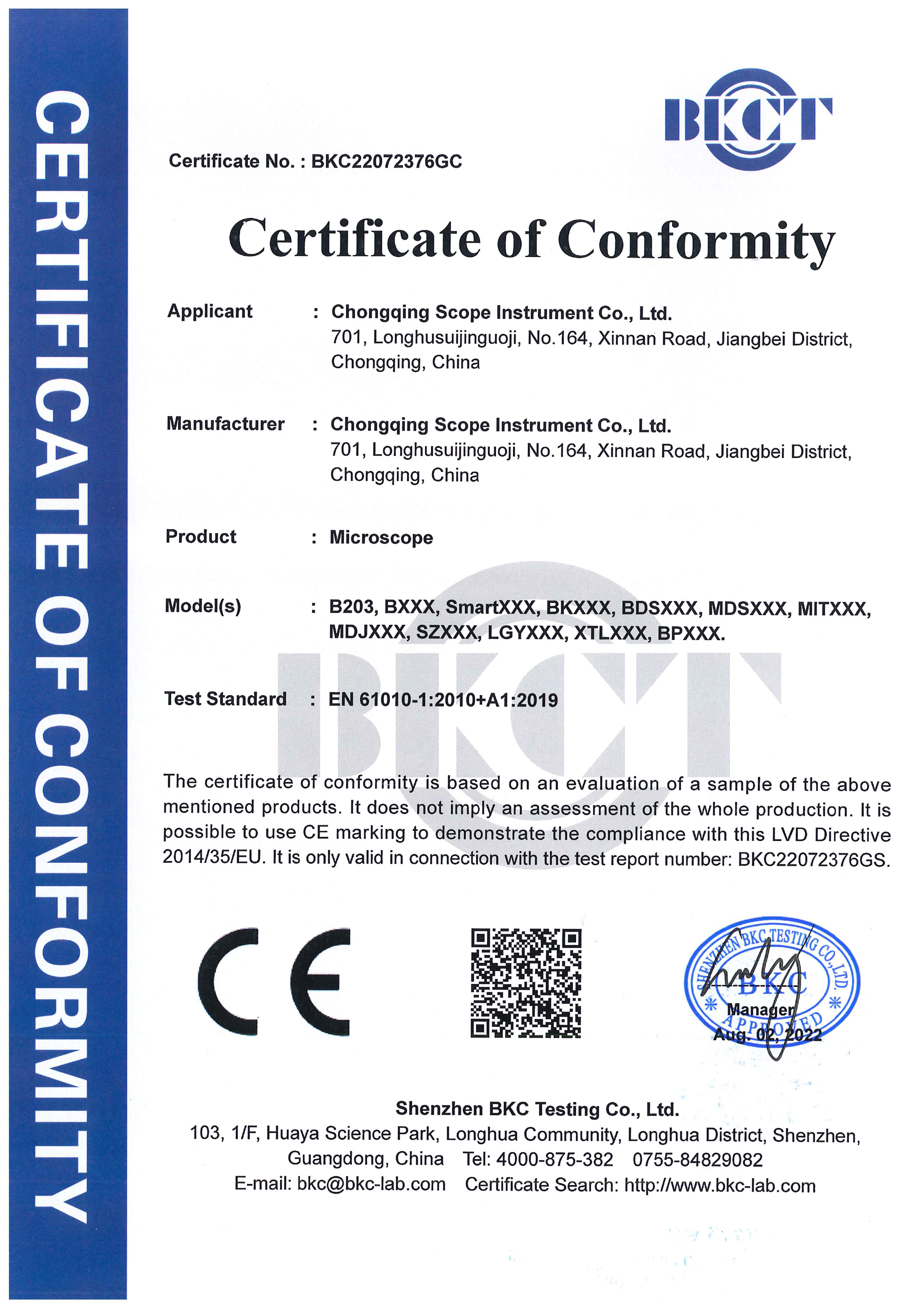
The safety-side CE document in the register is certificate BKC22072376GC, issued by BKC on 2022-08-02 and valid to 2032-08-01, citing EN 61010-1:2010+A1:2019. Its stated scope covers the model-family prefixes B203, BXXX, SmartXXX, BKXXX, BDSXXX, MDSXXX, MITXXX, MDJXXX, SZXXX, LGYXXX, XTLXXX, and BPXXX. That prefix list is the operative part of the document: a biological monocular model beginning with B, a metallurgical model beginning with MIT, an inverted model beginning with BDS, or a stereo model beginning with SZ all fall inside those families, while a model outside them would not.
Layer 3 — Electromagnetic compatibility
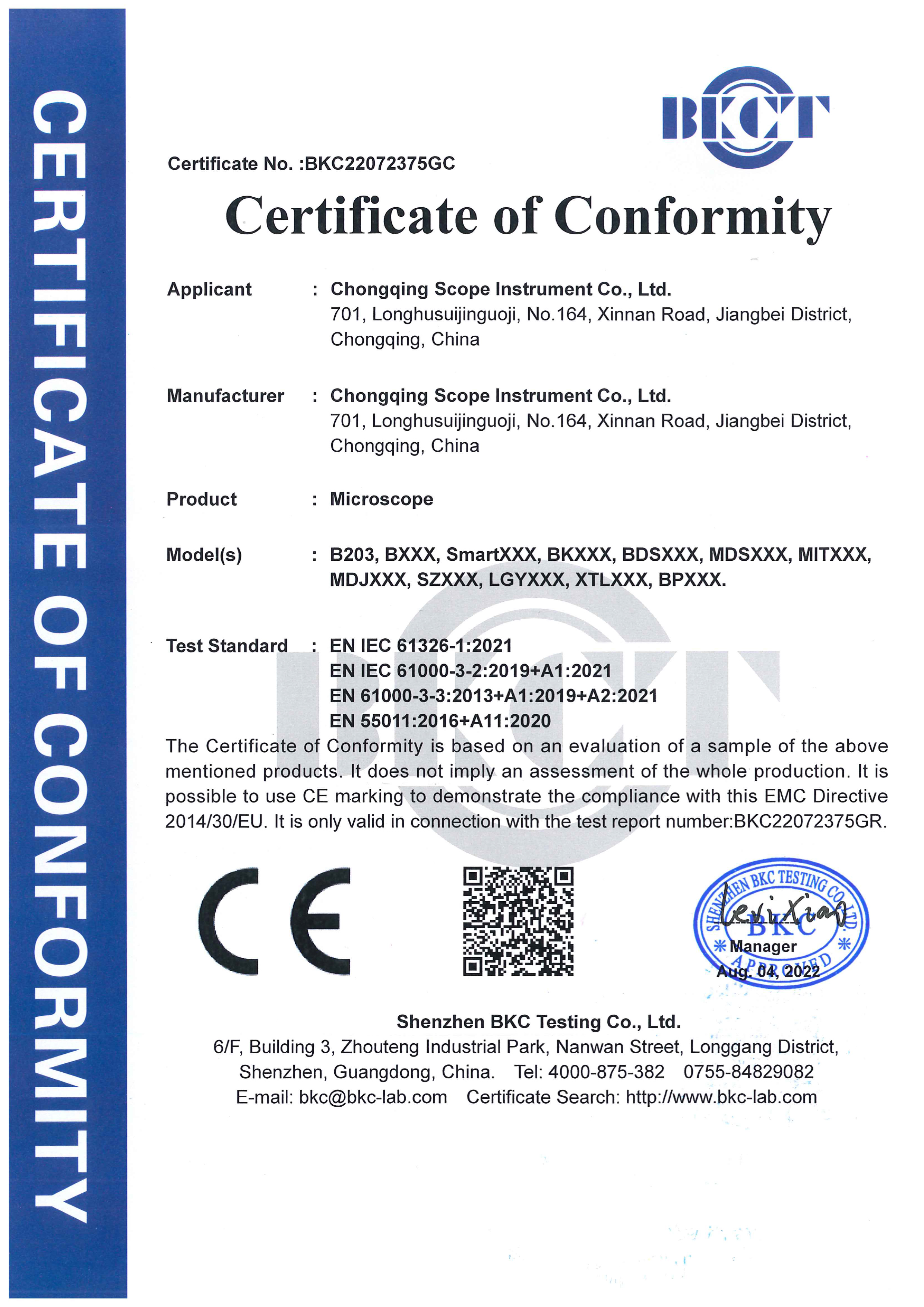
EMC is a separate conformity question and, in this register, a separate certificate: BKC22072375GC, issued 2022-08-04 and valid to 2032-08-03, citing EN IEC 61326-1:2021, EN IEC 61000-3-2:2019+A1:2021, EN IEC 61000-3-3:2013+A1:2019+A2:2021, and EN 55011:2016+A11:2020, over the same prefix scope. This matters in practice wherever a microscope shares a bench with sensitive instrumentation or sits inside a production area — a common situation for metallurgical and industrial models such as MIT300 and MIT500.
Layer 4 — RoHS and the IEC 62321 series
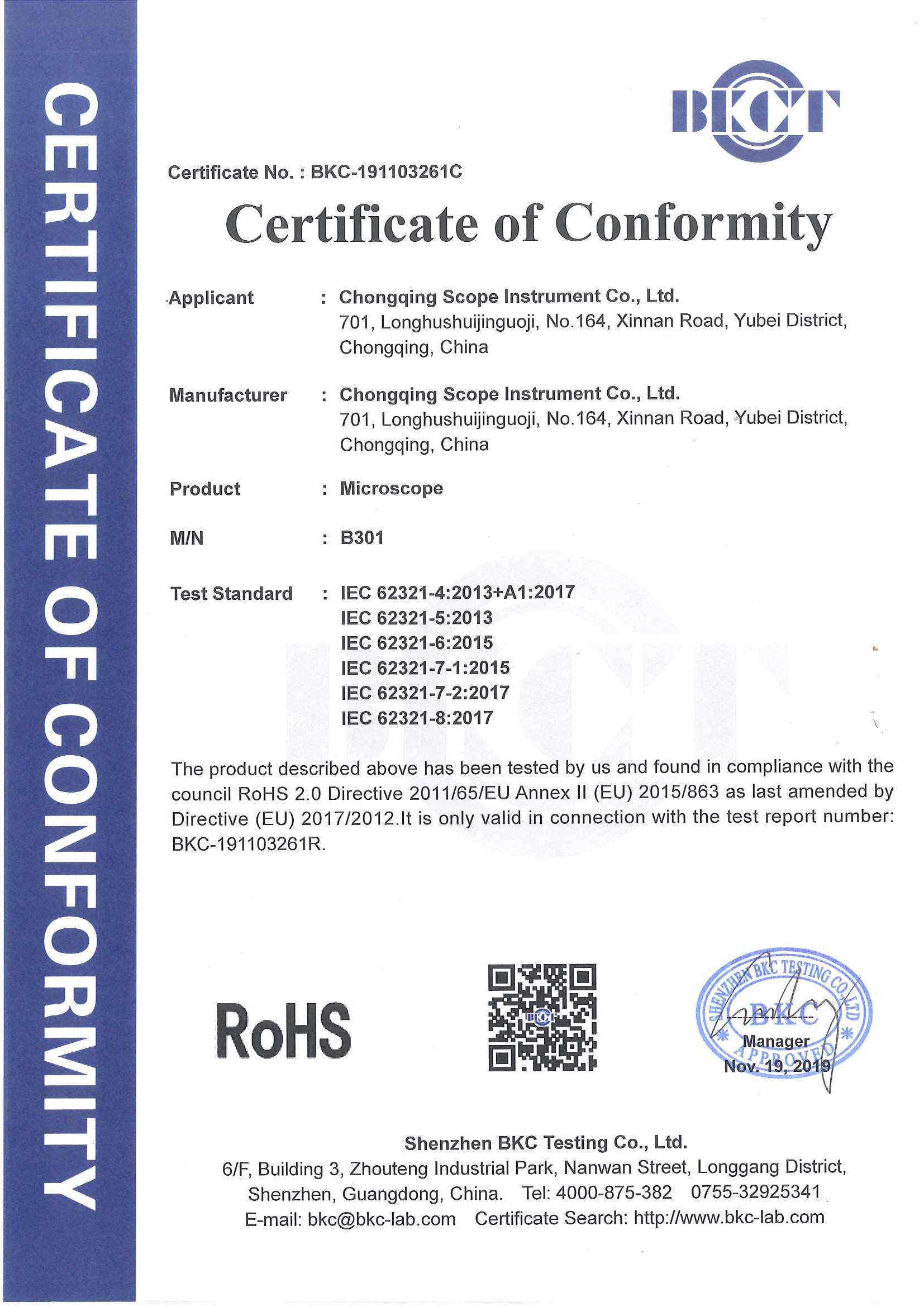
The hazardous-substance document in the register is BKC-191103261C, issued 2019-11-19 and valid to 2029-11-18, tested against IEC 62321-4:2013+A1:2017, IEC 62321-5:2013, IEC 62321-6:2015, IEC 62321-7-1:2015, IEC 62321-7-2:2017, and IEC 62321-8:2017. Its stated scope entry is narrower than the CE documents — it lists B203 — which is precisely the kind of detail a buyer should notice rather than skim.
Layer 5 — Build materials and optical configuration
No certificate proves that an instrument will still hold focus after two years of daily use. That depends on the physical build. Across the range, the bodies and mechanical assemblies are specified as aluminium alloy with glass optical elements — the material basis listed for models including MIT500, BK-POL, and BK-POLF, in addition to the biological and inverted families. Material specification matters for two compliance-adjacent reasons: dimensional stability under thermal cycling, and consistency of the mechanical interfaces the optical elements are aligned to.
Optical configuration is the second half of that physical layer. In polarizing units, the analyzer and Bertrand lens are not accessories — they are the reason the instrument can function as a polarizing microscope at all. Without a Bertrand lens, conoscopic observation of interference figures is not possible, which is the capability geologists and materials scientists are buying. BK-POL and BK-POLF both list an analyzer and Bertrand lens, together with λ/4 and λ plates and a quartz wedge, on a 174 mm revolving round stage. A buyer comparing polarizing offers should look for that combination before looking at the price.
Step-by-Step: How to Verify a Microscope Before You Commit
The following sequence turns the evidence chain into a procurement routine. It takes a buyer from a catalogue entry to an approved model in seven steps.
Step 1 — Fix the market and the applicable requirement first
State the destination market and the intended environment before requesting documents. A unit for a European teaching laboratory, a unit installed beside industrial testing equipment, and a unit for a materials research bench do not raise the same questions. Writing the requirement down prevents the conversation from drifting into generic claims.
Step 2 — Ask for certificates, not assurances
Request the certificate number, issuing body, cited standard, issue date, expiry date, and scope for every document relied upon. In this register that means BKC22072376GC, BKC22072375GC, and BKC-191103261C, each with the details shown in the table below.
| Document | Number | Issuer | Standard cited | Stated scope | Validity |
|---|---|---|---|---|---|
| CE — product safety | BKC22072376GC | BKC | EN 61010-1:2010+A1:2019 | B203, BXXX, SmartXXX, BKXXX, BDSXXX, MDSXXX, MITXXX, MDJXXX, SZXXX, LGYXXX, XTLXXX, BPXXX | 2022-08-02 to 2032-08-01 |
| CE — EMC | BKC22072375GC | BKC | EN IEC 61326-1:2021; EN IEC 61000-3-2:2019+A1:2021; EN IEC 61000-3-3:2013+A1:2019+A2:2021; EN 55011:2016+A11:2020 | Same prefix list as BKC22072376GC | 2022-08-04 to 2032-08-03 |
| RoHS | BKC-191103261C | BKC | IEC 62321-4:2013+A1:2017; IEC 62321-5:2013; IEC 62321-6:2015; IEC 62321-7-1:2015; IEC 62321-7-2:2017; IEC 62321-8:2017 | B203 | 2019-11-19 to 2029-11-18 |
Step 3 — Map the scope prefixes to your actual model
Take the model code on the quotation and test it against the prefix list. A B104 sits in the BXXX family; a SMART-2 or SMART-4 sits in SmartXXX; a BK5000, BK5000-PH, BK6000TR, BK-POL, or BK-POLF sits in BKXXX; an MIT300, MIT300D, or MIT500 sits in MITXXX; a BDS400 or BDS500 sits in BDSXXX; an SZ810 sits in SZXXX. If the code does not match a listed prefix, ask for the document that does cover it.
Step 4 — Check that the cited standard matches the risk
Safety and EMC are not interchangeable, and neither is a management-system certificate. If a supplier offers ISO 9001 in response to an electrical-safety question, the question has not been answered. Match the document to the risk you are actually managing, and record which one answered which question.
Step 5 — Verify the physical build against the datasheet
Check declared materials and mechanical specifications against the configuration you will receive. For an industrial bench, confirm the long-working-distance infinity objectives and the reflected illumination: MIT500 is specified with semi-apochromatic plan 5X/10X/20X/40X objectives, a 182×140 mm mechanical stage, and 5W LED reflected and transmitted illumination. For a polarizing bench, confirm the analyzer, Bertrand lens, and accessory plates. These are the details that decide whether the instrument performs the task the certificate was never designed to guarantee.
Step 6 — Test optical consistency rather than a single image
Optical performance consistency means the image quality holds across magnifications and across the field, not only in the centre of one objective. Request a demonstration that moves through the full objective set and through parfocality. On finite-optics models the correction is built into the objective; on infinity-corrected models the tube lens participates in the correction, which is one reason infinity systems behave more predictably when accessories are added.
Step 7 — Classify the model as teaching-grade or research-grade
The decisive indicators are on the datasheet. A monocular head with achromatic objectives — B104 is specified with a monocular head and achromatic 4X/10X/40X/100X objectives — is a teaching instrument, and it is a good one. A binocular body with finite plan objectives such as SMART-2 is a step up for routine laboratory use. Infinity-corrected optics with plan objectives, a trinocular port, and a larger mechanical stage — SMART-4, BK5000, BK6000TR, BDS500 — are the configurations to specify when imaging, measurement, or documentation is part of the protocol.
Where Compliance Questions Actually Appear: Five Use Cases
School teaching laboratories
Education buyers need durability, a simple optical path, and documentation that survives a public tender. In a Romanian project, 30 units of the BDS500 inverted laboratory microscope were supplied to a microscope distributor for school teaching, completed within two years and reported as achieving stable operation, with OEM service and integrated teaching and learning cited as the highlights. The buyer's compliance questions were about the certificate scope and the build consistency across the batch — not about research-grade optics.
Industrial metallography and quality control
Industrial benches share floor space with hardness testers and cutting equipment, so EMC documentation earns its place in the file. The MIT500 and MIT300 configurations — long-working-distance infinity plan objectives, polarizer and analyzer units, reflected LED illumination, and 200×150 mm or 182×140 mm stages — are specified for industry and laboratory metallography, materials science, and machinery manufacturing environments.
Geology, minerals, and materials science
Polarizing work is specification-driven. BK-POL, BK-POLF, and SMART-POL all list an analyzer and Bertrand lens, with λ/4 and λ plates and a quartz wedge, over a 174 mm or 142 mm revolving round stage. The SMART-POL analyzer unit is specified with a 0–90° range. For this category, the qualification question is optical configuration first and certificate scope second — but both are asked.
Cell culture and live-cell workflows
Inverted models place the optics below the stage so that vessels remain in place. BDS500 specifies a 54 mm culture dish holder, a four-hole rotating disc phase contrast condenser, and Köhler illumination from a 12V/50W halogen source; BDS400 specifies long-working-distance infinity phase contrast objectives at 10X/20X/40X with a long-working-distance N.A.0.3 condenser. These details determine whether the instrument fits the workflow, and they belong in the technical file alongside the certificates.
Fluorescence and multi-channel imaging
BK5000-FL combines an infinity-corrected optical system with blue, green, violet, and ultraviolet fluorescence filters, driven by a 5W LED or 100W mercury lamp. In this configuration the EMC and safety documents matter more than they do on a passive bench instrument, and the buyer should confirm that the exact build is inside the applicable scope before release of the purchase order.
Model-Level Comparison: Compliance-Relevant Configuration
Every model in the table below appears in the supplier's certificate register as an associated product for CE BKC22072376GC, CE BKC22072375GC, and RoHS BKC-191103261C. The comparison therefore focuses on what differentiates them for a buyer: build materials, the decisive optical specification, and application fit.
| Model | Category | Build materials | Decisive configuration detail | Application fit |
|---|---|---|---|---|
| B104 | Monocular biological | Aluminum alloy, glass | Monocular head; achromatic 4X/10X/40X/100X; Abbe N.A.1.25 | Biology, education, lab research |
| SMART-2 | Binocular biological | Aluminum alloy, glass | Finite plan 4X/10X/40X/100X; 145×140 mm stage | Biology, teaching, laboratory research |
| SMART-4 | Binocular biological (infinity) | Aluminum alloy, glass | Infinity plan 4X/10X/40X/100X; Abbe N.A.1.25 | Biology, lab research, education |
| BK5000 | Biological, binocular or trinocular | Stainless steel, glass | Infinity optical system; plan 4X–100X; 175×145 mm stage | Teaching and research |
| BK6000TR | Trinocular biological | Aluminum alloy, glass | Infinity plan 4X–100X; 100:0 and 80:20 light distribution | Biology, lab research, documentation |
| MIT500 | Metallurgical | Aluminum alloy, glass | Semi-apochromatic plan 5X/10X/20X/40X; reflected and transmitted 5W LED | Industry, laboratory metallography |
| MIT300 | Industrial metallurgical | Aluminum alloy, glass | LWD infinity semi-apochromatic 5X–50X; polarizer and analyzer | Industrial, mineral research |
| BK-POL | Polarizing | Aluminum alloy, glass | Analyzer and Bertrand lens; λ/4, λ plate, quartz wedge; 174 mm round stage | Geology, minerals, materials science, biomedicine |
| BK-POLF | Petrographic | Aluminum alloy, glass | Non-stress LWD semi-apochromatic plan 5X–50X; reflected 5W LED; analyzer and Bertrand lens | Geology, industry, materials science, biology |
| BDS500 | Inverted laboratory | Aluminum alloy, glass | Phase contrast and bright field; Köhler 12V/50W; 54 mm culture dish holder | Cell culture, biology, laboratory research |
FAQ
Which certification documents should a buyer request before ordering a microscope?
Request three product-level documents plus the management-system set. For the Chongqing Scope microscope range, the product-level documents are CE certificate BKC22072376GC (safety, EN 61010-1:2010+A1:2019), CE certificate BKC22072375GC (EMC, including EN IEC 61326-1:2021 and EN 55011:2016+A11:2020), and RoHS certificate BKC-191103261C (tested to the IEC 62321 series). The supplier additionally states that ISO 9001, ISO 14001, ISO 45001, and ISO 13485 documentation can be provided. In every case, ask for the number, standard, scope, and expiry date, not just the announcement that a certificate exists.
How can a buyer tell whether a model such as B104 or SMART-2 meets research-grade expectations?
The datasheet answers it before the certificate does. B104 is specified with a monocular head and achromatic 4X/10X/40X/100X objectives, which places it in the teaching and routine-laboratory category. SMART-2 adds a binocular head and finite plan objectives, a suitable step for routine laboratory use. Research-grade expectations — imaging, measurement, documentation, added accessories — are better matched by infinity-corrected configurations with plan objectives, a trinocular port, and a larger mechanical stage, such as SMART-4, BK5000, BK6000TR, or BDS500. Match the optical architecture to the protocol, then confirm the model sits inside the certificate scope.
What configuration factors explain the price gap between teaching-grade and research-grade models?
Prices are not part of the published record here, but the configuration drivers are visible on the datasheets: a monocular versus binocular or trinocular head; achromatic versus plan versus semi-apochromatic objectives; finite versus infinity correction; LED versus halogen illumination with a Köhler condenser; 125×115 mm versus 210×241 mm mechanical stages; and the presence of phase contrast, polarizing, or fluorescence accessories. A polarizing unit with an analyzer, Bertrand lens, λ/4 and λ plates, and a quartz wedge is a different instrument from a bright-field teaching model, and the quotation should reflect the difference line by line. Ask for that line-item breakdown rather than a single total.
What should a pre-order sample evaluation cover?
Test optical consistency, not a single image: move through the full objective set, check parfocality and edge sharpness, and confirm illumination uniformity across the field. Check mechanical behaviour — stage travel, focus knob smoothness, and the security of the optical elements. Confirm that the delivered model code matches the certificate scope, and inspect the packaging and documentation that will travel with a bulk order. The supplier states a minimum order quantity of 1 unit, so a single-unit evaluation before a programme order is commercially realistic.
What minimum order quantity and lead time should a buyer plan for?
The supplier states a minimum order quantity of 1 unit, a lead time of 15 days, a monthly capacity of 3,000 units, and a one-year warranty with online support. Those figures should be confirmed against your specific model and configuration, because instrument build time varies with the optical set and accessories requested. If you want to test one unit before committing, or request a quotation for a configured batch, contact the team at [email protected] or by WhatsApp on +86 15223521781 with the model codes and destination market.
Conclusion: Build the File Before You Build the Order
Compliance in microscopy is not a badge earned once. It is a file assembled per order: a certificate number that resolves to a scope, a scope that resolves to a model code, a cited standard that resolves to the risk being managed, and a physical build that supports the performance claimed in the specification. Buyers who work through that chain in seven steps reach a purchase order with far fewer unknowns than buyers who accept a forwarded PDF.
For laboratory and industrial models alike — a B104 destined for a teaching bench, an MIT500 destined for a metallography laboratory, or a BK-POLF destined for a geology department — the same four questions apply. The instrument is only compliant when all four answers point to the same model number.
Request a sample, a quotation, or the compliance file
Chongqing Scope Instrument Co., Ltd. supplies biological, metallurgical, polarizing, inverted, fluorescence, and stereo microscopes with OEM and ODM services, including logo printing after technical verification. Send your model codes, destination market, and configuration requirements to receive the matching certificate documentation and a quotation.
Email: [email protected] · Tel / WhatsApp: +86 15223521781 · Website: www.cqscopelab.com
Download the full product catalogue: Chongqing Scope product brochure (PDF)
Have Questions or Need More Details?
Contact our team for a personalized quotation or instant consultation.
Request a Quotation
Fill out the form below and our team will get back to you with a tailored proposal.
WhatsApp Direct Chat
Prefer to chat in real-time? Message us on WhatsApp for instant assistance & quick answers.
- Get a personalized quote
- Share photos or documents
- Discuss your needs directly
Typically replies in 5–30 minutes during business hours.