
How to Evaluate a Microscope Supplier's Technical Capacity Before You Commit
How to Evaluate a Microscope Supplier's Technical Capacity Before You Commit
A microscope supplier's technical capacity is the part of an offer that a quotation cannot show. Two suppliers can quote the same three-line specification — 1000x magnification, LED illumination, trinocular head — and still differ completely on whether the objective set is infinity-corrected, whether the nosepiece will hold alignment after a year of daily use, and whether a replacement lamp, stage insert or polarizer will still be available in three years.
For buyers who have moved past discovery and are close to committing, the useful question is not who claims the better microscope. It is what a supplier can actually document about the instruments it builds. This guide sets out a six-check verification sequence for laboratory and industrial buyers, the evidence to request at each step, and the way to run the same checklist across several candidates so that the comparison is like-for-like.
What 'Technical Capacity' Actually Means in a Microscope Purchase
Technical capacity is a supplier's demonstrated ability to configure, build, document and support instruments that hold the optical and mechanical specifications stated in its own catalogue — across the instrument families a buyer may need, not only the single model on the quotation.
In practice the term breaks into three verifiable layers:
- Range depth. Does the supplier genuinely build biological, inverted, metallurgical, polarizing, fluorescence and stereo lines, or does it list one hero instrument and rely on trading partners for everything else? A supplier with real range depth can describe what changes between configuration levels inside a family, not just between families.
- Specification control. Can the supplier state, and hold, the choices that determine image quality — objective type, objective set matching, nosepiece position count, head type, and the illumination module? The answer is testable: an engineering-backed supplier answers configuration questions in specific terms, a reseller answers them by sending the catalogue page again.
- Support continuity. Will the parts that wear out — lamps, fuses, stage inserts, objective threads, polarizer and filter slides — still be supplied, and can any of them be replaced by the user without a service visit?
The failure mode buyers report is rarely a non-functioning instrument on arrival. It is a specification that turns out to be less controllable than the catalogue implied: an objective set that is not parfocal, a lamp module that is discontinued, an inscription or logo applied to a machine that cannot be serviced locally. Each of those problems is visible before the order if the buyer asks the right questions in the right order.
Technical capacity is also not the same thing as certification. A certificate confirms that a quality management system exists and has been audited. It does not tell you which objective type is fitted, whether the nosepiece is a four-position or five-position unit, or whether a 12V/30W halogen module or a 5W LED module is standard on the model you are buying. Certification and technical capacity answer different questions, and a decision-stage evaluation needs both.
Industry Background: Why Verification Moved to the Decision Stage
Microscope procurement has become a verification exercise because the market has grown and fragmented at the same time. The global microscope market was valued at USD 11.9 billion in 2025 and is projected to reach USD 21.2 billion by 2033, according to Grand View Research. Published 2025 estimates differ noticeably by scope — Precedence Research gives USD 14.5 billion for the same year, while Market Research Future gives USD 3.57 billion — because research firms define whether accessories, software and services are included differently. Buyers comparing supplier claims should treat market headlines the same way they treat catalogue claims: as a starting point that requires an explicit definition.
Segment structure matters more than the headline number. Optical microscopes remained the largest product segment in 2025, accounting for approximately 37% of the global market share, per MarketsandMarkets. The life science segment dominated applications with a 32.4% revenue share in 2025, driven by genomics and drug discovery research, according to Grand View Research. Electron microscopes held a 41.9% revenue share in the same year, which shows how much value sits at the high end of the market even though optical instruments carry most of the day-to-day laboratory and industrial workload.
The reference point for specification language comes from a small group of global manufacturers: Carl Zeiss AG (Germany), Leica Microsystems (Danaher), Nikon Corporation (Japan) and Evident, formerly Olympus. Their catalogues define the vocabulary — infinity-corrected optics, plan objectives, Koehler illumination, trinocular ports — that every other supplier's documentation imitates. That is precisely why a buyer cannot verify capacity by reading specification words alone. The same words can describe a genuinely engineered instrument or a configuration assembled from whatever components were available.
Compliance expectations have tightened alongside this. Medical laboratory equipment and in vitro diagnostic (IVD) microscopes must comply with the IEC 61010-2-101 safety standard, published by the International Electrotechnical Commission. Buyers in regulated settings therefore have two parallel verification tasks: confirming that the safety and quality documentation applies to the instrument family being purchased, and confirming that the supplier can physically deliver the optical and mechanical configuration it describes.
What a Verifiable Supplier Should Be Able to Document
Chongqing Scope Instrument Co., Ltd. is a supplier of laboratory and medical training instruments and metallographic equipment based in Chongqing, China, with more than 20 years of sales experience and more than 500 clients worldwide. Its documentation set is a useful worked example of what a buyer should expect to see before committing, because it separates the four things that a technical capacity check is looking for.
Range depth across instrument families
The company's microscope range covers biological microscopes, metallographic microscopes, fluorescence microscopes, inverted microscopes and stereoscopic microscopes, used for laboratory biological research, industrial research and material testing, with configuration adjusted to individual requirements. Alongside microscopes, the same supplier provides hardness testers (Brinell, Vickers, Rockwell and micro Vickers), metallographic sample cutting machines, mounting presses, grinding and polishing machines, medical manikins and laboratory consumables. For a buyer, that combination is relevant because a lab purchasing a metallurgical microscope, a cutting machine and a hardness tester from one source has fewer compatibility questions to resolve.
Manufacturing base and engineering headcount
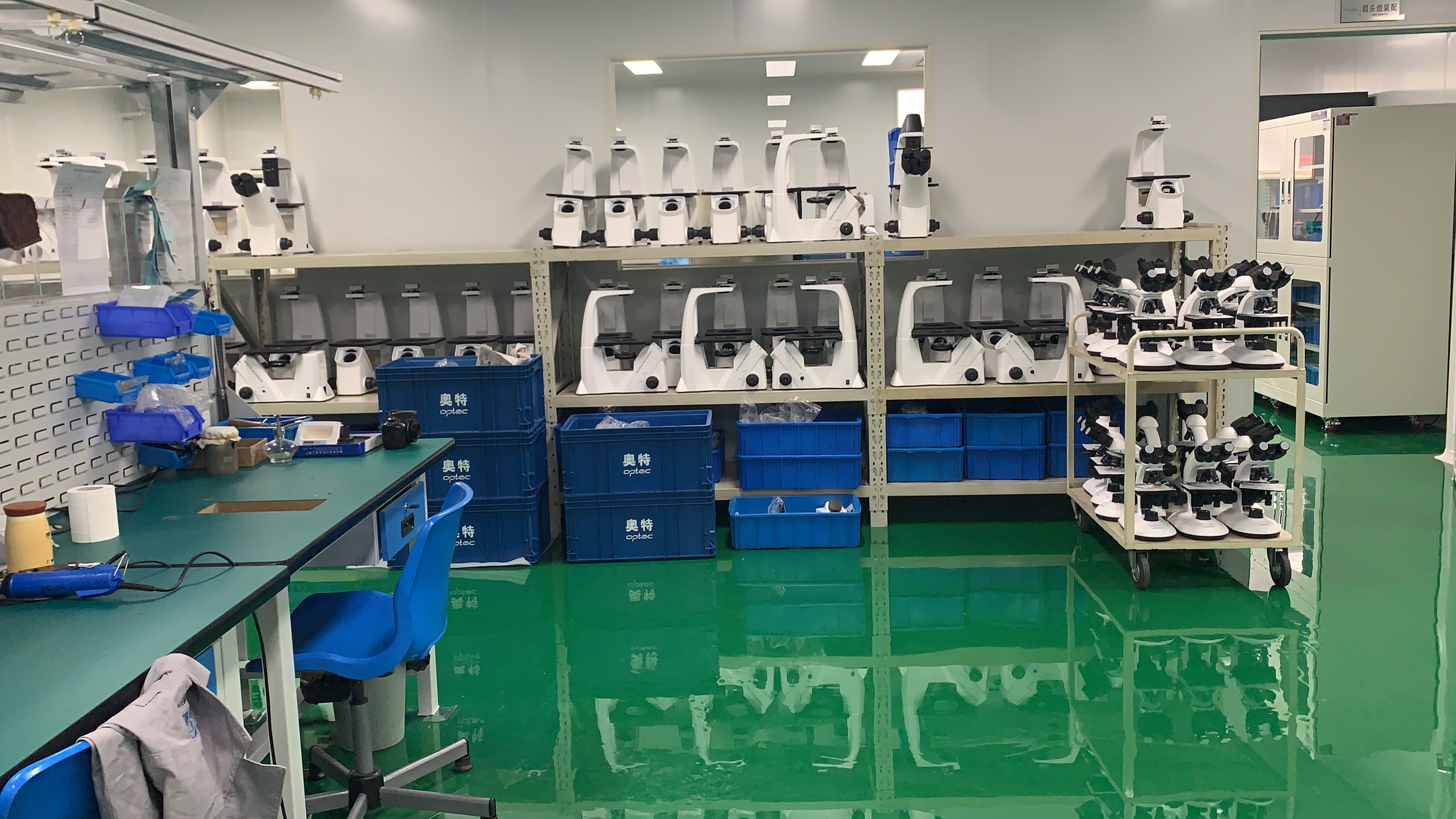
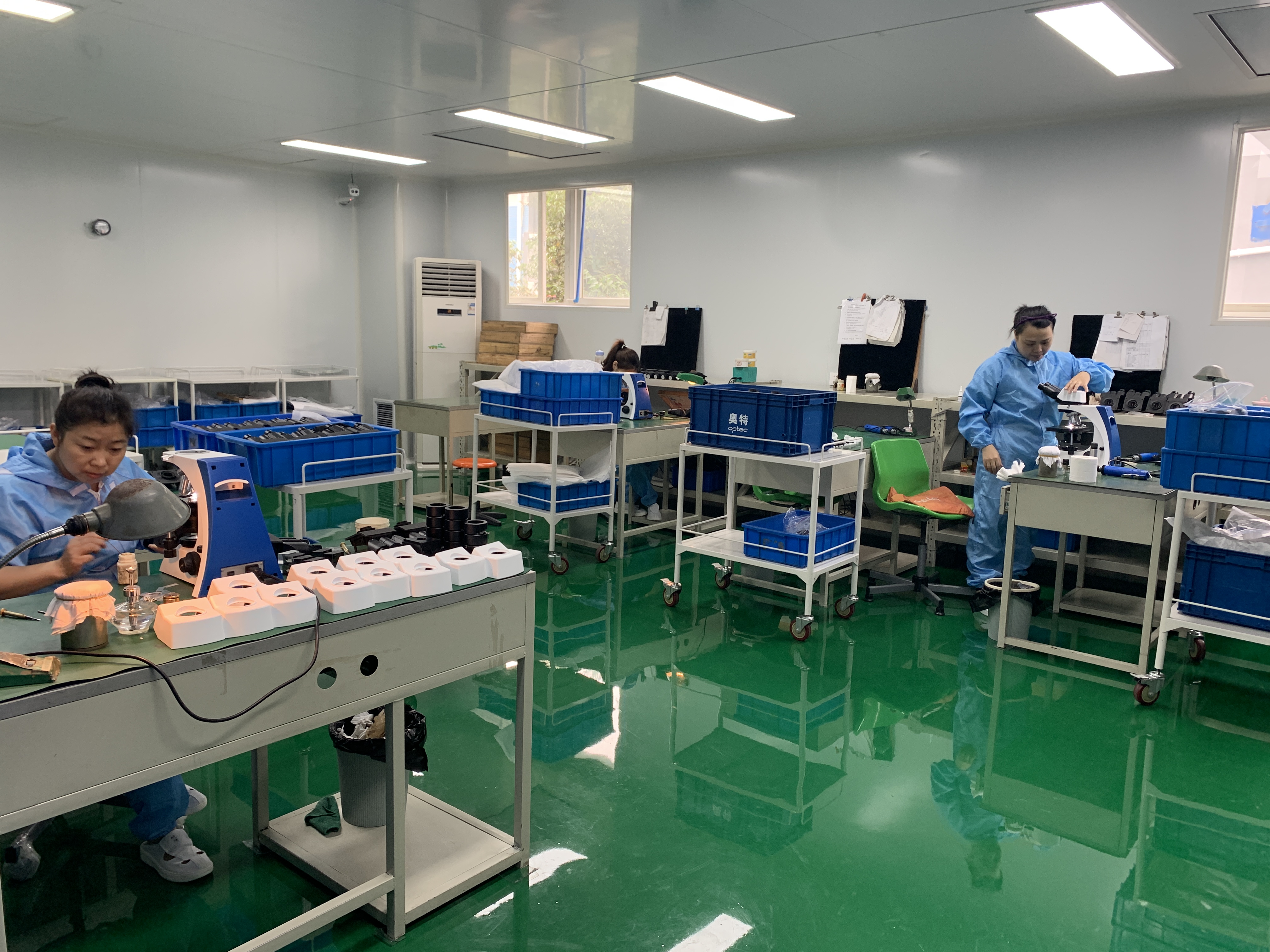
The factory covers 5,000 m2, employs more than 100 people, and produces 30,000 units annually. A research and development team of 20 engineers handles configuration and customisation work. The export ratio is 50%, with main markets in Europe, Southeast Asia, the Middle East, South America and Africa. Those figures are the ones a buyer should ask any supplier for in writing, because they indicate whether customisation requests will be handled by engineers or by a sales desk.
Compliance and export documentation
Export certificates stated as available include ISO9001, ISO14001, ISO45001, ISO13485, CE and RoHS. Export packaging is neutral, without logos, in cardboard boxes or wooden cases prepared to export standards. Additional customs documents such as CO, Form E and Form F can be provided on request. A buyer assessing compliance should ask for scope-bearing copies rather than accepting certificate logos on a website.
Product-line performance facts and risk controls
For its current microscope line, the supplier documents a superior optical system, a metal body, a low parts replacement rate and long service life compared with traditional microscopes. Two figures are stated explicitly: a 40% reduction in image capture time when the instrument is connected to a digital camera, and a total cost of ownership 25% lower than alternatives, attributed to minimal maintenance and extended service life. Lighting configurability is also documented — more than 10 optional lighting configurations against the two or three options typical of traditional models — and a low-voltage design that supports more than 8 hours of outdoor use with a power bank.
The risk register is equally specific. The failure points identified are bulb degradation, accessory replacement, dust in the optical path, and mould or fogging on optical surfaces. The control measures listed are a manual power-outage procedure, a supplied instruction manual, a dust cover, and anti-mildew and anti-fog treatment. After-sales support is delivered as an online repair service including operation videos, with accessories supplied separately. Parts replacement can be carried out by users without professional support. This is exactly the kind of statement a buyer should demand: named failure modes with named controls, rather than a generic service promise.
The Six-Check Verification Workflow
Step 1 — Map your applications to instrument families before requesting quotations
Write down what will actually be observed: adherent cell cultures, polished metal specimens, thin sections, mineral grains, electronic components, teaching slides, or routine documentation imaging. Each of those maps to a different family — inverted, metallurgical, petrographic or polarizing, stereo, biological — and each family carries its own configuration logic. Quotations requested before this step tend to compare instruments that are not substitutes for one another.
Step 2 — Audit the model range for depth, not for gallery size
Range depth is easiest to verify by looking for a consistent, named lineup rather than a wall of photographs. In the inverted family, for example, a supplier should be able to point to a specific platform — the BDS500 inverted laboratory microscope — and explain what changes as you move up or down the configuration list. The same test applies to the MIT300 industrial metallurgical microscope, the BK-POL polarizing microscope and the SZ810 stereo microscope. For each one, ask which objectives, which head type (binocular, trinocular or monocular), which stage, and which illumination module are standard, and which are options. A supplier that answers only in generalities about the family, without referencing a named platform, has not demonstrated depth.
Step 3 — Interrogate the optical system
Ask directly whether the objectives are infinity-corrected or achromatic. Infinity-corrected optics place a parallel beam between the objective and the tube lens, which allows intermediate accessories such as fluorescence filter cubes, polarizers or discussion tubes to be inserted without changing focus or magnification. Achromatic objectives belong to the older finite-tube convention and are common in entry-level instruments. Neither answer is automatically wrong — but the answer must match the intended use and the specification sheet.
Follow with four more optical questions: whether the objectives form a matched set or a mixed collection, whether they are parfocal and parcentric across the nosepiece, how many positions the nosepiece holds and whether it is a reversed design, and which head types are available. Binocular, monocular and trinocular heads serve different buyers — a trinocular port is required for camera-based documentation, while a monocular head is typically a teaching-lab choice. A supplier that cannot confirm the head options for a named platform cannot confirm much else.
Step 4 — Confirm illumination and power configuration
Illumination is where specification drift shows up most often, because the module is easy to substitute. The two common options are a 12V/30W halogen unit and a 5W LED module. Halogen delivers a broad continuous spectrum but generates heat and requires lamp replacement; LED runs cooler, holds colour temperature more stably and is better suited to long observation sessions and field use. Ask which is standard on the quoted model, which is optional, whether the light path supports field diaphragm and aperture diaphragm adjustment, and whether dimming is continuous.
If the instrument is meant for fieldwork or for sites without stable mains power, ask specifically about low-voltage operation — the current line documents support for more than 8 hours of outdoor use with a power bank. If the supplier claims high lighting configurability, ask for the configuration list: more than 10 optional lighting configurations are documented for this line, against the two or three options typical of traditional models.
Step 5 — Verify documentation and compliance scope
Request certificate scope, issuing body and validity for ISO9001, ISO14001, ISO45001, ISO13485, CE and RoHS, and confirm that the scope covers the instrument family you are buying rather than only consumables. For medical laboratory or IVD use, ask how IEC 61010-2-101 applies to the configuration. Then confirm the export paperwork chain — neutral packaging, cardboard or wooden case, and documents such as CO, Form E or Form F — because documentation failures delay delivery as often as production failures do.
Step 6 — Audit the manufacturing and support base
Facility size, headcount, annual output and engineering team size are the fastest proxy for delivery stability; for this supplier they are 5,000 m2, more than 100 employees, 30,000 units annually and 20 R&D engineers. Ask how the assembly environment is controlled — a dust-free workshop matters directly to optical cleanliness. Finally, ask for the consumable spares list and the service route. A supplier that documents failure modes such as bulb degradation, optical-path dust and mould, together with controls such as dust covers and anti-mildew treatment, is telling you how the instrument will behave in year three, not only on delivery day.
Use Cases: Running the Checklist Against Four Buying Scenarios
Cell culture and live-cell work. The requirement is an inverted platform such as the BDS500 inverted laboratory microscope, and the verification questions are optical and thermal: can the supplier configure phase contrast, are the objectives suited to observation through a vessel base, and does the illumination module run cool enough for multi-hour sessions? A 5W LED module changes the answer to the last question, and a documented 40% reduction in image capture time matters when the workflow depends on camera output.
Mineralogy, petrography and geology teaching. The relevant platform is a polarizing microscope such as the BK-POL polarizing microscope. Ask whether the optics are strain-free, whether the stage rotates, and what protection is provided against dust and humidity — because a dusty optical path and mould are the two failure modes named in the supplier's own risk register, and teaching laboratories are exactly where they occur. Dust covers and anti-fog treatment move from accessories to requirements in this scenario.
Metallurgy, materials testing and semiconductor inspection. The requirement is a metallurgical platform such as the MIT300 industrial metallurgical microscope, usually with reflected-light illumination and a choice between bright field and dark field configuration. Verification here should focus on the illumination module, the objective set for polished specimens, and whether the same supplier can also deliver the supporting metallographic chain — cutting machines, mounting presses, grinding and polishing machines, and hardness testers — so that specimen preparation and inspection stay compatible.
Distributors and teaching-lab programmes. Here the technical check is joined by a commercial one. Stereoscopic models such as the SZ810 stereo microscope and the biological range need to survive repeated handling in classrooms. Ask about OEM and ODM terms: logo printing on the machine or a custom logo label, both subject to technical verification before production, and a minimum quantity requirement for customisation. Neutral export packaging and the CO, Form E and Form F document set determine how smoothly the first container clears customs.
Comparison Tables: Claims, Evidence and Configuration
The first table converts typical catalogue claims into the evidence a decision-stage buyer should be able to obtain. Each row is a question that has a verifiable answer.
| Verification area | What the catalogue typically shows | Evidence to request before committing |
|---|---|---|
| Range depth | A gallery of instrument photographs | A named platform for each family in scope (for example BDS500 inverted, MIT300 metallurgical, BK-POL polarizing, SZ810 stereo) plus a statement of which configurations are standard and which are optional |
| Optical system | 'High-quality objectives' | Objective type (infinity-corrected or achromatic), whether the objective set is matched, nosepiece position count, head type — binocular, trinocular or monocular |
| Illumination | 'LED or halogen illumination' | The specific module and rating, whether a 12V/30W halogen unit or a 5W LED module is standard, dimming behaviour, and the spare lamp or LED module supply route |
| Compliance | Certificate logos on the website | Scope-bearing copies of ISO9001, ISO14001, ISO45001, ISO13485, CE and RoHS documentation, plus confirmation of how IEC 61010-2-101 applies for medical or IVD use |
| Manufacturing base | 'Modern factory' | Facility size, headcount, annual output, engineering team size, and the assembly environment |
| Spares and after-sales | 'Lifetime support' | A consumable spares list, which parts are user-replaceable, and how remote service is delivered |
The second table restates the configuration comparison that the supplier itself documents for its current microscope line, so that buyers can see which dimensions are backed by stated figures and which are qualitative.
| Dimension | Traditional microscope (per supplier comparison) | Current-generation line (per supplier comparison) |
|---|---|---|
| Optical system and body | Not itemised in the comparison | Superior optical system with metal body and long service life |
| Maintenance routine | Requires frequent professional calibration and cleaning | Simple post-use care only |
| Parts replacement | Professional support expected | Low parts replacement rate; user-level replacement without professional support |
| Lighting configurations | 2–3 options | More than 10 optional lighting configurations |
| Image capture | Not itemised in the comparison | 40% reduction in image capture time when connected to a digital camera |
| Field use | Not itemised in the comparison | Low-voltage design supports more than 8 hours of outdoor use with a power bank |
| Total cost of ownership | Not itemised in the comparison | Slightly higher purchase price, but 25% lower total cost of ownership through minimal maintenance and extended service life |
FAQ: Verifying a Microscope Supplier Before You Commit
What certification evidence should I request from a microscope supplier?
For medical laboratory equipment and in vitro diagnostic instruments, the applicable safety standard is IEC 61010-2-101, published by the International Electrotechnical Commission, so ask how it applies to the configuration you are buying. Beyond that, request scope-bearing copies of ISO9001, ISO14001, ISO45001, ISO13485, CE and RoHS documentation and check that the scope covers the instrument family, not only consumables. Chongqing Scope Instrument Co., Ltd. states that official export certificates for ISO9001, ISO14001, ISO45001, ISO13485, CE and RoHS can all be provided, together with customs documents such as CO, Form E and Form F, and that export packaging is neutral, in cardboard boxes or wooden cases.
How can I confirm that a supplier really builds the microscope families it lists?
Test range depth platform by platform. Ask for a named instrument in each family you need — for example the BDS500 inverted laboratory microscope, the MIT300 industrial metallurgical microscope, the BK-POL polarizing microscope and the SZ810 stereo microscope — and then ask which objectives, head type, stage and illumination module are standard on each. A supplier with genuine manufacturing capacity answers with configuration detail; a reseller repeats the catalogue wording. Supporting indicators are facility size, headcount, annual output and engineering staff: Chongqing Scope documents a 5,000 m2 factory, more than 100 employees, 30,000 units of annual output and a 20-engineer R&D team, with assembly carried out in a dust-free workshop.
Does a technically stronger microscope cost more to own?
Not necessarily, because purchase price and cost of ownership move in different directions. The supplier's own comparison states that the current line carries a slightly higher initial purchase price than traditional microscopes but a total cost of ownership 25% lower, attributed to minimal maintenance and a long service life. The supporting facts are a metal body, a low parts replacement rate, and simple post-use care instead of the frequent professional calibration and cleaning that traditional instruments are described as requiring — parts replacement can be carried out by the user without professional support.
Can I validate a supplier with a sample before committing to volume?
For laboratory consumables, sampling is straightforward: pipettes, centrifuge tubes, shaking flasks and cell culture dishes are supplied in large quantities with free samples available in the early stage, and they are sterilised before use. For microscopes, validation normally runs through the configuration and documentation route rather than a free instrument: confirm objective type, nosepiece configuration and illumination module against the specification sheet, and for OEM projects complete the technical verification step that must be cleared before logo printing is approved. Chongqing Scope supports OEM and ODM work, including logo printing on the machine or a custom logo label, subject to a minimum quantity requirement.
How do I judge whether a supplier can keep to its delivery schedule?
Judge capacity first and schedule second. Documented capacity indicators for Chongqing Scope are a 5,000 m2 facility, more than 100 employees, 30,000 units of annual output and a 50% export ratio across Europe, Southeast Asia, the Middle East, South America and Africa. Ask for a written production plan tied to your exact configuration, together with the packing and document plan — neutral export packaging plus CO, Form E or Form F as required. Also confirm the recovery route: after-sales support is provided as an online repair service with operation videos, accessories are supplied separately, and the supplier's own risk register names bulb degradation, accessory replacement, optical-path dust and mould as the failure modes addressed by manual power-outage procedures, the instruction manual, dust covers and anti-mildew treatment.
Conclusion: Make the Supplier Prove Capacity, Not Describe It
A microscope purchase becomes low-risk when the verification happens before the order rather than after it. Map applications to instrument families, test range depth against named platforms, pin down the optical system and the illumination module, confirm that certification scope covers the actual product, and audit the manufacturing base, spares and service route. Run the same six checks against every candidate and the comparison stops being about wording and starts being about evidence.
Next step. The full specification, configuration and certification details referenced in this guide are collected in the Chongqing Scope product brochure, available for download here: Chongqing Scope Instrument Co., Ltd. product brochure.
To have a configuration checked against your application, request a quotation or discuss sample and OEM requirements directly: website www.cqscopelab.com, email [email protected], or WhatsApp +86 15223521781.
Prepared for laboratory, industrial and distribution buyers comparing microscope suppliers. All technical figures above are drawn from the manufacturer's published product, comparison and risk-control documentation.
Have Questions or Need More Details?
Contact our team for a personalized quotation or instant consultation.
Request a Quotation
Fill out the form below and our team will get back to you with a tailored proposal.
WhatsApp Direct Chat
Prefer to chat in real-time? Message us on WhatsApp for instant assistance & quick answers.
- Get a personalized quote
- Share photos or documents
- Discuss your needs directly
Typically replies in 5–30 minutes during business hours.