
How to Specify Infinity-Corrected Optics in a Biological Microscope: A 2026 Technical Guide
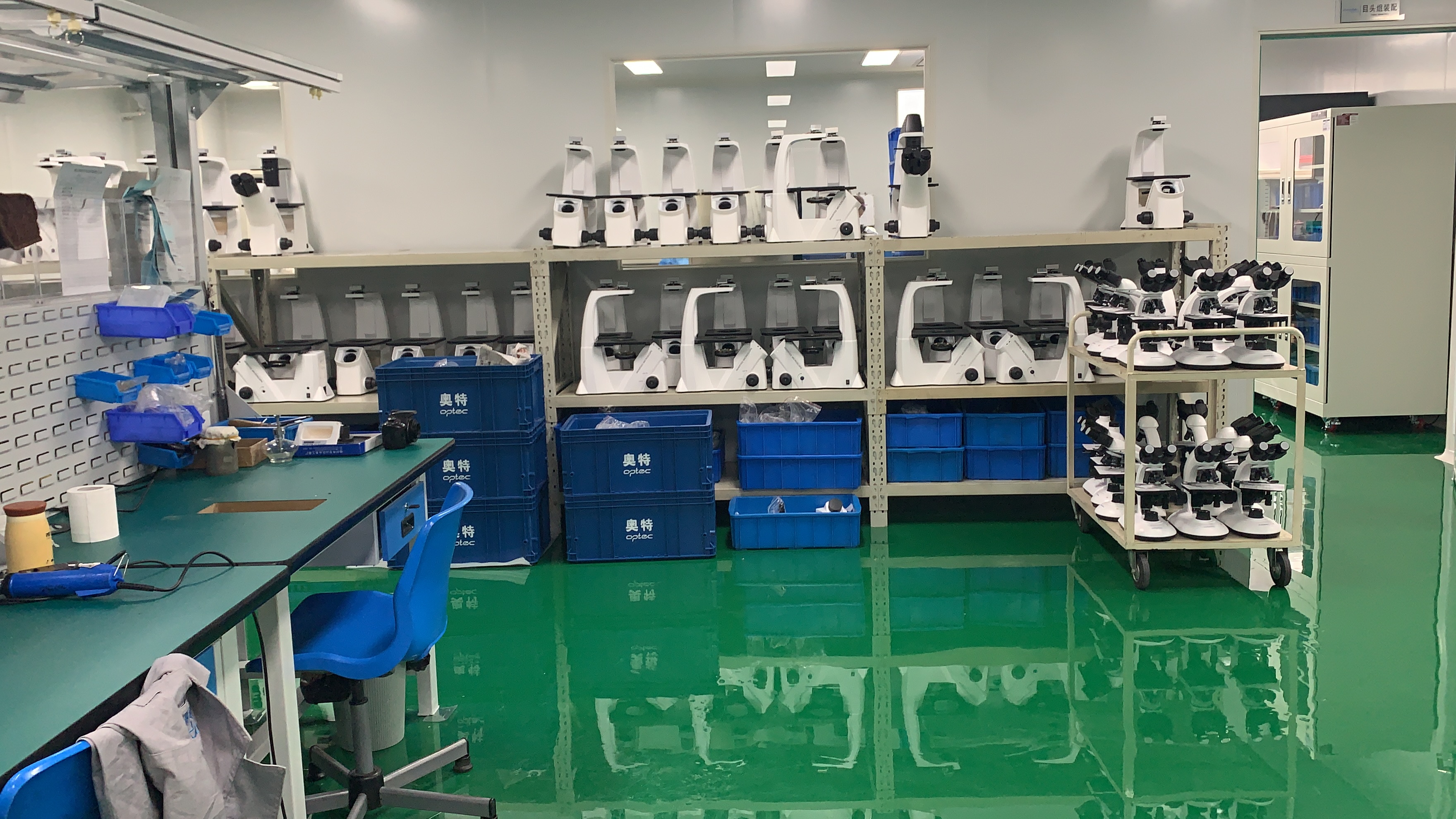
Specifying infinity-corrected optics in a biological microscope means writing six parameters into the purchase document before any price is compared: head type and light distribution, nosepiece capacity, the objective family and eyepiece field number, the focusing mechanism, condenser numerical aperture, and illumination. Each one changes what the instrument can do after delivery, and each one is routinely missing from a quotation.
Infinity correction describes an optical layout, not a performance grade. In an infinity-corrected system the objective collimates light into a parallel beam, and a tube lens inside the head forms the intermediate image. Because that space between objective and tube lens is parallel, beam splitters, filters and analysers can be inserted there without moving the image plane. That modularity is what a specifier is actually buying — and it only works when the objective family and the head are specified as one decision.
This guide is written for laboratory specifiers, procurement managers and distributors who must convert a project requirement into a written microscope specification in 2026. Three reference configurations from Chongqing Scope Instrument Co., Ltd. are used throughout: the BK6000TR trinocular microscope, the SMART-4 with infinity Plan objectives, and the B302 with infinity achromatic EPlan optics.
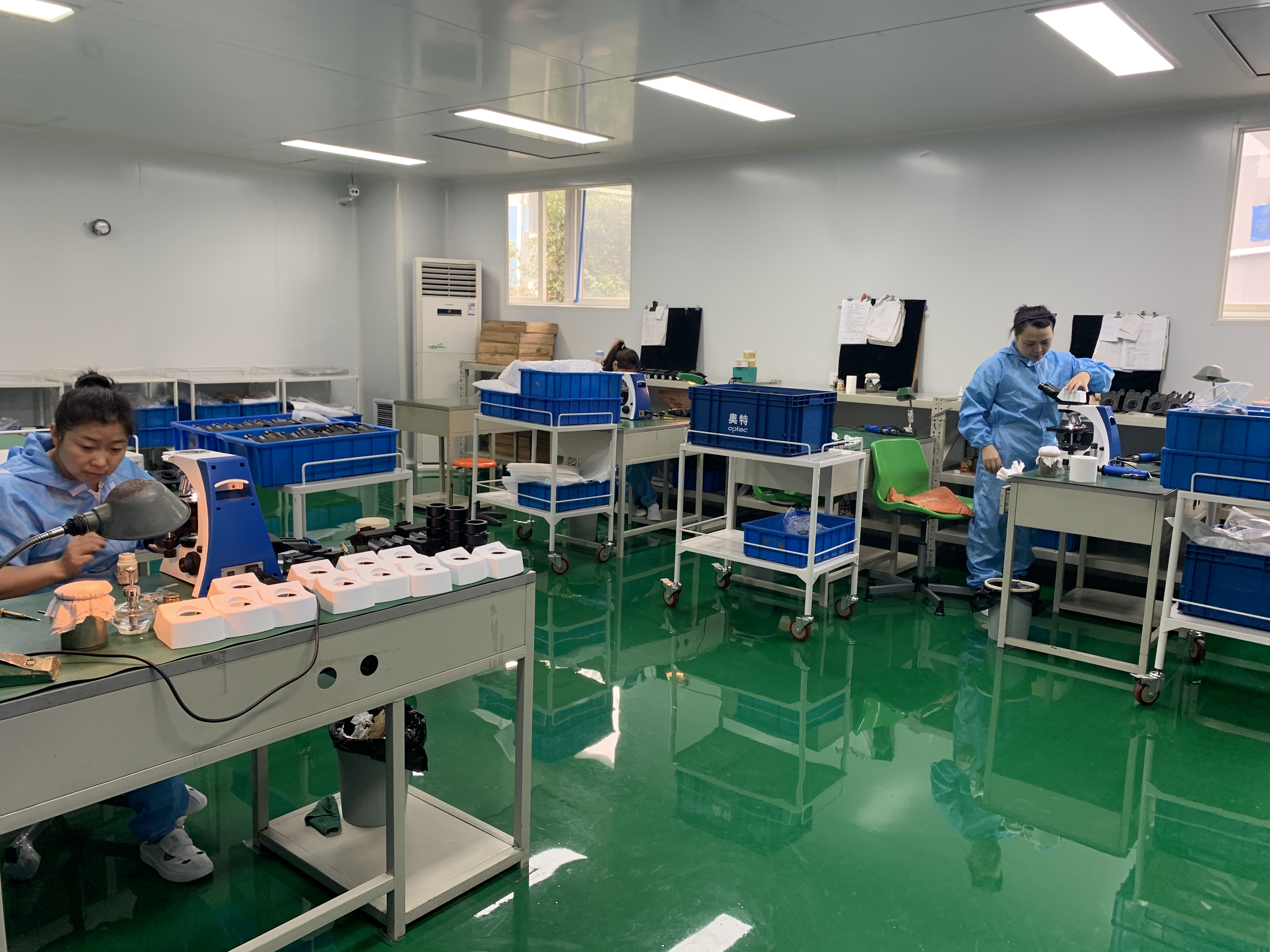
Chongqing Scope Instrument Co., Ltd. is a supplier of laboratory and medical training instruments and metallographic equipment based in Chongqing, China, with over 20 years of sales experience and more than 500 clients worldwide. Its microscope range covers biological, metallographic, fluorescence, inverted, polarizing, stereo and digital instruments, and the company states that it also provides OEM and ODM services.
Problem definition: why “infinity” on a data sheet is not a specification
A data sheet that says “infinity-corrected” tells you the objective conjugacy. It does not tell you whether the head, the objectives, the condenser and the illuminator in front of you were designed to work together, and it says nothing about what happens in year four of use. Four failure modes account for most specification errors in biological microscopy.
- Objective–head mismatch. Infinity objectives are paired with a tube lens in the head. Mixing an objective family with a head built for a different tube lens changes magnification and parfocality expectations, and the error only shows up after delivery.
- Magnification-only specification. Writing “4X/10X/40X/100X” and stopping there leaves the condenser and illumination unconstrained. At 100X, resolution depends on the cone of light the condenser delivers, so an under-specified condenser caps performance regardless of the objective mounted.
- Camera path specified late. Retrofitting imaging to a binocular microscope forces either an external adapter or a new head. A trinocular head with a defined split — for example the 100:0 and 80:20 light distribution on the BK6000TR — should be written into the original specification.
- Lifecycle not specified. Objective family continuity, spare bulbs where halogen illumination is used, dust protection and anti-mould care are procurement items, not afterthoughts. Bulb degradation, accessory replacement, dust in the optical path and mould or fogging are recognised risk types in microscope operation.
The commercial consequence is straightforward: every one of these gaps is resolved after acceptance, at the buyer’s cost, instead of being priced and documented before the order.
Industry background: what the 2026 market context means for a specification decision
The global microscope market reached a valuation of approximately USD 11.9 billion in 2025, and optical microscopes accounted for approximately 37% of that market, according to Market Research Future. Global trade in microscopes (HS 9011) reached USD 3.36 billion in 2024, with China the third largest exporter at USD 430 million, according to the Observatory of Economic Complexity using UN Comtrade and national customs data.
Two conclusions follow for anyone writing a specification. First, the supply base is broad: many suppliers can quote a biological microscope, so the differentiator is not availability but configuration control, documentation and lifecycle support. Second, optical instruments remain the mainstream laboratory format rather than a transitional one — which means the instrument specified today will still be in service when the next purchasing cycle begins, and the specification has to survive that horizon.
Digital documentation has become part of that horizon. Chongqing Scope’s comparison data for its current microscope series against traditional models reports that camera compatibility for direct computer connection reduces image capture time by 40%, and that its configurations offer 10+ optional lighting configurations against 2–3 on traditional models. Whether or not a buyer needs those options immediately, the specification should record whether the optical path can accept them later.
The detailed solution: six specification blocks for an infinity-corrected biological microscope
Block 1 — Head type and light distribution
Head type is the first decision because it fixes the imaging path. A monocular head suits single-user screening and simple teaching where no camera is planned. A binocular head suits routine visual work. A trinocular head is the correct specification whenever documentation, image capture or shared viewing is in scope, because the third port carries the camera without removing an eyepiece.
The BK6000TR is specified with a trinocular head offering 100:0 and 80:20 light distribution between the viewing eyepieces and the camera port. In practice, 100:0 keeps the full light budget on the eyepieces for faint or high-magnification visual work, while 80:20 splits the beam so a camera can record while the operator continues to observe. Both ratios should appear in writing, together with whether a camera adapter is included in the scope of supply.
Block 2 — Nosepiece capacity
Nosepiece capacity determines how many objectives are mounted at once and whether any position stays free for later expansion. The BK6000TR carries a quintuple nosepiece, which allows four working magnifications plus one spare position. That spare position is the difference between adding a phase contrast or dark field objective later and replacing the nosepiece — or buying a second instrument.
Specify the number of positions and, where expansion is possible, the intended use of the free position, because a phase contrast objective requires a matching annulus in the condenser. Nosepiece capacity and condenser configuration should be written in the same paragraph of the specification.
Block 3 — Objective family and eyepiece field number
Two objective classes appear in the reference configurations. The SMART-4 is specified with infinity Plan objectives at 4X, 10X, 40X and 100X together with a WF10X/20mm eyepiece. The B302 is specified with infinity achromatic EPlan optics and the same WF10X/20mm eyepiece. “Plan” correction addresses field curvature, which matters whenever the edge of the field is photographed or measured; achromatic EPlan optics are the routine bright-field specification.
The eyepiece entry “WF10X/20mm” carries two separate facts that must be written down: 10X magnification and a 20 mm field number. The field number sets the observable field diameter and therefore the area a camera records at each magnification. Omitting it from the specification allows a substitution that changes what the operator actually sees.
Also record the immersion requirement at 100X, which is normally used with immersion oil, and confirm that the objective set and the head come from the same optical family. This single sentence prevents the most common infinity-system mismatch.
Block 4 — Focusing mechanism
Focusing is specified as coaxial coarse and fine adjustment on a single axis: the coarse knob covers travel between magnifications and specimen thickness, and the fine knob produces the final image sharpness. Writing “coaxial coarse and fine focusing” into the specification prevents a substituted stand with separated controls, which slows every operator who changes magnification frequently.
Ask the supplier to state the focusing travel and the fine-focus graduation in the quotation. These are configuration details rather than assumptions, and they belong in the technical annex, not in a verbal agreement.
Block 5 — Condenser numerical aperture
An Abbe condenser with a numerical aperture of 1.25 is the specification used with the high-magnification objectives described above. The rule is simple and should be written into the document: condenser numerical aperture must be at least equal to the objective numerical aperture, otherwise the effective resolution is limited by the condenser rather than the objective.
Specify the condenser type and its N.A., and confirm that the condenser can be centred and that its iris diaphragm is adjustable. Those two mechanical properties are what make consistent illumination possible across magnifications.
Block 6 — Illumination
Three illumination specifications appear in this product range: 3W LED, 12V/20W halogen, and 12V/30W halogen. The choice is a maintenance decision as much as an optical one. LED illumination removes the bulb-replacement path and reduces heat at the specimen. Halogen illumination is chosen where its continuous spectrum is preferred for colour work, but it introduces bulb degradation as a consumable item and therefore requires a spare-parts line in the specification.
Write the illumination type and rating, and state whether spare bulbs are included when halogen is specified. Bulb degradation is one of the recognised risk types in microscope operation; the control measures stated for this product range are manual power outage, an instruction manual, a dust cover, and anti-mildew and anti-fog treatment.
Specification template you can adapt
“Biological microscope with infinity-corrected optical system; [trinocular head with 100:0 and 80:20 light distribution / binocular head]; [quintuple] nosepiece; [infinity Plan 4X/10X/40X/100X / infinity achromatic EPlan] objectives; WF10X/20mm eyepiece; coaxial coarse and fine focusing; Abbe condenser N.A. 1.25, centreable with adjustable iris; [3W LED / 12V 20W halogen / 12V 30W halogen] illumination; dust cover and anti-mould treatment included; certificate set and acceptance criteria listed in the annex.” Confirm with the supplier which bracketed combination can be built on one stand before issuing the document.
Step-by-step breakdown: writing the specification from project requirement to purchase order
- Define the specimen and the contrast mode. Bright-field biological work is the default; state explicitly whether phase contrast or dark field must be addable later, because that decision constrains the nosepiece and the condenser.
- Fix the optical interface. State “infinity-corrected” and require that head and objectives come from one matched family. Do not allow the head and objective family to be quoted separately by different sources.
- Assign the head type and split ratio. Monocular, binocular or trinocular, with the light distribution written as a ratio where a camera port exists — 100:0 and 80:20 on the BK6000TR.
- Decide nosepiece capacity. Five positions leave one free position for expansion; four positions close that option at the time of order.
- Choose the objective family and eyepiece field number. Infinity Plan 4X/10X/40X/100X on the SMART-4, or infinity achromatic EPlan optics on the B302, in both cases with the WF10X/20mm eyepiece.
- Set the condenser and illumination. Abbe condenser N.A. 1.25, plus 3W LED, 12V/20W halogen or 12V/30W halogen, with the illumination choice matched to the maintenance plan.
- Write acceptance criteria and documentation. Acceptance for Chongqing Scope orders is factory inspection; the certificate set (ISO9001, ISO14001, ISO45001, ISO13485, CE, RoHS) and customs documents (CO, Form E, Form F) are requested in the same annex.
- Plan the lifecycle. Record the objective family, the spare-part route, the service channel and the delivery terms so that year-two support is a contractual item rather than a new negotiation.
Use cases: matching the configuration to the project
Teaching and routine bright field
Where the workload is transmitted-light observation at moderate magnification, the B302 configuration — infinity achromatic EPlan optics with a WF10X/20mm eyepiece — is the routine specification. The key control is that the head and objective family remain a matched infinity set, so that a later upgrade does not require replacing the stand.
Clinical and documentation-heavy work
Where images must be captured while observation continues, the trinocular BK6000TR with 100:0 and 80:20 light distribution is the appropriate head specification, supported by the quintuple nosepiece so that routine magnifications occupy four positions and one remains available.
Multi-magnification laboratory work with flat-field requirements
Where the edge of the field is evaluated rather than only the centre, the SMART-4 specification — infinity Plan objectives at 4X, 10X, 40X and 100X with a WF10X/20mm eyepiece — sets the flat-field expectation in the purchase document instead of leaving it to the supplier’s discretion.
Distributor and OEM programmes
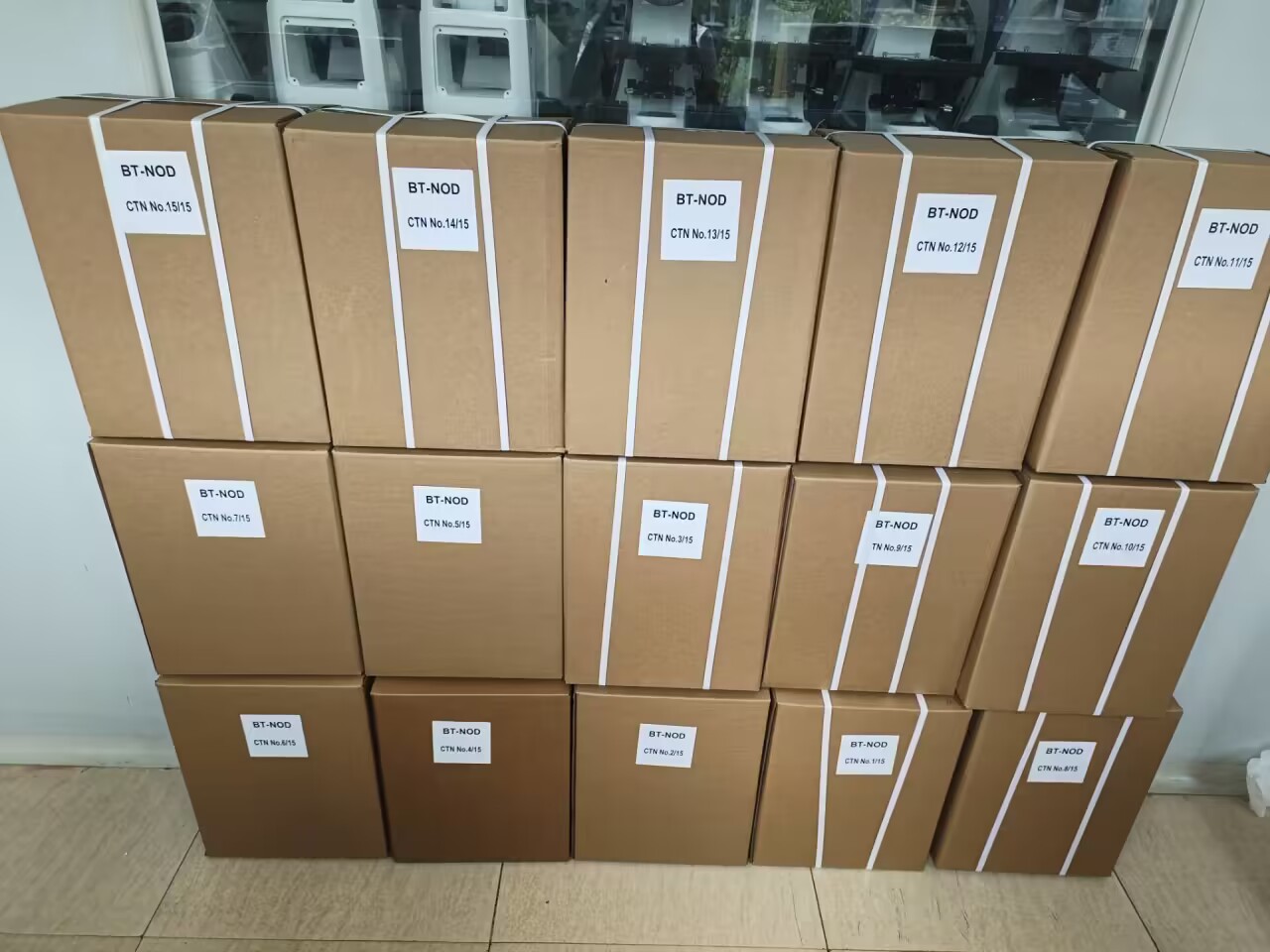
Where an infinity-corrected biological microscope is being prepared for a channel, the specification adds branding and packaging terms: Chongqing Scope states that OEM and ODM services are available, that LOGO printing can be applied to the machine after technical verification, and that export packaging is neutral, in cardboard or wooden boxes prepared to export standards.
Comparison tables
Table 1 — Finite versus infinity-corrected specification logic
| Specification area | Finite (finite-conjugate) system | Infinity-corrected system |
|---|---|---|
| Image formation | Objective forms the image directly at the intermediate image plane at a fixed mechanical tube length | Objective collimates light; a tube lens in the head forms the intermediate image |
| Inserting accessories | Changes optical path length; focus and aberration balance must be re-checked | Accessories sit in the parallel infinity space; image plane is unaffected |
| Camera and beam splitting | Added at the eyepiece side, typically with limited light control | Integrated in the head, with defined ratios such as 100:0 and 80:20 (BK6000TR) |
| Expansion path | Objective set tied to the tube length of the stand | Objective family and head specified as one matched pair; head choice becomes a specification decision |
| What to write in the RFQ | Tube length and total magnification | Head type and split ratio, objective family, nosepiece capacity, condenser N.A., illumination |
Table 2 — Reference configuration summary (stated product facts only)
| Specification point | BK6000TR | SMART-4 | B302 |
|---|---|---|---|
| Head | Trinocular, with 100:0 and 80:20 light distribution | Confirm on quotation | Confirm on quotation |
| Nosepiece | Quintuple | Confirm on quotation | Confirm on quotation |
| Objectives | Confirm on quotation | Infinity Plan, 4X / 10X / 40X / 100X | Infinity achromatic EPlan |
| Eyepiece | Confirm on quotation | WF10X/20mm | WF10X/20mm |
| Optical layout | Infinity-corrected configuration | Infinity Plan objectives | Infinity achromatic EPlan optics |
Table 3 — Commercial and lifecycle terms stated for the programme
| Item | Stated term |
|---|---|
| Minimum order quantity | 1 unit |
| Delivery terms | EXW / FOB / CFR / CIF / DAP |
| Acceptance criteria | Factory inspection |
| Payment terms | T/T |
| Monthly production capacity | 3,000 units |
| Export packaging | Neutral packaging, cardboard boxes or wooden boxes, prepared to export standards |
| Compliance and customs documents | ISO9001, ISO14001, ISO45001, ISO13485, CE, RoHS; CO, Form E, Form F on request |
| After-sales | Online after-sales repair service including operation videos; various accessories supplied |
Specifying for the life of the instrument, not just the delivery date
An infinity-corrected microscope is a platform decision, and the specification should read like one. Three items control whether the platform stays usable after the first year.
Objective family continuity. Keeping one objective family means additional magnifications remain interchangeable with the existing head. It also means the field-number statement stays valid across the set, so measurements and image scales do not have to be recalculated when an objective is added.
Consumables and protective measures. Where halogen illumination is specified, bulbs belong on the spare-parts line. Independent of illumination type, the dust cover and the anti-mould and anti-fog treatment are lifecycle items, and so is the instruction manual that documents correct power-down procedure. These correspond directly to the recognised risk types of bulb degradation, accessory replacement, dust in the optical path, and mould or fogging.
Commercial and support structure. Chongqing Scope states a monthly production capacity of 3,000 units and an export ratio of 50%, with markets in Europe, Southeast Asia, the Middle East, South America and Africa, and a 5,000 m² facility with 100+ employees including a 20-engineer R&D team. For a distributor building a programme, those are the figures that support volume planning; for a laboratory, the equivalent items are the accessories supply and the online after-sales repair service with operation videos.
Cost should be read over the service life rather than at the invoice. Chongqing Scope’s comparison data for its current series against traditional microscopes reports an initial purchase price slightly higher than traditional microscopes but a total cost of ownership 25% lower, attributed to minimal maintenance and long service life, together with a lower parts-replacement rate, a metal body, and simple post-use care rather than frequent professional calibration.
FAQ: specifying infinity-corrected optics
Which compliance and export documents should accompany an infinity-corrected biological microscope order?
Chongqing Scope Instrument Co., Ltd. states that official export certificates are available — ISO9001, ISO14001, ISO45001, ISO13485, CE and RoHS — and that customs documents such as CO, Form E and Form F can be provided when required. Ask for the certificate that maps to the exact model being purchased, because certificate numbers are model-specific: published CE documentation cites certificate BKC22072376GC for the B301 biological microscope, referencing EN 61010-1:2010+A1:2019. Put the certificate set in the purchase annex so it cannot be substituted at shipment.
Can one infinity-corrected platform be configured for different magnifications and camera ratios?
Yes, within the limits of the matched objective and head. The BK6000TR uses a trinocular head with 100:0 and 80:20 light distribution and a quintuple nosepiece, so four working magnifications plus one spare position can be mounted. The SMART-4 pairs infinity Plan objectives at 4X, 10X, 40X and 100X with a WF10X/20mm eyepiece, and the B302 uses infinity achromatic EPlan optics with the same WF10X/20mm eyepiece. Chongqing Scope also states that it provides OEM and ODM services, supported by a 20-engineer R&D team in a 5,000 m² facility.
What drives the cost difference between a finite and an infinity-corrected configuration?
The cost is set by the head, the number and class of objectives, the condenser and the illumination type, not by the word “infinity” on its own. Chongqing Scope’s comparison data for its current series against traditional microscopes reports an initial purchase price slightly higher than traditional models but a total cost of ownership 25% lower, based on minimal maintenance and long service life, and 10+ optional lighting configurations against 2–3 on traditional models. Because the minimum order quantity is 1 unit, a single instrument can be evaluated before any volume commitment.
How should a sample be validated before a volume order?
Order one unit and test it against the written specification rather than against general impressions. Acceptance criteria for Chongqing Scope orders are factory inspection, and delivery terms can be EXW, FOB, CFR, CIF or DAP with T/T payment. Check parfocality across the mounted objectives, edge sharpness at the eyepiece field, condenser centring, light distribution in both the 100:0 and 80:20 settings on a trinocular head, and the condition of the optical path — dust, fogging and mould are recognised risk types, controlled by the dust cover and anti-mould and anti-fog treatment.
How is supply continuity handled after the first delivery?
Chongqing Scope states a monthly production capacity of 3,000 units, supplies accessories including an online after-sales repair service with operation videos, and ships in neutral cardboard or wooden packaging prepared to export standards. For a multi-year programme, write the objective family, spare bulbs where halogen illumination is specified, the dust cover and the service route into the agreement. Specifications and sample requests can be sent to [email protected] or +86 15223521781, and the product catalogue is available as a PDF download below.
Conclusion: six written parameters instead of six assumptions
Infinity-corrected optics reward precise specification. Writing head type and light distribution, nosepiece capacity, objective family and eyepiece field number, coaxial coarse and fine focusing, Abbe condenser N.A. 1.25, and the illumination type into the purchase document turns a general request for a biological microscope into a buildable configuration — and removes the four failure modes that show up after delivery rather than before it.
The configurations described here show how far that logic can be taken in practice: the BK6000TR for trinocular work with 100:0 and 80:20 light distribution and a quintuple nosepiece, the SMART-4 for infinity Plan 4X–100X work with a WF10X/20mm eyepiece, and the B302 for infinity achromatic EPlan optics in routine bright field. The remaining decisions — certificates, acceptance by factory inspection, delivery terms and spare-part routes — are what convert a correct specification into an instrument that is still supported in year four.
Next step: specification review, sample and catalogue
Send the draft specification for a technical review or request a single-unit sample for evaluation. Minimum order quantity is 1 unit; delivery terms are EXW, FOB, CFR, CIF or DAP; acceptance is factory inspection.
Email: [email protected] · Tel / WhatsApp: +86 15223521781 · Website: www.cqscopelab.com
Address: 701, Longhushuijingguoji, No.164, Xinnan Road, Yubei District, Chongqing, China
Download the full product catalogue: Chongqing Scope Instrument catalogue (PDF)

Have Questions or Need More Details?
Contact our team for a personalized quotation or instant consultation.
Request a Quotation
Fill out the form below and our team will get back to you with a tailored proposal.
WhatsApp Direct Chat
Prefer to chat in real-time? Message us on WhatsApp for instant assistance & quick answers.
- Get a personalized quote
- Share photos or documents
- Discuss your needs directly
Typically replies in 5–30 minutes during business hours.