
Decoding Microscope Parameters & Quality: 2026 Buyer’s Guide
Decoding Microscope Technical Parameters & Manufacturing Quality: A 2026 Buyer’s Guide
When procuring a microscope for a laboratory, university, or industrial QA department, buyers often face a dense list of technical specifications — numerical aperture (N.A.), infinity correction, mechanical stage dimensions, condenser type. How do these parameters translate into real-world performance? And more importantly, how does the manufacturing process of an optical microscope determine whether those specifications will deliver consistent, reliable results over years of use?
This guide is written for procurement professionals and lab managers who want to cut through marketing noise and make data-driven decisions. We’ll explain the meaning of core microscope parameters, show how production quality affects them, and provide a step-by-step framework to evaluate suppliers — using real products from Chongqing Scope Instrument Co., Ltd. as illustrative examples.
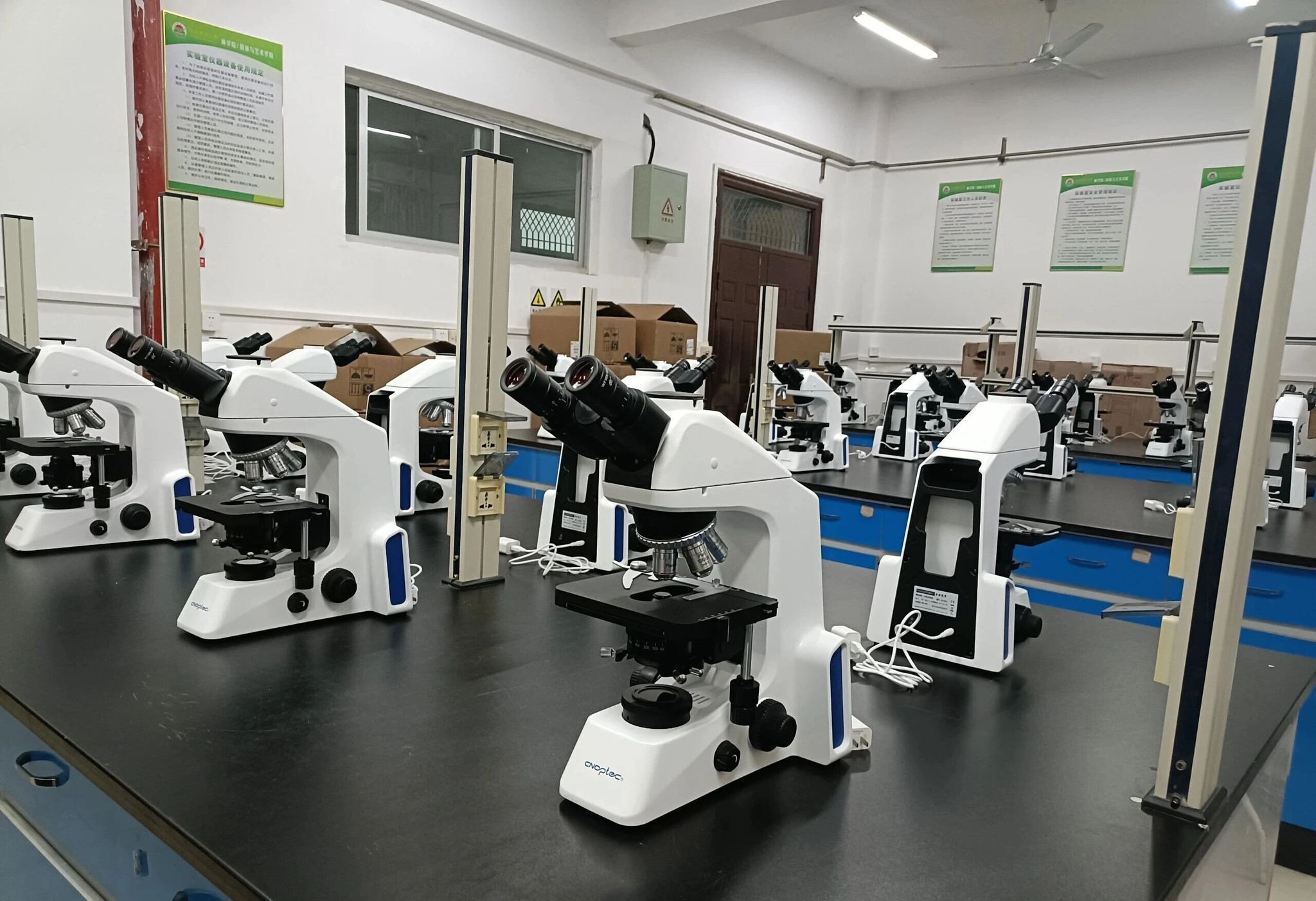
Cover: A modern optical microscope in a laboratory environment — understanding parameters is the first step to correct procurement.
1. The Real Problem: When Parameters Mislead
A common mistake is to treat a microscope as a commodity with interchangeable parts. For example, two binocular microscopes may list “Plan 4X/10X/40X/100X” objectives, yet their image clarity, chromatic correction, and mechanical stability can differ dramatically. The difference lies in three hidden factors:
- Optical design – Finite vs. infinity-corrected systems affect modularity and aberration control.
- Material quality – Aluminum alloy castings vs. stamped metal; low-stress glass vs. ordinary glass in polarizing applications.
- Assembly & calibration – Coaxial focusing mechanisms that drift over time, or condenser alignment that shifts after first shipment.
The question becomes: How can a buyer verify that the listed parameters are delivered in every unit?
2. Industry Context: The 2026 Microscope Supply Landscape
China now supplies over 60% of the world’s laboratory microscopes, with manufacturers like Chongqing Scope (established 2017, 5,000 m² factory, 100+ employees, 20 R&D engineers) producing 30,000 units annually. While many suppliers offer OEM/ODM services, the gap between “spec sheet” and “actual build quality” varies widely. International buyers increasingly demand ISO9001, CE, RoHS, and real-world case validation — not just a spec sheet.
3. Step-by-Step: How to Decode Technical Parameters
We’ll use the B204 upright microscope (a typical upright microscope for biology and teaching) as an example. Its data sheet reads:
| Parameter | B204 Specification | What it means for you |
|---|---|---|
| Head | Binocular | Comfortable for prolonged observation; trinocular options allow camera attachment. |
| Eyepiece | WF10X/18mm | Wide-field; 18mm field number gives a good balance between magnification and field of view. |
| Objectives | Plan 4X/10X/40X/100X | “Plan” means flat-field correction; essential for photomicrography. 100X requires oil immersion. |
| Nosepiece | Quadruple | Four positions; sufficient for most education and routine lab work. |
| Mechanical Stage | 125×115 mm | Sturdy XY movement; size supports standard 25×75 mm slides. |
| Condenser | Abbe N.A.1.25 | N.A. 1.25 matches the 100X oil objective; crucial for resolution at high magnification. |
| Focusing | Coaxial coarse/fine knob | Allows precise, drift-free focusing; a mark of quality mechanical engineering. |
| Illumination | 3 W LED | Low heat, long life (50,000+ hours), stable color temperature; no halogen bulb replacement. |
Beyond the spec sheet, the B204 is built with an aluminum alloy frame and glass optics, and its focusing mechanism uses a coaxial design that prevents stage drift — a common fault in cheaper microscopes. The manufacturing process includes a 100% factory quality inspection before shipping, as per Chongqing Scope’s standard procedure.
3.1 Infinity Optical System – Why It Matters
Many modern infinity microscopes (like the BK5000 or SMART-4) use an infinity-corrected optical tube. This allows insertion of modules (polarizers, DIC prisms, fluorescence filters) between the objective and the tube lens without degrading image quality. If your application requires phase contrast, dark field, or fluorescence, an infinity system is highly recommended.
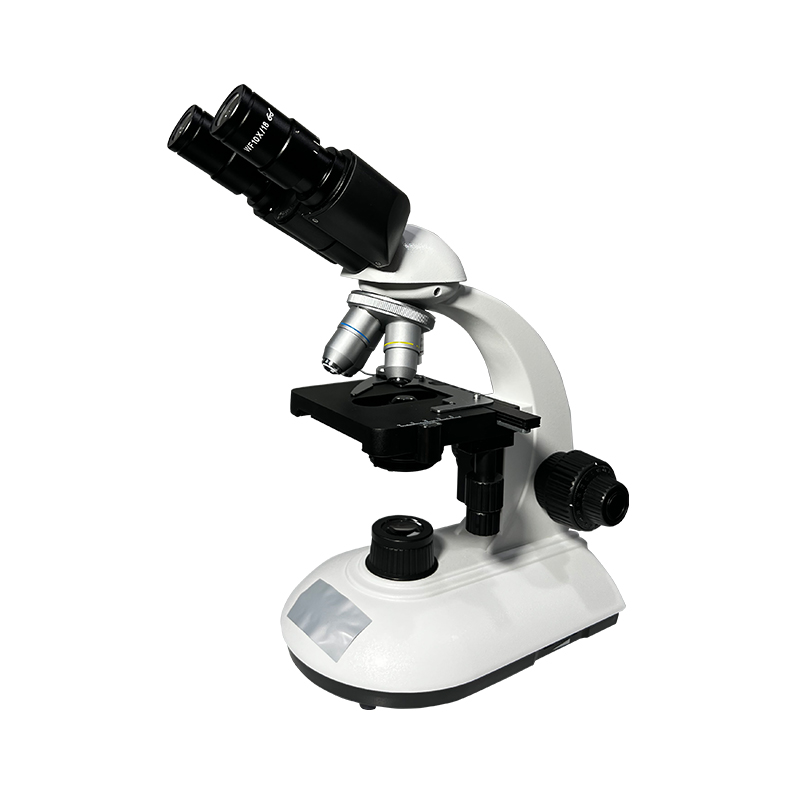
B204 Upright Microscope – a reliable choice for education and routine lab work, with clearly defined parameters and robust construction.
4. How Manufacturing Quality Affects Your Microscope
Parameters are only as good as the production process that realizes them. Below are four critical manufacturing aspects that directly impact microscope performance and longevity.
4.1 Material Selection
High-grade microscopes use aluminum alloy die-castings for the stand and arm. Cheaper alternatives use plastic or sheet metal, leading to vibration, misalignment, and short service life. Chongqing Scope uses aluminum alloy and glass for all its biological and metallurgical models, ensuring stiffness and thermal stability.
4.2 Optical Component Quality
The objectives must be made from low-dispersion, low-stress glass. For polarizing microscopes (e.g., SMART-POL, BK-POLF), non-stress objectives are critical — otherwise, birefringence artifacts will corrupt mineral analysis. Similarly, fluorescence microscopes require high-transmission glass for weak signal detection.
4.3 Assembly and Calibration
Even the best components fail if assembly is sloppy. Coaxial focusing must be free of backlash; the mechanical stage must move smoothly without play; the condenser must be centered with the optical axis. At Chongqing Scope, each unit undergoes a factory inspection that checks these parameters. Their CE certification (No. BKC22072376GC) and RoHS compliance (No. BKC-191103261C) attest to systematic quality control.
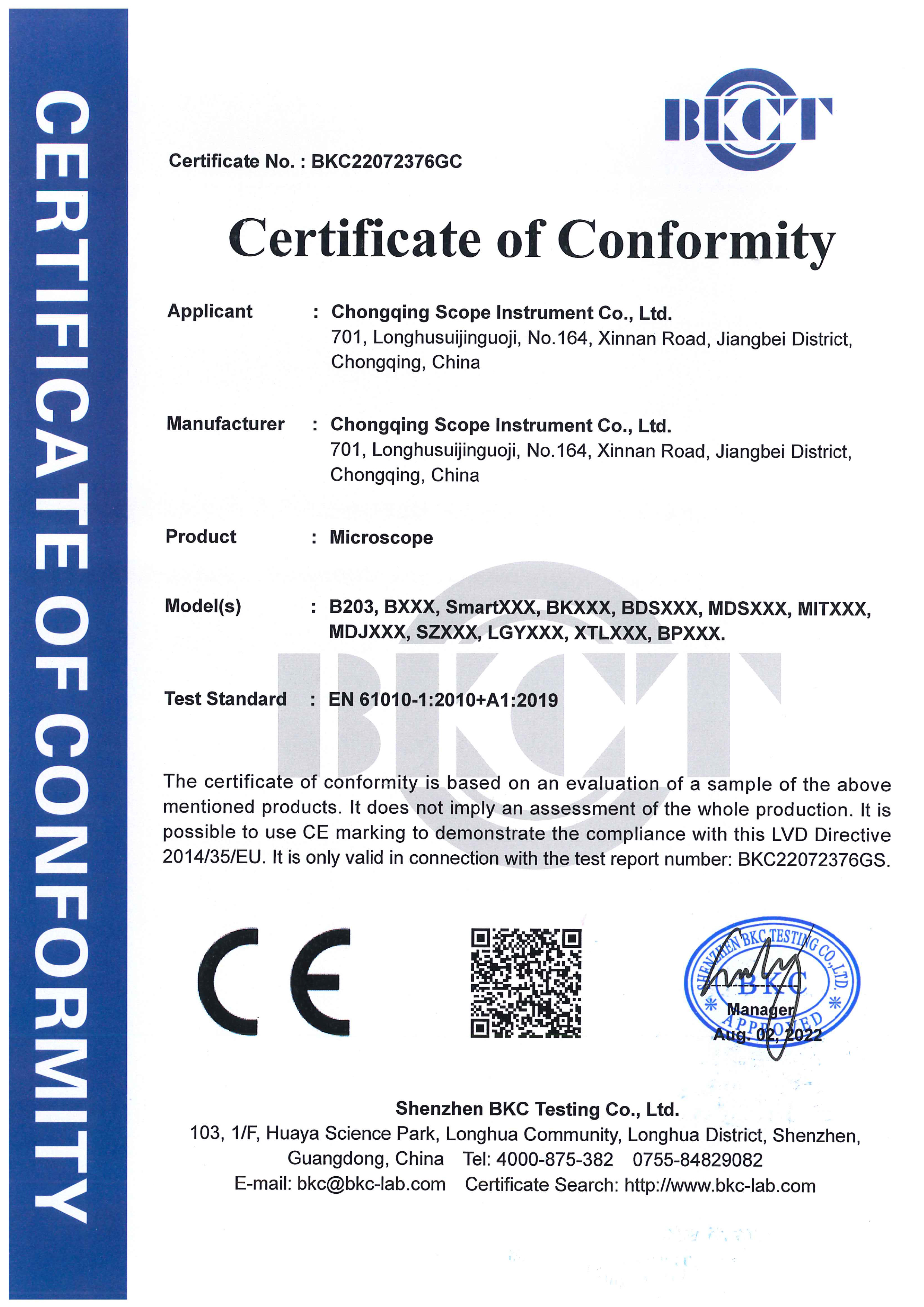
CE certification confirms that electrical safety and electromagnetic compatibility standards are met throughout the production process.
4.4 Anti-Mildew and Anti-Fog Treatment
Optical components are vulnerable to mold and dew in humid environments. Reputable manufacturers treat lenses with anti-mildew coatings and provide dust covers. Chongqing Scope’s application data specifies operating conditions: 0 °C to 40 °C, max 85% humidity — and includes such treatments to prevent optical fogging in tropical or coastal markets.
5. Real-World Use Case: Romanian School Teaching Project
In 2024, a Romanian distributor purchased 30 units of the BK5000 biological microscope (trinocular model with Plan infinity objectives) for secondary school biology labs. The order required OEM branding and integrated teaching materials. After two years of operation, the distributor reported stable performance with zero service calls. The BK5000’s key advantage: its infinity optical system allowed easy addition of a digital camera for group viewing, and the LED illumination eliminated frequent bulb changes.

BK5000 microscopes deployed in a Romanian school – a case proving that proper parameter selection coupled with solid manufacturing delivers long-term value.
6. Comparison: Modern Microscope vs. Traditional Models
To help buyers quantify the difference in quality, here is a comparison based on Chongqing Scope’s internal data and the contrast unit provided:
| Aspect | Modern Microscope (e.g., MIT500, BK5000) | Traditional Microscope |
|---|---|---|
| Optical System | Infinity corrected, plan objectives | Finite (160 mm), often achromatic |
| Body Material | Aluminum alloy, metal body | Plastic or thin sheet metal |
| Illumination | LED (50,000 h life), low voltage | Halogen (200 h life), high heat |
| Camera Compatibility | Trinocular port, 100% light to camera | Requires adapter, light loss |
| Maintenance | User-replaceable parts, simple care | Requires professional calibration |
| Total Cost of Ownership (5 yr) | ~25% lower | Higher due to bulb changes, repairs |
| Image Capture Time | Reduced by 40% (direct digital capture) | Slower due to analog workflow |
7. Step-by-Step Framework for Procurement
- Define your application – Teaching, clinical, industrial metallurgy, geoscience? This determines the microscope type (biological, metallurgical, polarizing, inverted).
- Extract critical parameters – For biology: N.A., plan objectives, stage size, illumination type. For industry: working distance, bright/dark field capability, stage travel.
- Verify manufacturer’s production capability – Ask for factory scale, R&D team size, certification (ISO, CE, RoHS). Chongqing Scope’s 5,000 m² plant and 20 engineers are concrete indicators.
- Request a sample or factory inspection – Check focusing smoothness, stage movement, and image centration. Many suppliers accept EXW/FOB inspection.
- Evaluate after-sales support – Warranty period, availability of spare parts, online video support. Chongqing Scope offers 1-year warranty and online repair guidance.
8. Frequently Asked Questions
Numerical aperture (N.A.) defines the light-gathering ability. A condenser with N.A. 1.25 can match the 100X oil objective (which also has N.A. ~1.25), ensuring full resolution. A lower N.A. condenser would limit the effective resolution of the objective.
Infinity-corrected optics allow insertion of filters, polarizers, and DIC prisms without changing the image plane. For advanced techniques like fluorescence or phase contrast, infinity is essential. For basic brightfield teaching, a finite system may suffice, but infinity offers future flexibility.
Look for a coaxial coarse/fine focusing system with a braked stage. Quality manufacturers use hardened steel guides and anti-backlash mechanisms. The best test is to manually move the stage and check for play — a well-made stage should feel smooth and solid.
Insufficient lens sealing, lack of anti-mildew treatment, and storage in high humidity. Suppliers that export to tropical regions (e.g., Southeast Asia, South America) should apply anti-fog coatings and provide desiccants. Chongqing Scope includes such measures as standard.
9. Conclusion
Interpreting microscope parameters is not an abstract exercise — it is the foundation of a successful procurement decision. But parameters alone are incomplete without understanding how they are achieved in the factory. By examining a manufacturer’s material choices, optical glass quality, assembly precision, and certification evidence, you can predict whether the microscope will deliver its promised specifications for years.
Chongqing Scope Instrument Co., Ltd. offers a full range of biological, metallurgical, fluorescence, polarizing, stereo, and inverted microscopes backed by CE, RoHS, and ISO certifications. With a factory of 5,000 m², 100+ employees, and an annual output of 30,000 units, they have the capacity and expertise to serve OEM, wholesale, and lab procurement needs worldwide.
Want to evaluate their product specifications and quality documentation?
Download the full company brochure: Click here to view brochure
Or contact the sales team directly:
Email: [email protected]
WhatsApp: +86 15223521781
Have Questions or Need More Details?
Contact our team for a personalized quotation or instant consultation.
Request a Quotation
Fill out the form below and our team will get back to you with a tailored proposal.
WhatsApp Direct Chat
Prefer to chat in real-time? Message us on WhatsApp for instant assistance & quick answers.
- Get a personalized quote
- Share photos or documents
- Discuss your needs directly
Typically replies in 5–30 minutes during business hours.