
How to Read a Microscope Data Sheet: Certificates and Parameters Explained
How to Read a Microscope Data Sheet: Certificates and Parameters Explained
A microscope quotation should be treated as a set of claims about optical performance and market access. Whether you are buying a biological microscope for a school, a laboratory microscope for a research team, or a metallurgical microscope for a quality-control lab, the data sheet and the certificate folder decide more than the price does. They tell you whether the instrument can physically produce the required image and whether it can be imported, sold, and installed in the target market without compliance delays.
This article explains how to read both layers of a microscope offer: the product-level certificate layer and the optics specification layer. It also gives model-specific examples from Chongqing Scope Instrument Co., Ltd., a China-based manufacturer that supplies biological, metallurgical, fluorescence, polarizing, and stereo microscope families to clients across Europe, Asia, the Middle East, South America, and Africa.
Why the Paperwork Matters as Much as the Optics
In global microscope purchasing, most disputes do not start with broken lenses. They start with ambiguous documents. A brief statement such as “CE certificate available” does not tell the buyer which model is covered, which standard version applies, or which EU-related requirement is addressed. Similarly, a specification that says “biological microscope” without showing the objective set, illumination type, condenser, or stage geometry is too vague to support an informed purchasing decision.
Buyers in the research and evaluation stage should therefore check three questions before comparing prices:
- Which exact model is covered by a certificate?
- Which standard and certificate number are listed?
- Which optical configuration corresponds to the actual samples and workflow?
These questions are practical. They prevent a customs problem, reduce the risk of ordering the wrong microscope family, and make later supplier communication more efficient.
Market Context: Why Optical Microscopes Still Need This Level of Scrutiny
Optical microscopes are not a minor category. The global microscope market was estimated at USD 11.9 billion in 2025 and is projected to reach USD 21.2 billion by 2033, according to Grand View Research. Within that market, optical microscopes remain the largest product segment with approximately 37% of global share in 2025, based on MarketsandMarkets data. Life-science applications account for a large share of demand as well: 32.4% of the application market in 2025 was attributed to the life-science segment by Grand View Research.
The consequence is direct: thousands of laboratories, distributors, and teaching institutions are buying optical microscopes every year. Many of those purchases depend on certificate compliance. For medical laboratory equipment and in vitro diagnostic microscope use, standards such as IEC 61010-2-101 are commonly referenced by procurement teams. This makes certificate literacy a core buying skill, not an administrative extra step.
The Certificate Layer: CE, RoHS, and ISO in Practice
The certificate folder supplied with a microscope usually contains two different things. Company-level management certificates describe how the company runs its quality, environmental, occupational health, and medical-device processes. Product-level certificates describe whether a specific instrument model or a stated model family meets a technical requirement. The two are often confused.
Company-Level Certificates: A Baseline, Not a Product Approval
Chongqing Scope Instrument Co., Ltd. holds ISO9001, ISO14001, ISO45001, ISO13485, CE, and RoHS certifications, according to its corporate profile. The ISO certificates are management-system certificates. They show that the supplier operates with documented processes covering quality, environmental management, occupational health and safety, and medical-device-related quality management.
However, an ISO certificate alone does not prove that a particular microscope model meets a specific EU safety or EMC standard. Buyers should treat ISO certificates as evidence of process maturity, and then ask for product-level documents that name the exact model.
CE Certificates: What a Standard Number Actually Tells You
A CE-related certificate is only useful when it can be matched to a model and a standard. In the public documentation of Chongqing Scope, two CE certificates are available as representative examples.
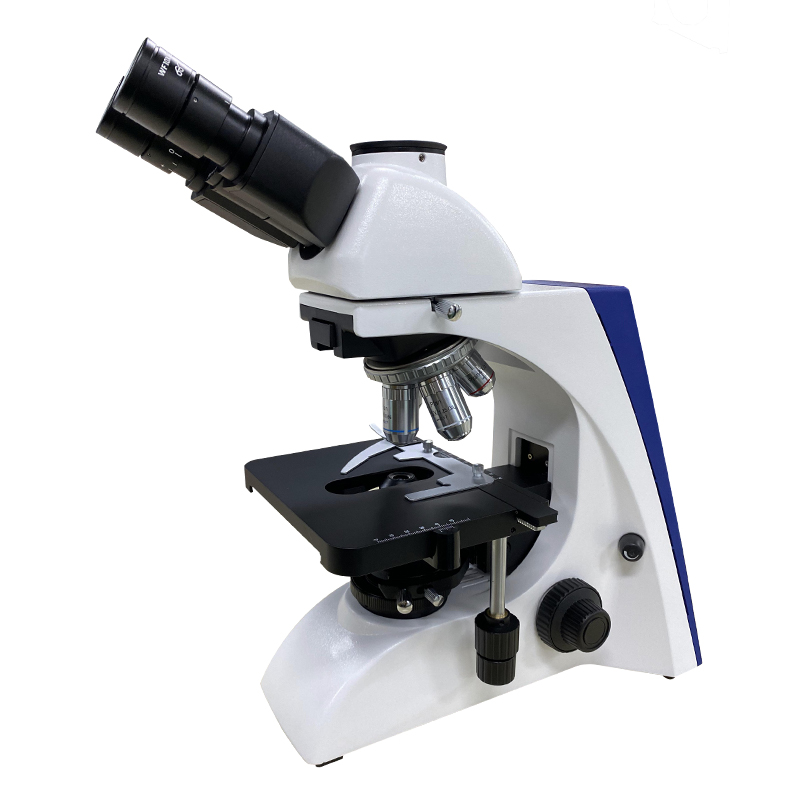
The B301 biological microscope is listed with CE certificate BKC22072376GC, issued by BKC for the EU market, and the applicable standard is EN 61010-1:2010+A1:2019. This standard is an electrical-safety-related requirement for laboratory and similar equipment. If a buyer is purchasing B301 units for an EU school or laboratory project, this certificate number and standard should appear in the documentation package.
A second CE certificate, number BKC22072375GC, applies to the BK5000-PH Phase Contrast Microscope. That certificate is issued by BKC for the EU market under standard EN IEC 61326-1:2021, which relates to electromagnetic compatibility requirements for electrical equipment for measurement, control, and laboratory use. Its stated scope line also references multiple model families from the supplier, including B203, BXXX, SmartXXX, BKXXX, BDSXXX, MDSXXX, MITXXX, MDJXXX, SZXXX, LGYXXX, XTLXXX, and BPXXX.
Reading these two CE certificates together shows an important principle: the CE documentation folder is not one generic sheet. It may contain different certificates using different standards. The correct document to check is the one that applies to the particular model in the order.
RoHS: A Substance Restriction, Not a Safety Certificate
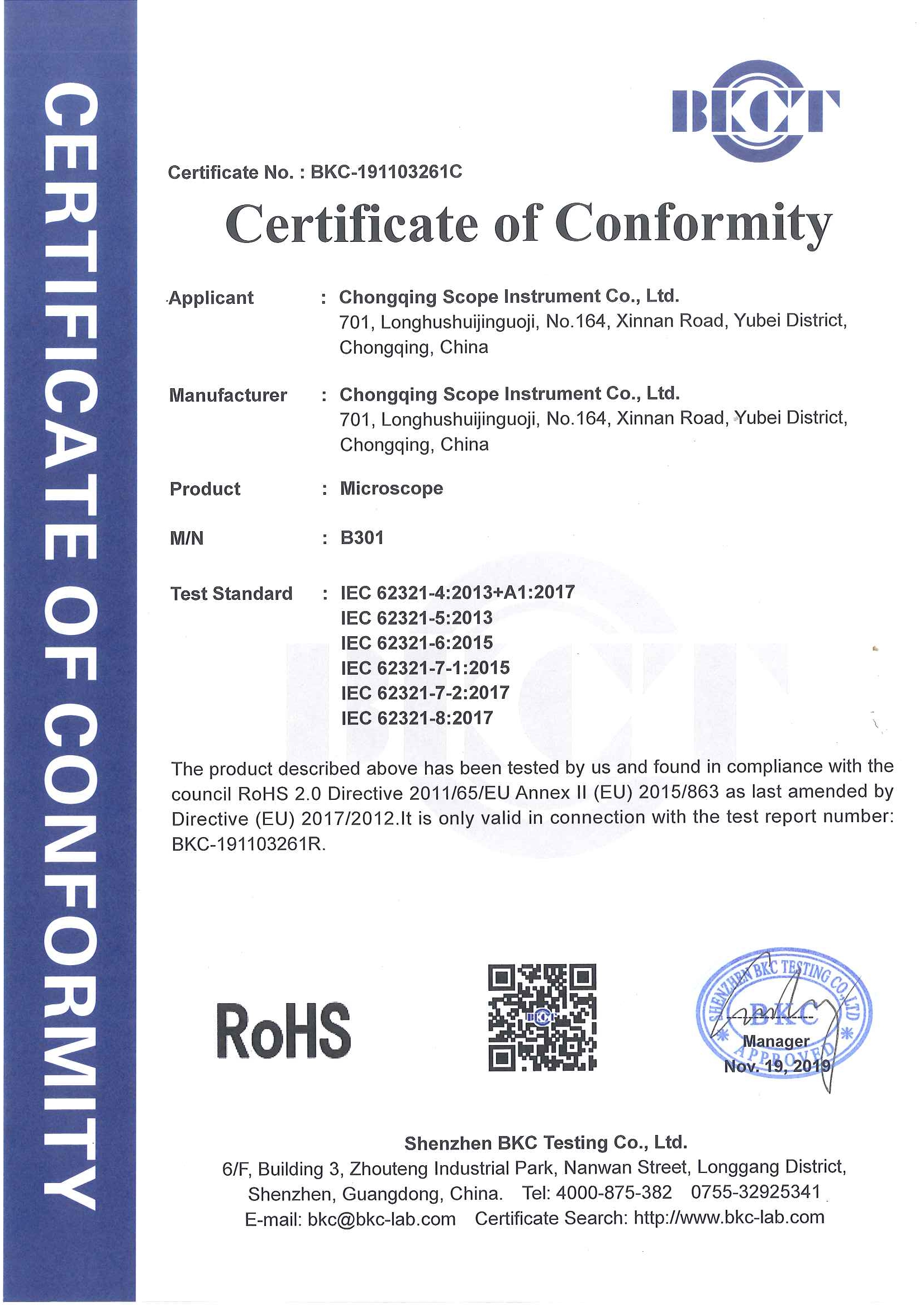
RoHS is different from CE. RoHS restricts hazardous substances in electrical and electronic equipment. It is not a safety certificate in the same sense as the EN 61010 family, and it should not be used as a substitute for the relevant safety documentation.
In the Chongqing Scope file, the B203 product is RoHS certified under certificate number BKC-191103261C, issued by BKC for the EU market. The applicable standard listed is IEC 62321-4:2013+A1:2017. A buyer who needs RoHS evidence should ask the supplier to attach this certificate or an equivalent document that is specific to the ordered model.
The Right Way to Ask: Model, Standard, and Number
Instead of asking a supplier only “Do you have CE?” a more productive request is: “Please send the CE and RoHS certificate pages that list our ordered model, together with the standard names, certificate numbers, and the issuing body.” This simple change in wording turns a vague conversation into an auditable document check.
The Specification Layer: Reading Optical Parameters Correctly
Once the certificate folder is understood, the next step is reading the specification page. The most useful data-sheet parameters are the head type, optical system, objective set, eyepiece field, stage size, condenser, and illumination.
Head Type: Monocular, Binocular, or Trinocular
The head determines comfort and image-sharing capability. A monocular microscope such as the B104 is a straightforward entry-level biological instrument. Binocular models such as the SMART-2 and B301 provide two eyepieces for more comfortable observation. Trinocular heads add a third vertical camera or observation port, which is common on laboratory and research instruments when the user wants to connect a digital camera.
Optical System: Finite and Infinity-Corrected Design
Modern laboratory-grade microscopes frequently use an infinity-corrected optical system. This means the objective projects an image at infinity and a tube lens in the microscope body then forms the intermediate image. Infinity systems allow accessories such as filters, polarizers, or fluorescence attachments to be inserted into the parallel optical path without changing the basic magnification. Several Chongqing Scope models use infinity objectives, including the BK5000 series, the SMART-4, the BK6000TR, and parts of the inverted range such as the BDS400 and BDS500.
Finite optical systems are simpler and often sufficient for education and routine bright-field work. The B301, for example, is built around achromatic objectives at 4X, 10X, 40X, and 100X, a quadruple nosepiece, and an Abbe N.A.1.25 condenser, which is a practical configuration for basic biological teaching laboratories.
Objectives: Beyond the Magnification Number
Objective lines contain more than magnification. A label such as “Plan 4X/10X/40X/100X” means the objectives are plan-corrected, providing a flatter image field across the viewing area. The letters “LWD” in a specification mean long working distance, which is useful when observing thicker samples, culture dishes, or industrial parts that require clearance between the objective and the specimen surface.
For example, the MIT300 metallurgical microscope uses LWD infinity plan objectives at 5X, 10X, 20X, and 50X. The MIT300D dark-field version adds bright-and-dark-field objectives in a quadruple nosepiece, making it useful for metallography and materials science. The inverted BDS400 tissue microscope uses LWD infinity phase-contrast objectives at 10X, 20X, and 40X, intended for cell-culture observation where the user needs sufficient working distance above the dish.
Stage, Condenser, and Illumination
A mechanical stage allows precise specimen movement and is important for systematic scanning. The B301 uses a 125 mm x 115 mm mechanical stage. Larger stages such as the 200 mm x 150 mm stage on the MIT300 and MIT300D support wider industrial specimens.
Illumination also affects workflow. LED illumination is common on modern biological microscopes because it generates less heat and has a stable light output. Halogen illumination is still used on some metallurgical and laboratory models where specific color rendering or high-intensity reflected light is preferred. For polarized-light microscopy, buyers should look for the presence of a polarizer and analyzer, as well as other compensator elements.
The overall message is simple: a specification line such as “4X–100X biological microscope” is not enough. The complete optical path should be listed so that the buyer can judge whether the microscope is appropriate for the actual sample type and application.
Reference Table: Matching Microscope Families to Application Requirements
The table below shows how microscope families from Chongqing Scope correspond to typical use cases. It is a starting point for discussion with a supplier, not a substitute for a detailed technical review of the ordered configuration.
| Application Area | Typical Microscope Family | Configuration Indicators |
|---|---|---|
| School teaching and basic biology | B104, SMART-2, B301, B302, B204 | Monocular or binocular head; simpler bright-field objective sets such as 4X/10X/40X/100X; Abbe N.A.1.25 condenser; LED illumination; mechanical stage |
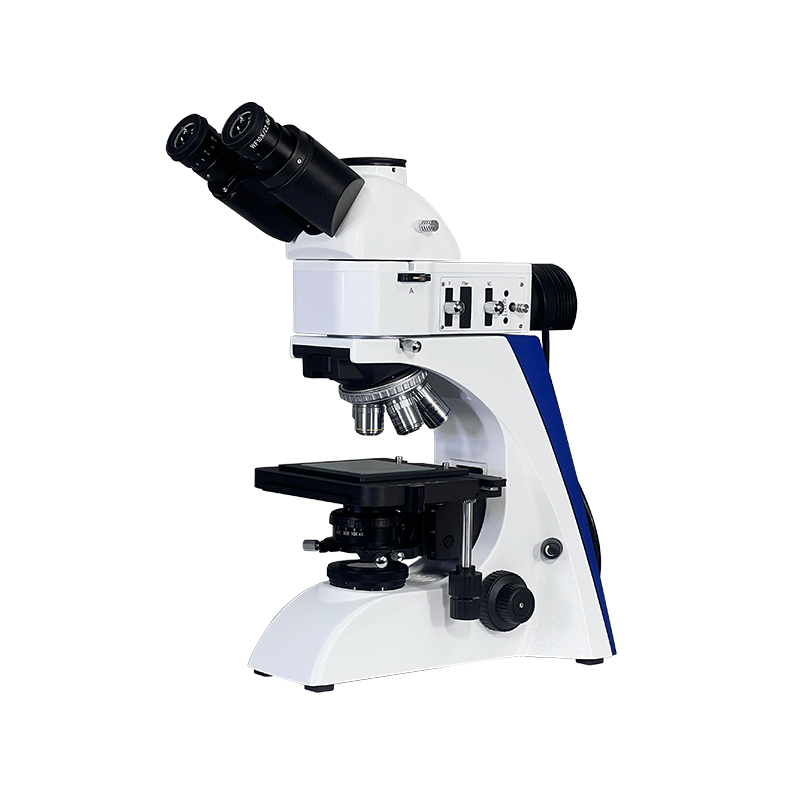
| Laboratory research and phase-contrast observation | BK5000, BK5000-PH, BK6000TR, SMART-4 | Infinity optical system; plan or phase-contrast objectives; binocular or trinocular head |
| Inverted cell-culture and tissue observation | BDS400, BDS500 | Inverted design; LWD infinity phase-contrast objectives; culture-dish holder; long-working-distance condenser |
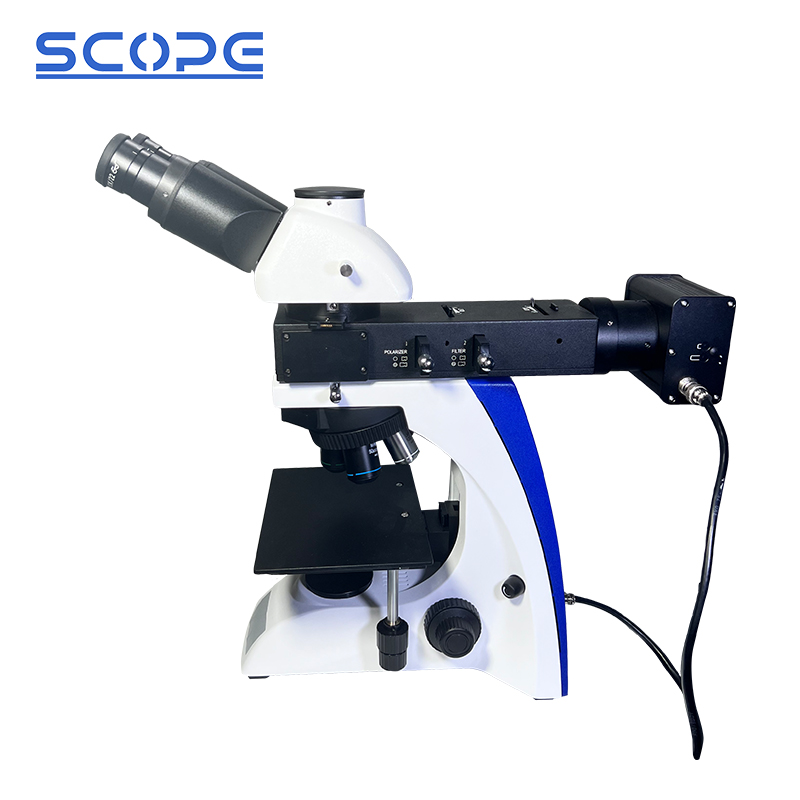
| Industrial inspection and metallography | MIT300, MIT500, MIT300D, MDS400 | Reflected illumination; LWD infinity plan objectives up to 50X; optional polarizer and analyzer; bright-field/dark-field versions |
| Geology, mineralogy, and materials science | BK-POL, BK-POLF, SMART-POL | Polarizing microscope design; rotating round stage; analyzer; compensator slips; non-stress objectives |
| Low-magnification industrial assembly, textiles, and gross inspection | SZ810 | Stereo microscope design; zoom objective range 0.65X to 5.3X; long working distance of 110 mm |
Step-by-Step Document and Specification Check Before You Commit
For buyers who are comparing multiple suppliers, the following workflow reduces the risk of a mismatch between the quotation and the actual microscope delivered.
- Define the sample and the workflow first. A laboratory that examines stained blood smears needs a different configuration from a lab that inspects metal fracture surfaces. The observation mode, specimen size, contrast requirement, and camera requirement should come before the model number.
- Choose the microscope family. Once the workflow is clear, select the family likely to handle it. Bright-field biological microscopes are intended for transparent specimens on glass slides. Inverted microscopes are mainly for cell-culture vessels. Metallurgical microscopes use reflected illumination for opaque materials. Polarizing microscopes are designed for birefringent materials such as minerals, crystals, and some polymers.
- Request certificates by exact model. Send the supplier the model list and ask for product-level CE or RoHS certificates that reference those models or the relevant series scope. Record the certificate number, issuing body, applicable standard, and market.
- Compare the full optical path, not just the total magnification. Check head type, eyepiece field number, objective set, nosepiece capacity, condenser, stage size, focusing mechanism, and light source. For example, a microscope with a 1000X printed maximum magnification may still be unsuitable for metallography if the reflected illumination path is absent.
- Align commercial constraints with project scale. If private labeling is needed, confirm that the supplier supports OEM logo customization. The capability description of Chongqing Scope includes OEM logo customization, a minimum order quantity of one unit, a monthly production capacity of about 3,000 units, and an approximate lead time of 15 days after the order is confirmed. The company also states that quality inspection is performed in the factory before dispatch.
- Plan a pilot order or a first controlled shipment. A pilot order allows the purchaser to inspect the actual certificate folder, verify packaging, check the finish quality, and test the instrument with real samples before scale-up.
Use Case: A 30-Unit Microscope Order for School Teaching
A documented case from Chongqing Scope involves a distributor in Romania that purchased 30 microscope units for school-teaching use. The order was built on an OEM arrangement, and the recorded outcome describes stable operation over a two-year period.
This case is useful because it shows what a distributor order looks like in practice. The buyer selected a teaching-appropriate microscope family, used an OEM configuration for branding, and then scaled the order to a batch quantity. For a purchasing manager, the practical takeaway is that a school project can remain straightforward only when the specification matches the teaching application and the related documents follow the same model identity as the goods.
Frequently Asked Questions
1. Is a company ISO certificate enough to show that a microscope is compliant with an EU market requirement?
No. ISO9001, ISO14001, ISO45001, and ISO13485 are management-system certificates. They describe how the company manages quality, environment, safety, and medical-device-related systems. They do not prove that a particular microscope model complies with an EU product-level standard. Buyers should ask for product-level documents such as CE and RoHS certificates, and verify the model, certificate number, standard, and issuing body.
2. Which CE and RoHS certificates are available for Chongqing Scope microscopes?
The B301 product is covered by CE certificate BKC22072376GC, issued by BKC for the EU market, under standard EN 61010-1:2010+A1:2019. The BK5000-PH Phase Contrast Microscope is covered by CE certificate BKC22072375GC, issued by BKC for the EU market, under standard EN IEC 61326-1:2021; that certificate also carries a scope line referencing multiple series families. The B203 product is covered by RoHS certificate BKC-191103261C, issued by BKC for the EU market, under standard IEC 62321-4:2013+A1:2017.
3. Which microscope configuration is most practical for a school teaching laboratory?
For secondary schools and many undergraduate teaching laboratories, a bright-field biological microscope with 4X, 10X, 40X, and 100X objectives, a mechanical stage, an Abbe N.A.1.25 condenser, and LED illumination is a practical configuration. In the Chongqing Scope portfolio, monocular and binocular models such as the B104 and SMART-2 are entry-level biological options, and the B301 is a binocular bright-field biological microscope with a clear specification sheet for teaching-oriented laboratory work.
4. Can a microscope be customized with an OEM logo for a small order?
According to the supplier capability description, Chongqing Scope offers OEM logo customization. The stated minimum order quantity is one unit, and the monthly production capacity is approximately 3,000 units. Customization can be organized after the technical verification of the order is completed, and either logo printing or a specially customized logo label can be applied to the instrument.
5. What lead time and after-sales service should a buyer expect?
The published capability information lists an approximate production lead time of 15 days for OEM production, subject to order confirmation. Export packaging is prepared according to export standards, usually in cardboard or wooden boxes and without visible logos. The stated after-sales service includes a one-year warranty and online support, and export-related documents such as those needed for customs clearance can be provided where applicable.
Conclusion: Turn a Specification Sheet into a Confirmation Question List
A microscope data sheet should not be read like a marketing brochure. It should be read as a technical contract between the supplier and the buyer. The certificate layer tells you which market requirements are addressed and which models are covered. The specification layer tells you what the microscope can do with real samples in daily use.
For a distributor, lab manager, or institutional buyer, the final step is simple. Write down the intended application, select the microscope family, and ask the supplier to confirm the model, the certificate details, and the full optical configuration before issuing a purchase order.
Request a specification pack or quotation from Chongqing Scope Instrument Co., Ltd.
If you need a product brochure or want to verify a certificate for a specific microscope model, download the company brochure below or contact the export team directly.
Download Chongqing Scope Product Brochure
Email: [email protected]
Tel / WhatsApp: +86 15223521781
Have Questions or Need More Details?
Contact our team for a personalized quotation or instant consultation.
Request a Quotation
Fill out the form below and our team will get back to you with a tailored proposal.
WhatsApp Direct Chat
Prefer to chat in real-time? Message us on WhatsApp for instant assistance & quick answers.
- Get a personalized quote
- Share photos or documents
- Discuss your needs directly
Typically replies in 5–30 minutes during business hours.