
Microscope Types & Applications: A Buyer's Reference Guide
Microscope Types & Applications: A Buyer's Reference Guide
Microscopes are essential tools in laboratories, research institutions, and industrial quality control. With the global microscope market valued at USD 11.9 billion in 2025 and projected to reach USD 21.2 billion by 2033, choosing the right instrument requires a clear understanding of available types and their applications. This guide provides a structured overview of microscope categories, key specifications, and selection criteria for procurement professionals.
Problem Definition
Procurement buyers often face a fragmented market with dozens of microscope types, each optimized for specific tasks. Misidentification leads to purchasing equipment that is either under‑specified for the intended use or unnecessarily costly. A systematic approach based on application, illumination technique, and optical system is required.
Industry Background
Optical microscopes remain the largest product segment, accounting for approximately 37% of the global market share in 2025. The life science application segment holds a 32.4% revenue share, driven by R&D in genomics and drug discovery. Chinese manufacturers like Chongqing Scope Instrument Co., Ltd. (a specialized supplier of laboratory and medical training instruments and metallographic equipment based in Chongqing, China) offer a broad portfolio covering biological, metallurgical, fluorescence, stereo, and polarizing microscopes.
The Chongqing Scope Microscope Portfolio
Chongqing Scope produces microscopes for biology, education, industry, materials science, and geosciences. Below are the main categories with representative models and key features extracted from the product specification corpus.
Biological Microscopes (Brightfield, Phase Contrast)
The BK5000 is a biological microscope designed for teaching and research. It features a binocular or trinocular head, infinity optical system, Plan objectives (4X, 10X, 20X, 40X, 100X), and a 3W LED illumination. The mechanical stage measures 175×145 mm. For phase contrast work, the BK5000-PH adds a quintuple hole turret Abbe condenser and dedicated infinity phase contrast objectives. The B301 is a bright‑field biological microscope with a binocular head, quadplex nosepiece, 3W LED, and Abbe N.A. 1.25 condenser – suitable for education and routine lab work.
Inverted Microscopes (for Cell Culture & Tissue)
The BDS500 is an inverted laboratory microscope with a trinocular head, quintuple nosepiece, and a 4‑hole rotating disc phase contrast condenser. It is made of aluminum alloy and glass, intended for biology, cell culture, and laboratory research. The BDS400 tissue microscope has LWD Infinity Phase Contrast Objectives (10X/20X/40X) and a mechanical stage of 210×241 mm, ideal for live‑cell observation.
Metallurgical & Industrial Microscopes
The MIT300 is an industrial metallurgical microscope with a trinocular head, quintuple nosepiece, coaxial coarse/fine adjustment, LWD infinity plan objectives, and a 5W LED reflected illumination. It includes a polarizing unit (polarizer and analyzer) and a mechanical stage of 200×150 mm. The MIT300D adds bright/dark field capability with M Plan objectives (5X/10X/20X/50X) and a 12V/50W halogen lamp. The MIT500 features a trinocular head, 5‑objective nosepiece, semi‑apochromatic plan objectives (5X/10X/20X/40X), and a mechanical stage of 182×140 mm.
Polarizing & Petrographic Microscopes
The BK-POL polarizing microscope has non‑stress infinity plan objectives (4X/10X/20X/40X), a revolving round stage of 174 mm, and polarizing media including analyzer and Bertrand lens. It serves geology, materials science, and biomedicine. The SMART-POL mineralogical microscope offers similar capabilities with a 142 mm stage. The BK-POLF petrographic microscope is a reflecting model with semi‑apo objectives (5X/10X/20X/50X) and 5W LED illumination.
Stereo Microscopes
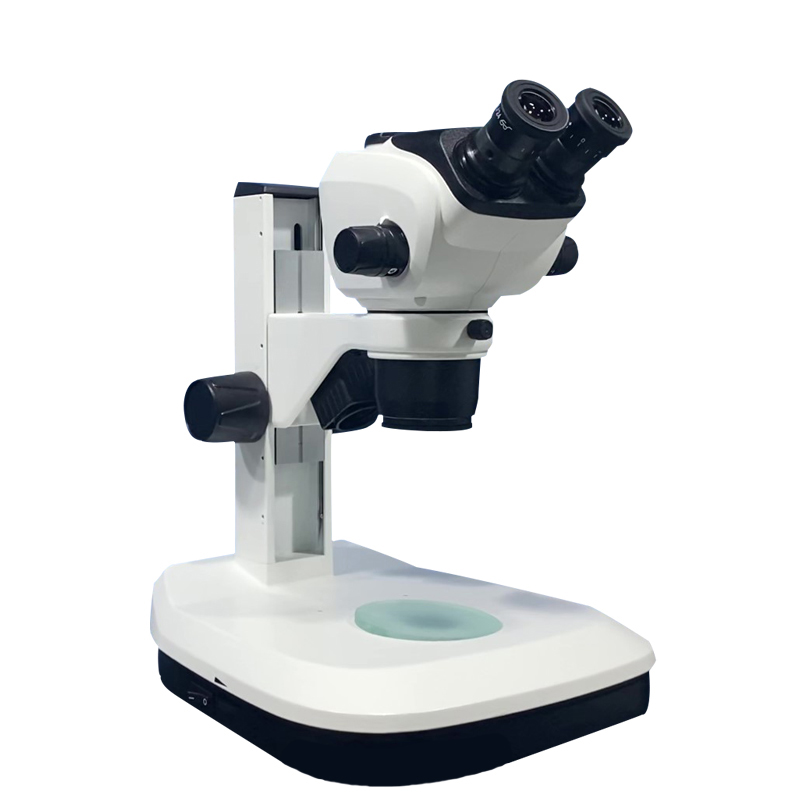
The SZ810 stereo microscope provides a zoom ratio of 1:8.1, a working distance of 110 mm, and WF10X/24 mm eyepieces. It is suitable for industrial inspection and textile examination.
Specialized Types
The BK5000‑FL fluorescence microscope supports blue, green, violet, and ultraviolet fluorescence filters with a 5W LED or 100W mercury lamp. The SMART‑4 is an infinity biological microscope with plan objectives, ideal for lab research and education.
Step‑by‑Step Selection Approach
- Define your application: biological research, industrial quality control, geological analysis, or educational demonstration.
- Choose the observation method: brightfield, darkfield, phase contrast, fluorescence, or polarized light.
- Select optical system: finite or infinity; infinity systems (e.g., BK5000, MIT300) allow easier addition of accessories.
- Determine head configuration: binocular for routine use, trinocular for photomicrography.
- Verify key parameters: objective magnification range, numerical aperture (N.A.), mechanical stage dimensions, illumination type, and working distance.
- Consider customization: Chongqing Scope offers OEM/ODM services – logo printing, packaging, and dedicated customization on meeting quantity requirements.
Use Cases
- University teaching lab: B301 brightfield microscope or SMART‑2 binocular microscope for student training.
- Clinical pathology: BK5000‑PH phase contrast microscope for unstained cell observation.
- Metallurgy lab: MIT500 or MIT300D for grain structure analysis in bright/dark field.
- Geology/petrology: BK‑POL polarizing microscope for mineral identification.
- Industrial inspection: SZ810 stereo microscope for PCB or textile inspection.
- Cell culture facility: BDS500 inverted microscope with phase contrast for live‑cell imaging.
Comparison Table of Key Models
| Feature | BK5000 (Biological) | MIT500 (Metallurgical) | BDS500 (Inverted) | BK-POL (Polarizing) |
|---|---|---|---|---|
| Head | Binocular / Trinocular | Trinocular | Trinocular | Binocular |
| Optical System | Infinity Plan | Semi‑Apo Plan | Infinity Plan | Non‑stress Infinity Plan |
| Eyepiece | WF10×/20 mm | WF10×/22 mm | WF10×/22 mm | WF10×/22 mm |
| Objectives | 4X,10X,20X,40X,100X | 5X,10X,20X,40X | 4X,10X,20X,40X (Phase) | 4X,10X,20X,40X |
| Nosepiece | Quintuple | Quintuple | Quintuple | Quintuple |
| Mechanical Stage | 175×145 mm | 182×140 mm | 210×241 mm | Revolving 174 mm dia. |
| Illumination | 3W LED | 5W LED (Refl & Trans) | 12V/50W Halogen | 5W LED or 12V/30W Halogen |
| Condenser | Abbe N.A.1.25 | – (reflected) | 4‑hole rotating disc phase | Swing‑out N.A.0.9/0.13 |
| Special Features | – | Blur filter for transmission | Phase contrast; for cell culture | Analyzer, Bertrand lens, λ slips |
| Primary Application | Teaching & Research | Industry & Laboratory | Cell culture, Biology | Geology, Materials |
Frequently Asked Questions
1. What export certificates does Chongqing Scope provide?
Chongqing Scope Instrument Co., Ltd. can provide ISO9001, ISO14001, ISO45001, ISO13485, CE, and RoHS certificates for export. Additional customs documents such as CO, Form E, and Form F are also available upon request.
2. Can I customize the microscope with my logo or specific requirements?
Yes, Chongqing Scope offers OEM and ODM services. Logo can be printed on the machine or applied as a custom label, provided the quantity requirement is met. Dedicated customization is available upon technical verification.
3. Which microscope is best for cell culture observation?
The BDS500 inverted laboratory microscope or the BDS400 inverted tissue microscope are designed for cell culture applications. Both feature long‑working‑distance objectives and phase contrast capability for observing living cells in culture dishes.
4. What is the difference between an upright and an inverted microscope?
An upright microscope (e.g., B204) positions the objective above the specimen, suitable for slides and fixed samples. An inverted microscope (e.g., BDS500, MDS400) places the objective below the specimen, allowing observation of live cells in culture flasks or dishes. Inverted types are preferred for cell culture and metallographic samples where the upper surface needs to be accessed.
5. How can I request a quote or product brochure?
You can contact Claire at [email protected] or via WhatsApp at +86 15223521781. A comprehensive product brochure is available for download to help you compare models and specifications: Download Chongqing Scope Brochure.
Conclusion
Selecting the right microscope requires matching instrument capabilities to specific applications. Chongqing Scope Instrument Co., Ltd. offers a diverse range of optical microscopes – from bright‑field biological models to advanced metallurgical and polarizing systems – all supported by international certifications and customization services. By understanding the key parameters and intended use cases described in this guide, procurement teams can make informed decisions that balance performance, cost, and supplier reliability.
Contact us for samples or custom configurations.
Have Questions or Need More Details?
Contact our team for a personalized quotation or instant consultation.
Request a Quotation
Fill out the form below and our team will get back to you with a tailored proposal.
WhatsApp Direct Chat
Prefer to chat in real-time? Message us on WhatsApp for instant assistance & quick answers.
- Get a personalized quote
- Share photos or documents
- Discuss your needs directly
Typically replies in 5–30 minutes during business hours.