
Ranked Manikin Models for Clinical Skills Training: CPR, Injection, Puncture & Nursing Picks
Ranked Manikin Models for Clinical Skills Training: CPR, Injection, Puncture & Nursing Picks
A clinical skills manikin earns its place in a curriculum by reproducing the landmark the trainee must find, returning a measurable signal when the technique is right or wrong, and remaining repairable when the skin, lung sac or marrow cavity wears out. This article ranks eleven models from the Chongqing Scope medical manikin range by those three constraints — instrumented feedback depth, anatomical specificity and curriculum coverage — and organises them by the clinical training need each one serves.
The five highest-ranked picks cover the skills that dominate medical and nursing skills labs: infant CPR, IV injection and vascular access, thoracic puncture with closed drainage, obstetric examination and delivery, and airway intubation. Six further picks extend coverage into full-function nursing, pediatric care, bone-marrow puncture, intramuscular injection, and anatomy teaching. Every specification below is taken from the manufacturer's published product data, and the ranking order is explained in full so that a procurement team can re-weight it against its own accreditation requirements.
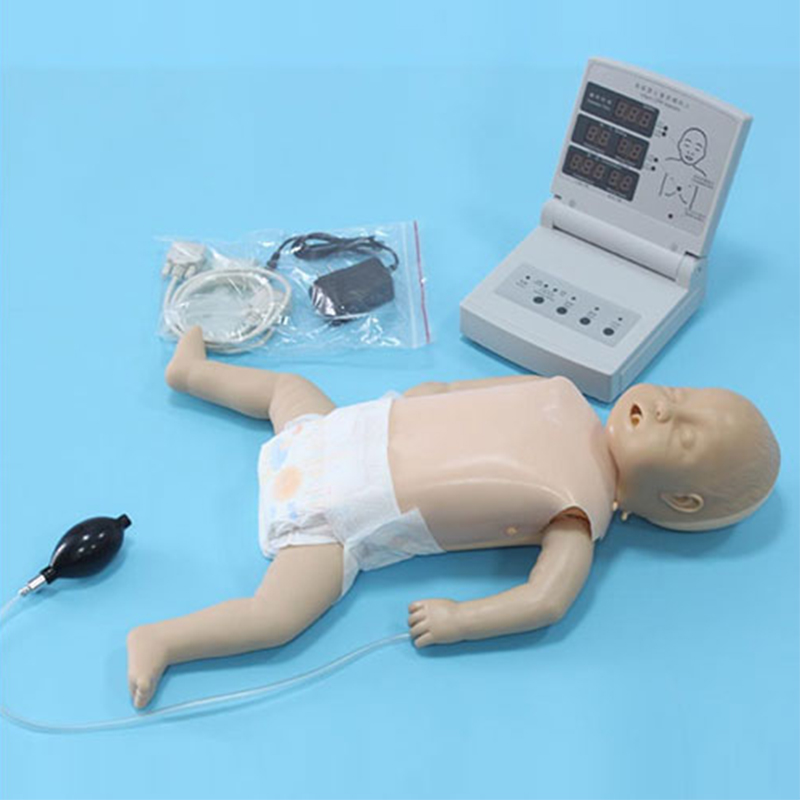 SC-CPR160 Infant CPR Manikin — ranked first in this list for instrumented infant compression and ventilation feedback.
Why Manikin Selection Is a Constraint Problem, Not a Catalogue Choice
Training institutions rarely fail to buy a manikin. They fail to buy the right constraint set. Four recurring failure modes explain most mismatched purchases.
- Landmark mismatch. A general nursing manikin cannot demonstrate the ischial spine station changes required for cervical assessment, and a torso model cannot teach knee arthrocentesis positioning. The model must contain the anatomy the procedure depends on.
- Missing feedback loop. Passive bodies let a trainee rehearse an error indefinitely. Where the skill has a numeric threshold — compression depth, tidal volume, compression-to-ventilation ratio — the model either measures it or the instructor must.
- Unplanned consumables. Replaceable lung sacs, changeable vein and skin components, and replaceable marrow cavities determine the real operating cost of a skills lab. Buying a model without a replacement path converts a teaching asset into a display item.
- Incomplete compliance file. Institutional and export procurement increasingly asks for a documented quality management system rather than a product photo.
Each ranked pick below is assessed against these four constraints using only documented product data.
Industry Background: Simulation Training Is Becoming a Compliance Requirement
Medical simulation is no longer an optional teaching aid in many markets. The global medical simulation market was valued at USD 1.9 billion in 2025 and is projected to reach USD 6.7 billion by 2033, according to Grand View Research. Healthcare anatomical models, the category that includes medical manikins, held the largest share of that sector at approximately 41.4% in 2025, also per Grand View Research.
Regional demand is uneven, which matters for buyers planning multi-site rollouts. North America dominated the healthcare simulation market in 2024 with a revenue share of approximately 45–48%, based on Precedence Research and WiseGuyReports figures. Asia-Pacific is the fastest-growing region, with an expected CAGR of 18.2% through 2033 according to Grand View Research. On the volume side, Global Insight Services estimated the training manikins market at 1.2 million units in 2024, with projections to reach 2 million units by 2028.
Regulation is tightening alongside demand. Market Research Future reports that China's National Medical Commission mandated simulation labs for the accreditation of all new medical schools as of 2024–2025. That requirement pulls hardware purchases into the accreditation timeline rather than the discretionary budget cycle.
Market size estimates vary by scope — some published figures include software and services while others cover hardware manikins only — so buyers should treat any single figure as directional. The competitive landscape is also concentrated at the premium end: major global competitors in the medical manikin and simulation market include Laerdal Medical, CAE Inc., Gaumard Scientific and Kyoto Kagaku, as identified by MarketsandMarkets.
One standard anchors the compliance side of procurement regardless of vendor. ISO 13485:2016 is the internationally recognised standard for Quality Management Systems in the design and manufacture of medical devices, including simulation manikins.
How This Ranking Was Built
This is an editorial ranking of one manufacturer's documented manikin range, not a market ranking of suppliers. Models are ordered using four weighted criteria:
- Instrumented feedback. Does the model return a measurable, real-time signal (digital count, indicator light, alarm, electronic display, printed report) rather than relying on instructor observation?
- Anatomical specificity. Does the specification name the landmarks, layers or structures required to perform and assess the target procedure?
- Curriculum coverage. How many required skills does one unit support before a second purchase becomes necessary?
- Serviceability. Does the specification document replaceable or changeable parts?
Models with instrumented feedback and named landmarks rank above general-purpose bodies, because they reduce instructor workload and produce assessment records. Cost is not used as a ranking input, since no vendor-listed prices are part of the documented data; cost drivers are discussed separately in the FAQ.
The Ranked Picks: Eleven Manikin Models by Clinical Training Need
#1SC-CPR160 Infant Manikin — Infant CPR and Basic Life Support
Training need: infant CPR, where the acceptable compression and ventilation thresholds differ from adult protocols and must be taught with numeric precision.
SC-CPR160 ranks first because it combines infant-specific compression thresholds with three simultaneous feedback modes — digital counting display, indicator light display and voice prompts.
- Simulated standard airway opening display.
- Compression feedback: correct compression intensity is displayed for the ≥4 cm area, and incorrect intensity for the <4 cm area, with indicator light and error alarm, real-time digital count, and a voice prompt naming the specific cause of the error.
- Ventilation feedback: insufflated tidal volume is accurately displayed between 30 ml and 50 ml with an indicator light and real-time digital count; a tidal volume below 30–50 ml triggers indicator light and alarm; ventilation that is too fast or too large causes gas to enter the stomach, which triggers indicator light display, alarm and a voice prompt naming the error.
- Compression-to-respiration ratio: 30:2 for single-rescuer or 15:2 for double-rescuer operation, run as five cycles of 30:2.
- Operating frequency: 2020 international standard of at least 100–120 compressions per minute.
- Operation modes: training operation and assessment operation.
- Hand-bulb squeezing simulates brachial artery pulsation for pulse-check training.
- Power: 220 V supply, regulated to 5 V output.
Standard configuration: advanced infant CPR model (1), high-end computer digital monitor (1), hard plastic body case (1), CPR barrier mask (50 sheets per box), four replaceable lung sac sets, 2020 international operation guide CD (1), first aid manual (1), instruction manual (1), and warranty card with certificate of conformity.
#2SC-J5S Intubation Model — Airway Management and Endotracheal Intubation
Training need: oral and nasal endotracheal intubation, including the two silent failure modes that cause the most harm — oesophageal placement and laryngoscope pressure on the teeth.
- Alarm prompt for tooth pressure caused by improper force during endotracheal intubation.
- Supports training operations and teaching demonstrations of oral and nasal tracheal intubation.
- Correct airway insertion triggers electronic display and music playing functions; air supply expands both lungs, and air injected into the tube air bag fixes the tube.
- Incorrect oesophageal insertion triggers electronic display and alarm, and the air supply causes the stomach to expand — giving the trainee a visible consequence rather than a verbal correction.
- Incorrect operation that causes the laryngoscope to press on the teeth triggers an electronic alarm.
- One pupil is normal and the other dilated for observation and comparison.
- The cricothyroid membrane puncture site is indicated.
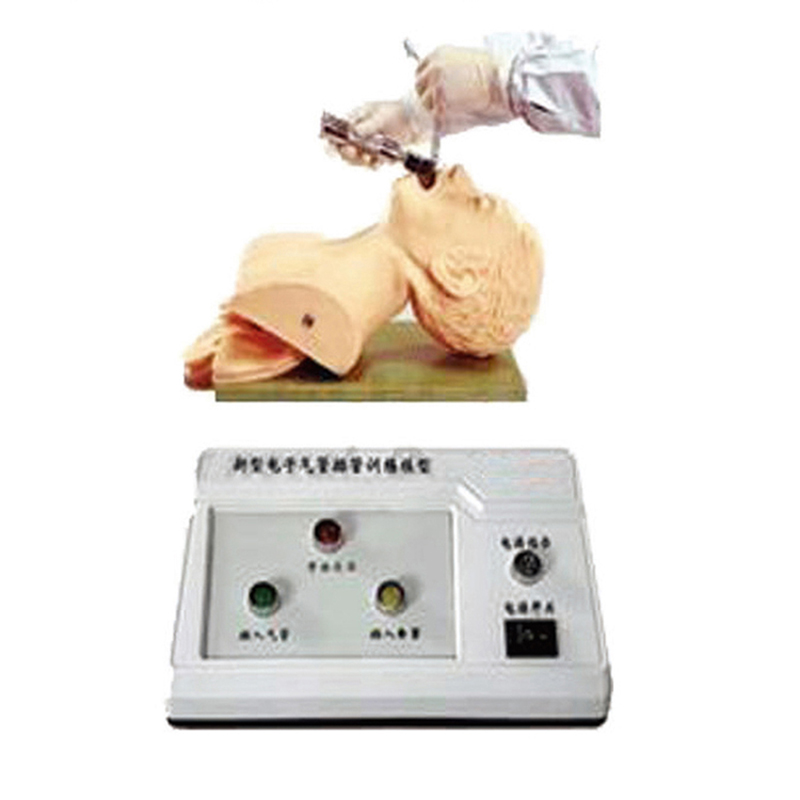 SC-J5S Electronic Human Tracheal Intubation Training Model — electronic display plus alarms for correct airway placement, oesophageal misplacement and laryngoscope tooth pressure.
#3SC-HS4 IV Injection Model — Venipuncture, Injection and Vascular Access
Training need: venipuncture, IV injection and infusion technique with immediate confirmation that the needle has entered the vessel.
- Electronic alarm device for arm puncture training.
- During puncture, an electronic message prompts that the needle has correctly penetrated into the blood vessel.
- During puncture, an electronic alarm prompts when the needle pierces the blood vessel.
- Construction: skin and muscles in imported thermoplastic elastic mixed rubber materials; nerves and blood vessels in imported latex materials; inner bones and joints of the arms in imported PVC, cast from metal moulds at high temperature, with the outer skin surface modelled on a real reference.
- Stated material behaviour: realistic operating feel, no deformation after disinfection and cleaning, and easy disassembly and replacement.
Standard configuration: standard hand model (1), electronic monitor (1 set), 5 ml infusion set (1 pair), instruction manual (1).
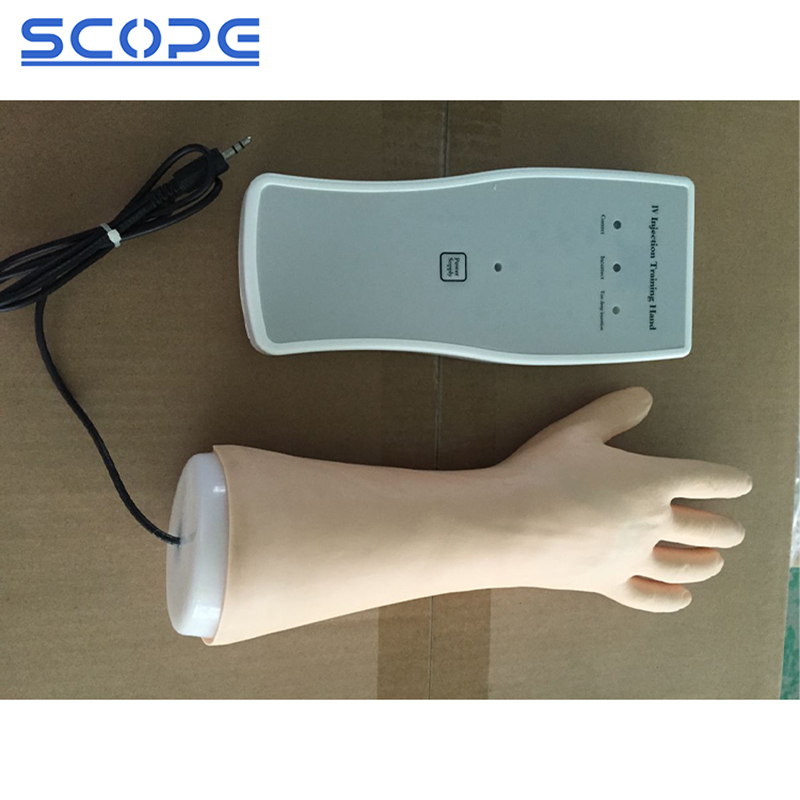 SC-HS4 IV Injection Model — electronic monitor and alarm confirm correct vessel penetration during arm puncture practice.
#4SC-L66 Puncture Manikin — Thoracic Puncture and Closed Drainage
Training need: pneumothorax puncture decompression, hydrothorax intubation and drainage after chest trauma, and post-operative drainage tube care.
- Supports closed drainage operation training for pneumothorax and hydrothorax after chest trauma, plus post-operative care practice for drainage tubes.
- Two windows on the right side of the chest display the anatomical structures of each chest layer, so the trainee can see what the needle path crosses.
- Pneumothorax puncture decompression and hydrothoracic intubation and drainage exercises are performed on the left thorax.
- The colour, volume and viscosity of the chest drainage fluid can be adjusted by the instructor.
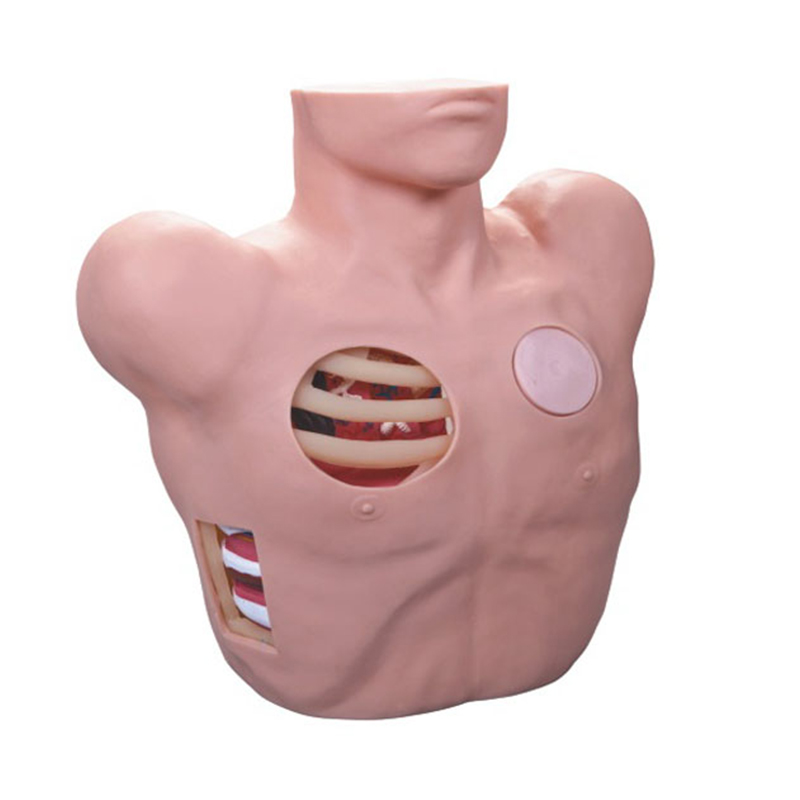 SC-L66 Thoracentesis and Drainage Model — chest windows expose layered anatomy while the left thorax accepts puncture and drainage procedures.
#5SC-F50 Gynecology Manikin — Obstetric Examination and Delivery
Training need: cervical assessment, labour progress documentation and normal delivery mechanics for basic obstetric technical training.
- Comprises a simulated lower-body model of a pregnant woman together with two fetus models, an attached umbilical cord and a placenta.
- Cervical examination model documents six stages: stage 1, cervix not dilated, cervical canal not effaced, fetal head at −5 relative to the ischial spine plane; stage 2, 2 cm dilation with 50% effacement, station −4; stage 3, 4 cm dilation with the canal completely disappeared, station −3; stage 4, 5 cm dilation, station 0; stage 5, 7 cm dilation, station +2; stage 6, 10 cm dilation, station +5.
- Fetal model: soft standard-fetus skin, identifiable fontanel, and fetal head suction technique can be practised; umbilical cord and placenta are supplied as fetal accessories.
- Childbirth model: the perineum is soft and extremely elastic, allowing midwifery operations to be simulated under realistic conditions, and perineal care techniques can be practised.
- The abdomen consists of a transparent abdominal wall and simulated skin, making it easy to demonstrate delivery and observe the positional relationship between the fetal head and the ischial spine plane.
#6SC-H130A Nursing Manikin — Full-Function Nursing Care
Training need: a single bench unit that covers a nursing skills checklist end to end, so a lab does not need a different body for each station.
The documented feature list covers 21 skills and structures: hair and face washing; eye and ear washing and administering; mouth cavity and artificial teeth care; endotracheal intubation; tracheotomy care; sputum suction; oxygen inhaling; oral and nasal feeding; gastrolavage; main organs in the thoracic cavity; venipuncture, injection and blood transfusion at the arm; deltoid subcutaneous injection; vastus lateralis injection; thoracic cavity, abdominal cavity, liver, bone marrow and lumbar puncture; enema; female and male urethral catheterisation; female and male bladder irrigation; ostomy; buttocks intramuscular injection; main organs in the abdominal cavity; and holistic nursing care including sponge bath and replacing clothes.
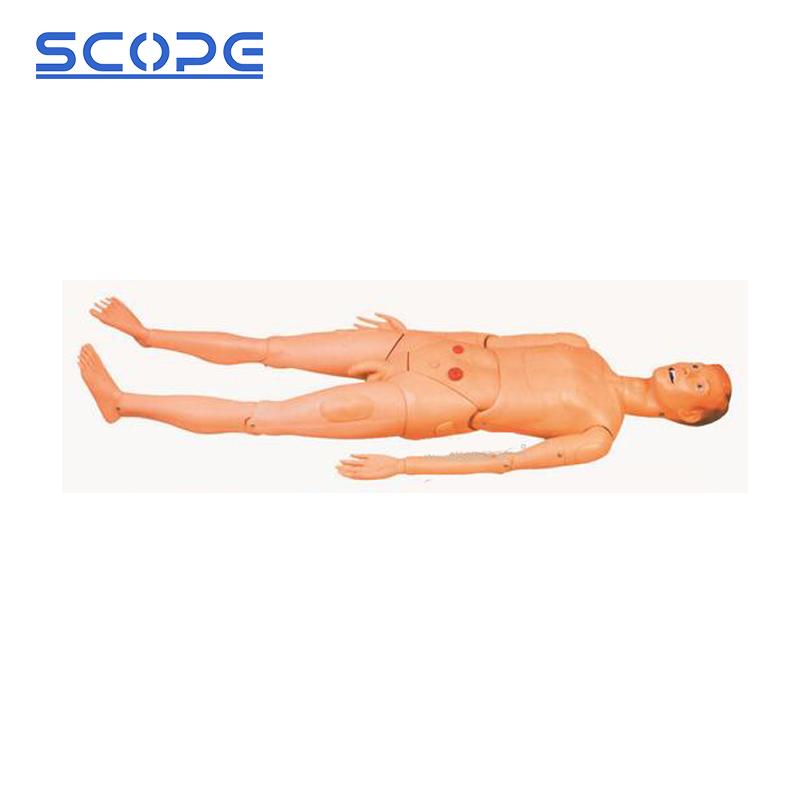 SC-H130A Nursing Manikin — one unit covering 21 documented nursing skills, from airway care to catheterisation and intramuscular injection.
#7SC-H140 Pediatric Training Model — Infant and Pediatric Care
Training need: pediatric nursing and emergency care, where scale and handling differ substantially from adult manikins.
- The baby's head, neck and limbs move freely, and the chest skin of a baby boy or baby girl can be replaced.
- Infant cephalic vein puncture and baby umbilical cord venipuncture.
- Infant oral and nasal intubation care.
- Gastric lavage, enema and catheterisation.
- Ostomy drainage.
- Deltoid and gluteal muscle injections.
- Overall care: bathing, breastfeeding, changing clothes and diaper changing.
#8SC-CK817 Clinical Manikin — Bone-Marrow Puncture and Landmark Training
Training need: landmark identification and puncture procedures that depend on palpation accuracy.
- The simulated standardised patient is placed in the supine position, with soft texture, real touch and lifelike appearance.
- Accurate anatomical landmarks — the suprasternal notch, the upper edge of the sternal manubrium and the anterior superior iliac spine — can be clearly palpated, which facilitates puncture positioning.
- Anterior superior iliac spine puncture training and sternal manubrium puncture training are both possible; the simulated bone marrow cavity can be penetrated with an obvious hollow feeling, and bone marrow can be extracted.
- The skin and simulated bone marrow cavity can be easily replaced.
#9SC-H4T Training Mannequin — Intramuscular Injection and Gluteal Anatomy
Training need: safe intramuscular injection technique taught against real anatomical references rather than a plain pad.
- The documented anatomical structure includes the proximal femur, greater trochanter, anterior superior iliac spine, posterior superior iliac spine and sacrum.
- The left buttock quarter is removable, allowing direct observation of the gluteus medius muscle, gluteus maximus muscle, sciatic nerve and vascular structures.
- Three intramuscular injection approaches can be trained: dorsal gluteal, ventral gluteal and lateral approaches.
- Material: imported plastic elastomer, produced by stainless steel mould injection and sintered at high temperature for durability and resistance to visible needle traces.
#10SC-A1041 Torso Model — Anatomy and Organ Relationships
Training need: classroom anatomy teaching where organ position and spatial relationships must be demonstrated and disassembled.
- Spine exposed outside the trunk, with a section of the spine removable, a female chest cap, interchangeable male and female reproductive organs, and a fetus in the female uterus.
- Divides into 23 pieces: trunk, female chest cover, head, eyeball, brain, spinal nerve, lungs (2 pieces), heart (2 pieces), liver, kidney, stomach (2 pieces), intestine (4 pieces), male reproductive organs (2 pieces) and female reproductive organs with fetus (3 pieces).
- Made of PVC, placed on a plastic seat, 85 cm in size.
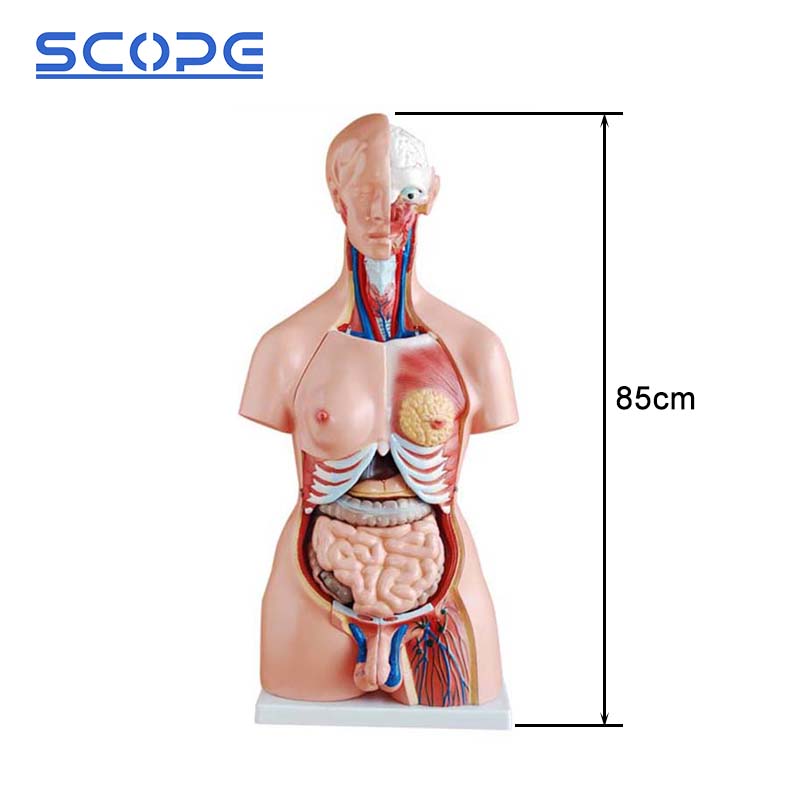 SC-A1041 Torso Model — 23 removable parts, 85 cm, with interchangeable reproductive organs and a removable spine section.
#11SC-A1025 Joint Model — Knee Joint Mechanics
Training need: teaching joint range of motion and the movement axes that puncture and examination procedures depend on.
- Shows knee flexion, extension and inward and outward rotation.
- Natural size, mounted on a plastic seat, 12 × 12 × 33 cm, made of PVC.
Also in the documentable range
Several further models extend the same constraint logic and are worth including in a lab specification, although they did not enter the ranked eleven because their feedback or coverage overlaps with a higher-ranked unit: the SC-CPR480 CPR Model (dynamic barcode indicator lights for compression depth in the 5–6 cm green band, under 5 cm yellow and over 6 cm red, tidal volume display across 500–1000 ml, thermal-printed score reports and simulated pupil and carotid responses), the SC-CPR100A Medical Manikin (basic adult CPR with airway opening, visible chest rise and fall and an alarm function), the SC-F55-1 Maternal Manikin (mechanical delivery transmission with four delivery-speed levels, fetal heart auscultation adjustable from 80 to 180, cephalic and breech presentation, umbilical cord around the neck and placenta previa simulation, plus pregnant CPR built to the 2020 international guidelines), the SC-HS3 Injection Model (arm injection and transfusion with blood flashback and changeable vein and skin), the SC-HL Medical Training Model (a wearable three-layer skin, subcutis and muscle pad for intradermal, hypodermic and intramuscular injection), the SC-CK20135 Training Manikin (knee arthrocentesis with tibia, collateral ligament, cruciate ligament, patellar ligament, fat pad, meniscus and synovial sac structures), the SC-A1010 Teaching Manikin (a natural-size adult skull in three parts), and the SC-J90 Medical Mannequin (a trauma assessment module documenting 17 injury configurations including burns, open fractures and amputation trauma).
Step-by-Step Breakdown: A Six-Step Shortlisting Workflow
Step 1 — Write the skill list before the model list. List every procedure a graduating cohort must be assessed on, then mark which of them require instrumented measurement. Skills with numeric thresholds (compression depth, tidal volume, compression-to-ventilation ratio) justify a powered model; purely observational skills usually do not.
Step 2 — Match the landmark, not the category. If the curriculum includes cervical assessment, the specification must name the ischial spine station changes; SC-F50 documents all six stages. If it includes knee arthrocentesis, the model must include the meniscus and synovial sac; SC-CK20135 documents those structures. Category labels such as "nursing manikin" do not guarantee landmark coverage.
Step 3 — Decide whether feedback must be instrumented. SC-CPR160, SC-CPR480, SC-CPR100A, SC-HS4, SC-J5S and SC-F55-1 all document electronic feedback, alarms or monitoring. Where a lab runs assessment rather than practice sessions, instrumented feedback removes the instructor as the recording device and produces a consistent record.
Step 4 — Verify the compliance file. Chongqing Scope Instrument Co., Ltd. holds ISO9001, ISO14001, ISO45001, ISO13485, CE and RoHS certifications. Because ISO 13485:2016 is the recognised quality management system standard for medical device design and manufacture, that certificate is the document most institutional buyers ask for first. Export clearance documents including CO, Form E and Form F can also be provided, and products ship in neutral export packaging.
Step 5 — Plan consumables and replaceables up front. Identify every documented replaceable part before ordering: replaceable lung sac devices and barrier masks on SC-CPR160, replaceable skin and simulated bone marrow cavity on SC-CK817, changeable vein and skin on SC-HS4, replaceable chest skin on SC-H140. Budgeting for them at the purchase stage avoids downtime later.
Step 6 — Confirm the commercial constraints. Stated production constraints are a minimum order quantity of 20 units, a lead time of 30–45 days, monthly capacity of 3,000 units, and a 1-year online warranty. If a lab rollout is tied to an accreditation date or a semester start, the lead time is the binding constraint, not the unit selection.
Use Cases: Matching Ranked Picks to Real Training Programs
Medical school skills lab. A core set built around SC-CPR160 for infant BLS, SC-CPR480 for adult BLS assessment, SC-J5S for airway management, SC-H130A for nursing skills and SC-A1041 for anatomy teaching covers the bulk of a preclinical and clinical skills curriculum from a small number of benches. The application profile for this range is medical school teaching for first aid training and medical education, operated manually.
Nursing college or vocational training centre. SC-H130A carries the widest documented skill list in the range; SC-HS4 and SC-HS3 cover vascular access with electronic and visual confirmation respectively, and SC-HL provides a low-cost wearable pad for high-repetition injection drills.
Emergency and first-aid training centre. SC-CPR160, SC-CPR480 and SC-CPR100A cover infant and adult resuscitation at three feedback levels, while SC-J90 adds a trauma assessment module for mass-casualty and pre-hospital scenarios.
Obstetrics and midwifery department. SC-F50 is the entry point for cervical assessment and normal delivery mechanics. SC-F55-1 extends the same teaching into mechanical delivery progression, fetal heart auscultation from 80 to 180, placental position simulation and pregnant CPR.
Distributor and OEM catalogue building. A distributor assembling a medical manikin catalogue needs coverage across categories rather than depth in one. Chongqing Scope Instrument Co., Ltd. is a supplier of laboratory and medical training instruments located in Chongqing, established in 2017, operating a 5,000 m² facility with more than 100 staff and an annual output of 30,000 units. One documented distributor engagement involved a medical manikin distributor in India ordering 500 units for medical teaching over a one-year period, with customized, durable models reported as operating stably. The company states OEM and ODM services including customization of product appearance and functions once quantity requirements are met and technical verification is complete, with logo printing on the machine or a customized logo label attached to the machine.
Export and logistics planning. With 50% of output exported to Europe, Southeast Asia, the Middle East, South America and Africa, packaging is prepared to export standards in neutral cardboard boxes or wooden boxes without logos, and clearance documents can be supplied on request. The documented application markets for this manikin range include the United Arab Emirates, Indonesia, Israel, India, Iraq, Laos and Malaysia.
Comparison Table: Eleven Ranked Manikin Models at a Glance
| Rank & Model | Primary Training Need | Documented Feedback / Key Feature | Material | Best-Fit Buyer |
|---|---|---|---|---|
| #1 SC-CPR160 | Infant CPR and BLS | Digital counting, indicator lights and voice prompts for compression intensity (≥4 cm band) and tidal volume (30–50 ml); 30:2 or 15:2; 100–120/min | PVC | Medical school, pediatric emergency training |
| #2 SC-J5S | Oral and nasal intubation | Electronic display and music on correct airway placement; oesophageal placement alarm with stomach expansion; laryngoscope tooth-pressure alarm | PVC | Anesthesiology and emergency skills lab |
| #3 SC-HS4 | IV injection and venipuncture | Electronic alarm and electronic confirmation message when the needle enters the vessel; 5 ml infusion set in standard configuration | Thermoplastic elastic mixed rubber, latex, PVC | Nursing college, infusion training |
| #4 SC-L66 | Thoracic puncture and closed drainage | Two right-chest windows showing each chest layer; left-thorax puncture and drainage; adjustable drainage fluid colour, volume and viscosity | PVC | Surgery, thoracic and trauma training |
| #5 SC-F50 | Obstetric examination and delivery | Six documented cervical stages from −5 to +5 station; two fetus models, umbilical cord and placenta; transparent abdominal wall | PVC | Midwifery and obstetrics department |
| #6 SC-H130A | Full-function nursing care | 21 documented skills including airway care, puncture, catheterisation, ostomy and intramuscular injection | PVC | Nursing school core bench unit |
| #7 SC-H140 | Pediatric and infant care | Cephalic and umbilical vein puncture; oral and nasal intubation care; deltoid and gluteal injection; replaceable chest skin | PVC | Pediatric nursing and neonatal care |
| #8 SC-CK817 | Bone-marrow and landmark puncture | Palpable suprasternal notch, sternal manubrium edge and ASIS; hollow-feel marrow cavity with marrow extraction; replaceable skin and cavity | PVC | Clinical skills assessment centre |
| #9 SC-H4T | Intramuscular injection | Removable left buttock quarter exposing gluteus medius, gluteus maximus, sciatic nerve and vessels; three injection approaches | Imported plastic elastomer | Nursing injection technique training |
| #10 SC-A1041 | Anatomy and organ relationships | 23 removable parts, 85 cm, removable spine section, interchangeable male and female reproductive organs, fetus in utero | PVC | Anatomy classroom, school teaching |
| #11 SC-A1025 | Knee joint mechanics | Knee flexion, extension and inward/outward rotation; natural size, 12 × 12 × 33 cm | PVC | Anatomy and physiotherapy teaching |
FAQ
What certifications should a medical training manikin supplier provide for institutional procurement?
Institutional procurement depends as much on the documentation set as on the product. Chongqing Scope Instrument Co., Ltd. holds ISO9001, ISO14001, ISO45001, ISO13485, CE and RoHS certifications. ISO 13485:2016 is the internationally recognised Quality Management System standard for the design and manufacture of medical devices, including simulation manikins, which makes it the certificate most commonly requested first. For cross-border orders, clearance documents such as CO, Form E and Form F can be provided, and products ship in neutral export packaging in cardboard boxes or wooden boxes without logos.
Which manikin models provide instrumented feedback instead of a passive body?
Six models in the documented range return measurable feedback. SC-CPR160 provides digital counting, indicator lights and voice prompts for infant compression intensity and tidal volume. SC-CPR480 provides dynamic barcode indicator lights for compression depth and tidal volume plus thermal-printed score reports. SC-CPR100A includes an alarm function for basic adult CPR. SC-HS4 uses an electronic alarm and an electronic confirmation message when the needle enters the vessel. SC-J5S uses electronic display and alarms for correct airway placement, oesophageal misplacement and laryngoscope tooth pressure. SC-F55-1 provides electronic monitoring of airway opening, number of breaths, breath volume, compression site, compression count and compression depth.
What drives the cost of a clinical skills training manikin?
Four documented cost drivers apply. First, instrumentation: electronic monitors, alarm panels and printing modules are components a passive body does not contain. Second, replaceable-part count: SC-CPR160 ships with four replaceable lung sac devices and a barrier-mask supply, SC-CK817 has replaceable skin and a simulated bone-marrow cavity, and SC-HS4 uses changeable vein and skin components. Third, material build: SC-HS4 specifies imported thermoplastic elastic mixed rubber for skin and muscle, imported latex for nerves and vessels, and imported PVC cast in metal moulds for inner bones and joints; SC-H4T uses imported plastic elastomer formed by stainless steel mould injection and high-temperature sintering. Fourth, configurability: SC-L66 allows drainage fluid colour, volume and viscosity to be adjusted, and SC-F55-1 offers four delivery-speed levels. Because no vendor-listed prices form part of the documented data, cost should be weighed against the number of curriculum skills each unit covers.
Can a training institution evaluate a manikin before committing to a bulk order?
Yes. Chongqing Scope Instrument Co., Ltd. states a minimum order quantity of 20 units for manikin orders and offers OEM and ODM services, including customization of product appearance and functions once the quantity requirement is met and technical verification is complete. Logo printing on the machine, or a specially customized logo label attached to the machine, are both available. Sample and technical enquiries can be sent to [email protected] or +86 15223521781.
What is the production lead time, capacity and after-sales coverage for manikin orders?
The stated lead time is 30 to 45 days, monthly capacity is 3,000 units, and after-sales support is a 1-year online warranty. Production runs in ODM mode with factory quality inspection as the stated quality-control step. If a lab rollout is tied to a semester start or an accreditation deadline, the next practical step is to send your skill list and required model quantities to [email protected] and request a configuration sheet together with the product catalogue, available at https://cdn.socialarks.com/sbsp/24782/common/2026/0512/6a02d2f8005e4.pdf.
Conclusion
Ranking clinical skills manikins is ultimately a ranking of constraints: does the model contain the landmark, does it measure the threshold, and can it be repaired. On those criteria, SC-CPR160 leads this list for infant resuscitation because it combines infant-specific thresholds with three simultaneous feedback modes and a complete standard configuration including four replaceable lung sacs. SC-J5S follows for airway management, where its oesophageal-placement alarm and laryngoscope tooth-pressure alarm address the two most dangerous silent errors. SC-HS4, SC-L66 and SC-F50 complete the top five by covering vascular access, thoracic drainage and obstetric assessment with documented landmarks and, in two cases, electronic feedback.
The remaining six picks are the coverage layer: SC-H130A for breadth across 21 nursing skills, SC-H140 for pediatric scale, SC-CK817 for palpation-dependent puncture, SC-H4T for anatomically referenced intramuscular injection, and SC-A1041 and SC-A1025 for classroom anatomy. A lab that selects against its own skill list rather than against a category label will usually find that three or four ranked picks carry most of the curriculum, with the rest filling defined gaps.
 SC-CK817 Clinical Skill Training Manikin — landmark accuracy and a replaceable marrow cavity for repeat puncture practice.
Build Your Manikin Specification
Send your skill list and target cohort size, and we will map it against the ranked models above with configuration sheets, model-level specifications and a quotation. Samples, OEM and ODM customization, and distributor pricing are all available from a minimum order quantity of 20 units, with a 30–45 day lead time and a 1-year online warranty.
Email: [email protected] | Tel / WhatsApp: +86 15223521781 | Website: www.cqscopelab.com
Download the full product catalogue: Chongqing Scope product brochure (PDF)
Have Questions or Need More Details?
Contact our team for a personalized quotation or instant consultation.
Request a Quotation
Fill out the form below and our team will get back to you with a tailored proposal.
WhatsApp Direct Chat
Prefer to chat in real-time? Message us on WhatsApp for instant assistance & quick answers.
- Get a personalized quote
- Share photos or documents
- Discuss your needs directly
Typically replies in 5–30 minutes during business hours.