
Manikin Materials & Build Methods: Injection, Puncture, CPR
Manikin Materials & Build Methods: Injection, Puncture, CPR
Material composition and construction method decide what a training manikin can be asked to do repeatedly. On an IV arm, the governing parameters are how the vein channel behaves after hundreds of needle entries and whether the vein and skin can be renewed before they leak. On a puncture model, they are landmark geometry, the depth and feel of the simulated tissue block, and how easily that block is replaced. On a CPR or airway model, the moulded shell matters far less than the sensor set, the feedback thresholds and the alarm logic built into it — a resuscitation manikin is specified by its display, not by its plastic.
This guide works through those parameters across injection, puncture and CPR/intubation models, using the published SC-series specifications of Chongqing Scope Instrument Co., Ltd. (Chongqing Scope), a Chongqing-based supplier of laboratory instruments and medical training manikins. The company states that its manikins are made of PVC and groups its medical training range into CPR, clinical and nursing categories. Where a named model's material or construction is not declared at model level, this guide marks the parameter as one to obtain in writing rather than assuming a value.
Why the PVC label tells a buyer almost nothing
A PVC label describes a polymer family, not a grade. Within that family a supplier can formulate a soft, highly plasticised compound for a skin or vessel component and a considerably more rigid compound for a torso shell, and both are correctly described as PVC. The properties a training buyer actually cares about — needle-entry resistance, leak behaviour after repeated puncture, surface texture, colour stability, tolerance of cleaning agents — follow from the compound, the wall thickness, the way the component is formed and whether it is replaceable. None of those follow from the four-letter label.
Chongqing Scope's stated position is that its medical manikins are made of PVC, and every model specification in this range that declares a material declares PVC: the SC-HS3 injection arm, the SC-J5S intubation model, the SC-CPR480 and SC-CPR100A CPR models, the SC-CK817 clinical manikin, the SC-H130A nursing manikin, the SC-A1041 torso model and the SC-F50 and SC-F55-1 maternal models included. That consistency has real procurement value. It means spare parts, repair practice, adhesives and cleaning routines transfer across a range built on one material system, which reduces the number of incompatible procedures a lab has to train its technicians on.
It does not tell you which compound sits in a deltoid pad, how thick a vein wall is, or what happens to a shoulder seam after two years of alcohol wipes. A workable selection rule follows: use the material label to filter a catalogue, then use four parameters to choose a model.
- What is replaceable, and at what interval. Every part a needle, blade or repeated compression destroys is a recurring cost and a training-continuity risk.
- Which feedback is mechanical and which is electronic. Blood flashback and hollow-feel landmarks are construction; compression depth zones and airway alarms are electronics. They fail differently and are maintained differently.
- How dimensional consistency is controlled between units. This is a tooling and process question, and it decides whether thirty units behave like one unit.
- What anatomical geometry is fixed by the shell. Palpable landmarks, viewing windows and airway routing are moulded in; they cannot be adjusted after delivery.
Injection models: the vein channel is the specification
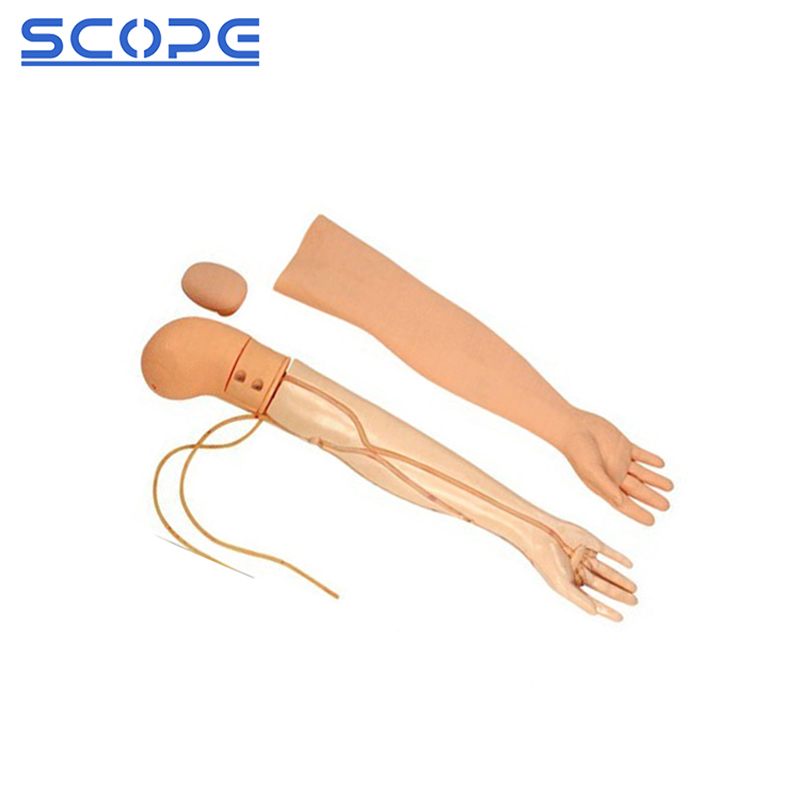
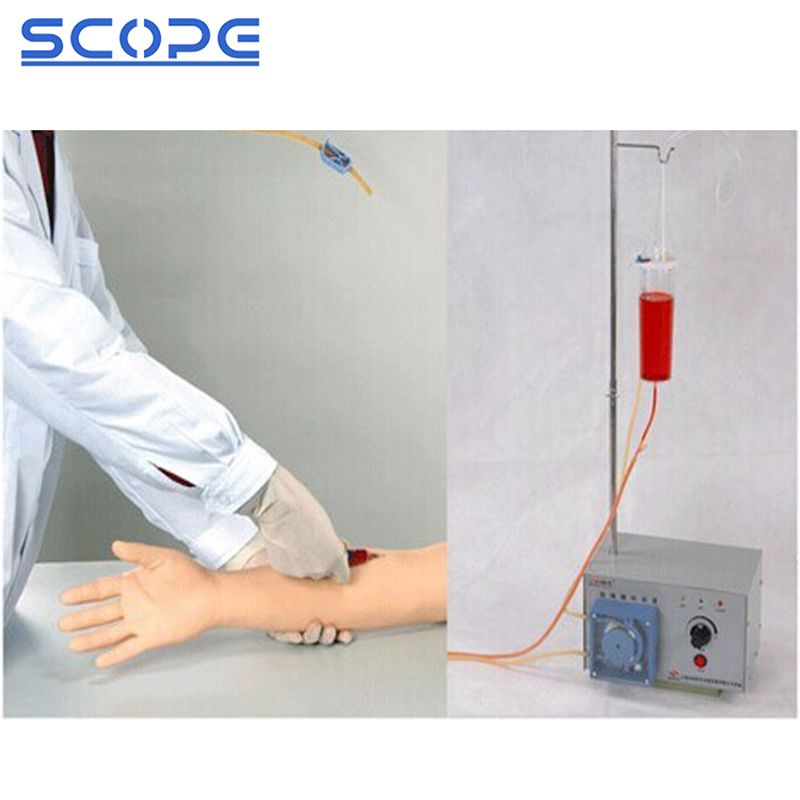
For a peripheral IV trainer, the published SC-HS3 specification is unusually explicit about construction, and each line of it maps onto a decision a buyer has to make. The model simulates injection, blood transfusion and hemospasia of the arm, covers deltoid muscle injection, produces an obvious feeling when the needle penetrates a vein, shows blood flashback to confirm correct placement, allows veins and skin to be punctured repeatedly without leaking, and ships with changeable vein and skin.
Read those as engineering statements rather than marketing ones. The obvious penetration feeling is a function of vessel wall thickness and compound hardness; an arm that offers no resistance teaches needle control badly and teaches nothing about depth. Flashback requires the vessel to be a closed, fluid-holding channel that reseals after withdrawal — and that same property is what makes repeated puncture without leakage possible. The two features are one engineering problem seen from two directions, which is why a model that flashes back convincingly on the first puncture but weeps on the twentieth has not solved either.
Replaceability is the third construction decision, and it converts a durability problem into a consumable cost. A fixed vein that cannot be renewed turns the whole arm into the wear part. A changeable vein and skin set keeps the shell, the frame and the deltoid pad in service while the parts that a needle actually destroys are renewed. For a school running 200 venipuncture attempts per term per station, that difference dominates the five-year cost of the equipment.
What to lock on the SC-HS4 IV Injection Model
The SC-HS4 is listed in the same medical-education range as an IV injection model, and it sits alongside the SC-HS3 in the catalogue. Because the vein and skin are the parts that wear, four questions settle its specification before price becomes meaningful.
- Vessel construction. Ask for the compound and wall thickness of the vein, and whether vein sets are supplied as pre-formed cassettes or as field-replaceable tubing. The two routes differ in how much skill the replacement takes and how consistently the vein sits in the arm afterwards.
- Flashback mechanism. Establish whether flashback is driven by line pressure that must be primed before a session, and what the priming and drainage procedure is. A flashback that depends on priming is not worse — but it adds a setup step to every class.
- Part numbers and interval. Request the part number, pack size and the supplier's recommended replacement interval per training seat, not per unit.
- Lab compatibility. If the IV lab will run both the SC-HS3 and the SC-HS4, check whether the arms share a stand, clamp or fluid reservoir. Shared fittings reduce the number of spares a store room has to carry.
On elastomer claims. If a specification states that a vein or skin component uses an imported plastic elastomer rather than a plasticised PVC compound, two things change for the buyer: the feel and recovery of the part, and its compatibility with cleaning agents. An elastomer and a plasticised PVC do not respond the same way to repeated flexing or to solvent-based wipes. Ask which specific parts of the model use the elastomer, which remain PVC, and what cleaning agents the supplier approves for each. A material name applied to a whole model is not a specification; a material name applied to a named part is.
Whole-body nursing coverage changes the replacement question
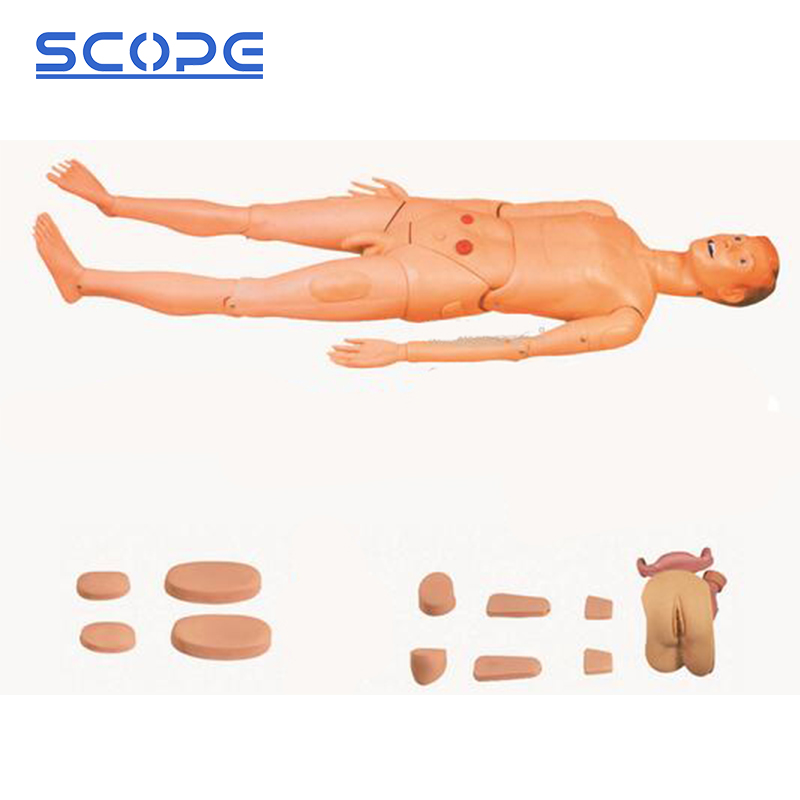
A single-site arm is not the only option for injection training. The SC-H130A nursing manikin covers deltoid subcutaneous injection, vastus lateralis injection and buttocks intramuscular injection alongside arm venipuncture, injection and blood transfusion, and adds thoracic cavity, abdominal cavity, liver, bone marrow and lumbar puncture plus catheterisation and ostomy care. The construction consequence is that each injection site is a separate tissue block inside one body, and each wears at its own rate depending on which skill the curriculum drills. Request the replacement list site by site rather than as a single body-part figure, and ask which sites share a common pad.
Intramuscular injection: why the moulding method enters the specification
An intramuscular trainer is judged on depth control and site selection. The trainee has to learn how far the needle travels, how the tissue gives, and where the site boundaries lie. That makes the injection pad's thickness, resilience and recovery after needle withdrawal the core fidelity parameters — and those are set by how the pad was made, not by what polymer family it belongs to.
Tooling and thermal history belong in the specification even though they never appear on a brochure. Where a shell or pad seat is produced by injection into a machined metal mould, the cavity dimensions repeat closely from shot to shot, and a replaceable insert — a pad, a cassette, an airway block — is more likely to seat to the same depth in every unit of a batch. That matters when a school buys thirty units and expects the same give at the deltoid site on all thirty. Where a high-temperature sintering or post-cure step is applied to a moulded part, the buyer-relevant consequences are normally dimensional stability and the reduction of residual process volatiles before packing; where no such step is applied, the equivalent question is how batch-to-batch variation is controlled instead — by tooling, by gauging, or by first-article inspection.
Neither route is automatically better for teaching. What is defensible is that the supplier states the route for the specific model and supports it with a process or inspection record. A general statement that a product family is injection moulded is not evidence about the unit in the crate.
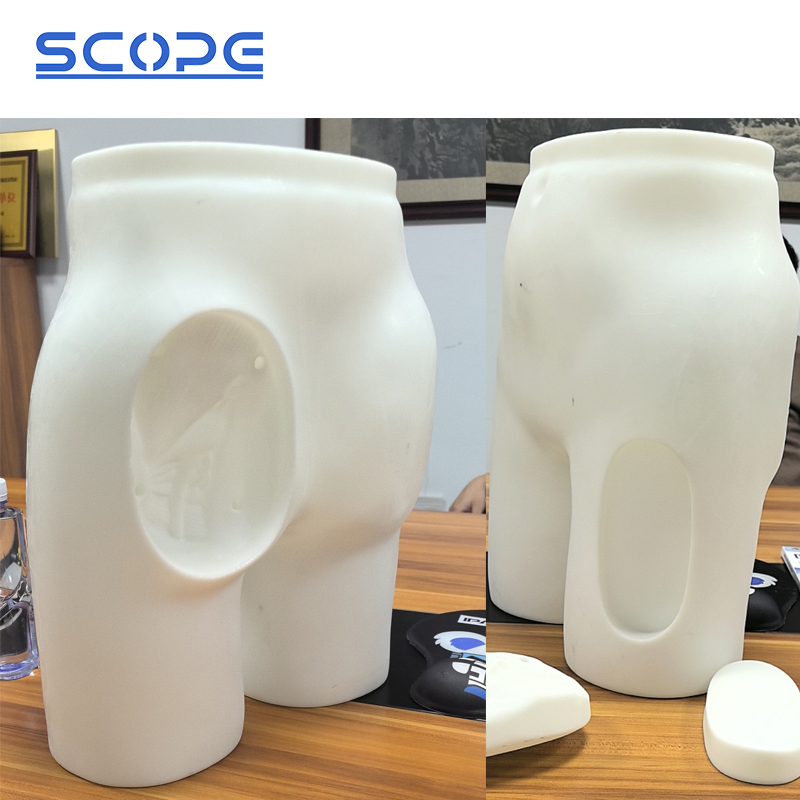
The SC-H4T appears in the medical-education catalogue as a training mannequin. For a model used to teach intramuscular injection, the confirmation list before qualification is short and specific:
- The moulding route for the body and the injection pad, and the tooling material used.
- Whether a high-temperature post-processing or sintering step is applied, and if so what it is intended to control.
- The dimensional tolerance at the injection site, stated as a number rather than as a quality adjective.
- Pad compound, hardness and thickness, and whether different pad hardnesses are available for different learner levels.
- Pad replaceability: part number, pack size and the tool needed to change it.
- Whether every unit in the order comes from the same tooling, and what first-article documentation accompanies the batch.
Puncture models: landmark geometry, hollow feel and viewing windows
The most fully documented puncture-relevant model in this range is the SC-CK817 clinical manikin, and its specification shows what a puncture buyer should be reading for. The simulated patient is placed supine with a soft texture and a lifelike appearance; the suprasternal notch, the upper edge of the sternal manubrium and the anterior superior iliac spine can be clearly palpated, which is what makes puncture positioning teachable at all; anterior superior iliac spine puncture and sternal manubrium puncture can both be trained; the simulated bone marrow cavity can be penetrated with an obvious hollow feeling and marrow can be extracted; and the skin and simulated bone marrow cavity can be easily replaced.
The hollow feeling is the skill being taught. If the cavity is too firm the trainee learns to push; if it is too soft there is no end-point and no lesson about depth. Palpability matters for the same reason: a landmark that cannot be found through the drape or the skin is a diagram, not a training model. And because a needle destroys the cavity it enters, replaceability is again the cost driver — which is why the specification calls out both the skin and the marrow cavity as replaceable rather than treating the torso as a sealed unit.
The engineering trade-off behind a visibility window
A window or transparent section that exposes the puncture field is a construction decision with consequences in both directions. It gives direct observation of needle depth relative to the landmark, which is valuable for demonstration and for a trainee who has not yet built a mental model of where the needle sits inside the body. It costs shell rigidity, it introduces an edge that has to be finished and sealed against cleaning fluid, and it has to be either moulded into the shell or fitted as a gasket-sealed insert.
Those two routes behave differently in service. A moulded window has no separate seal to fail, but it cannot be replaced if it is scratched or clouded by repeated cleaning. An inserted window can be renewed, but it introduces a joint that has to hold through handling, and a joint is where cleaning fluid eventually gets in. Neither is wrong; the buyer simply needs to know which one they are maintaining.
The SC-L66 puncture manikin is identified in the same medical-education range. For any puncture model that relies on a visibility feature, the confirmation list is: window geometry and its position relative to the target landmark, whether the window is moulded into the shell or fitted as an insert, the seal method, the cleaning agents the window material tolerates, and whether the visible field still reads correctly once the unit is draped for a scenario. Ask for these as a dimensioned drawing rather than a photograph.
Combining puncture with general nursing. If a curriculum combines landmark puncture with routine nursing care, the SC-H130A covers thoracic cavity, abdominal cavity, liver, bone marrow and lumbar puncture alongside venipuncture, catheterisation and ostomy care. Its puncture sites are part of a whole-body manikin, so the replacement question becomes site-specific and should be costed that way rather than as a single unit price.
CPR and airway models: the electronics set the specification
On a resuscitation trainer the plastic is the least interesting part of the purchase. What a buyer is actually choosing is a feedback architecture: which errors the model detects, how it reports them, and whether the report can be used as assessment evidence.
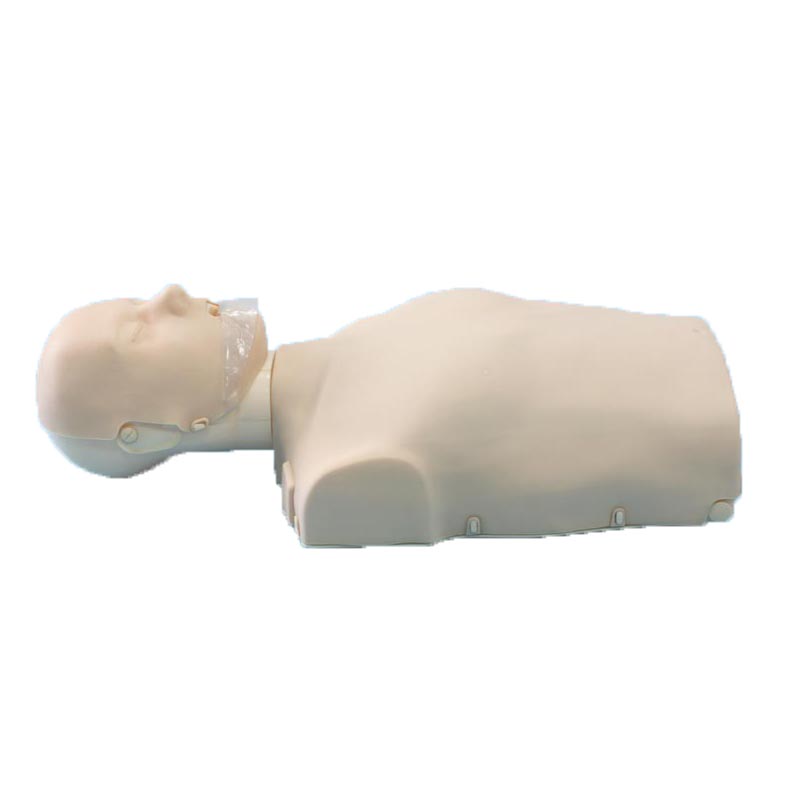
SC-CPR480: multi-channel feedback with a printed record
The published specification of the SC-CPR480 describes a full feedback chain. Compression depth is displayed by a moving barcode indicator against a 5–6 cm target zone: green for correct depth, yellow for under 5 cm, red for over 6 cm. A digital count runs alongside, and the unit records the specific reason for an error — excessive force, insufficient force, incorrect hand position — together with the number of correct compressions. Ventilation is measured on the same principle against a 500–1,000 ml tidal volume window, with its own count and error reasons. The protocol parameters are stated: 30:2 for single or double rescuer, five cycles, and a rate of at least 100–120 compressions per minute against the 2020 international standard, with operation timed in seconds. Both training and assessment modes are provided, with universal or customised assessment, and results can be thermally printed as long or short transcripts. Physiological simulation is included: pupils dilate and contract before and after an assessment cycle, and carotid pulsation can be palpated during compressions.
The buyer-relevant distinction is not "does it have electronics" but "which error channels does it report and what does the report look like". An alarm-only model tells a student that something is wrong. A model that names the error and prints a transcript gives an instructor a basis for correction and gives the course a record. Both are legitimate purchases; they serve different class sizes and different assessment regimes, and the second is wasted on a drop-in drill station where nobody reads the output.
Two practical details deserve a decision before ordering. First, the specification describes Chinese-language voice prompts while also stating that the prompt language and volume can be adjusted or the prompt turned off; for a lab teaching in another language, confirm the delivered configuration in writing, because if the prompt is disabled the barcode display and the count have to carry the feedback alone. Second, the standard configuration lists four replaceable lung sacs, one changeable face skin and two rolls of thermal printing paper — these are the recurring consumables, and they should be priced into the annual budget rather than discovered after the first assessment week.
SC-CPR100A: alarm-based feedback for drill stations
The SC-CPR100A is specified more simply: simulated airway opening, mouth-to-mouth ventilation with visible chest rise and fall, manual chest compression with a correct depth of 5–6 cm, a 30:2 ratio over five cycles, a 100–120 per minute rate, training mode only, and an alarm function. Its published specification lists alarm-based feedback without the assessment and printing functions described for the SC-CPR480.
That is a design choice with an operational consequence, not a deficiency. A drill station that runs continuous repetitions for a whole cohort benefits from a model the instructor can supervise by ear and by eye while moving between students; a printing assessment station benefits from recorded evidence. Many skills labs end up with both, and the sensible split is to put the recorded-feedback unit where assessment happens and the alarm-based units where repetition happens.
SC-J5S: the airway model is specified by its error channels
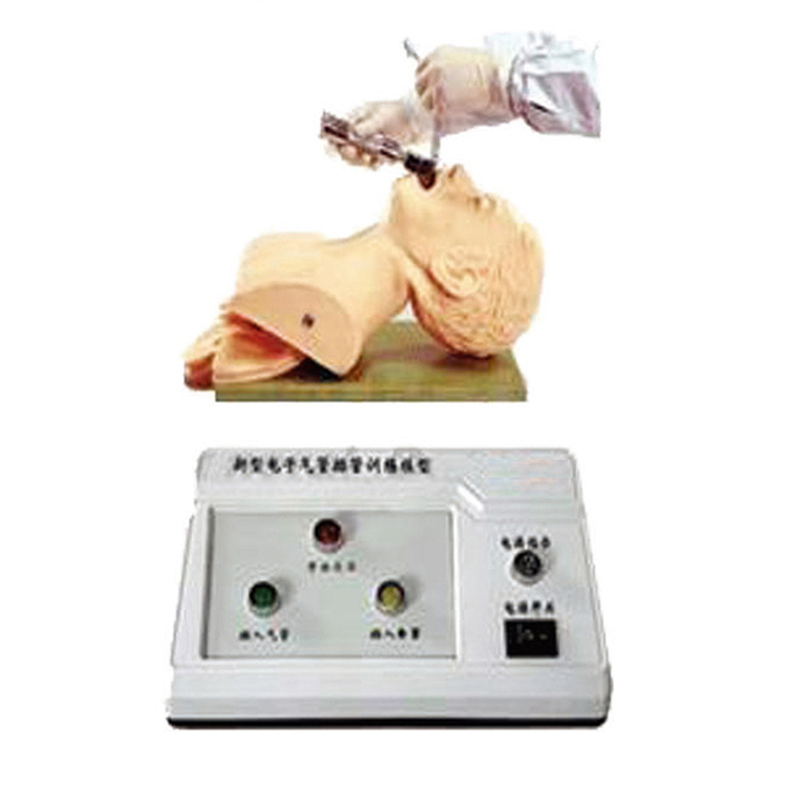
An intubation trainer is chosen for what it detects, and the SC-J5S specification is organised around exactly that. Tooth pressure from improper force during endotracheal intubation triggers an alarm. Oral and nasal tracheal intubation can be trained and demonstrated. Correct airway insertion produces an electronic display and a music prompt. Air supply expands both lungs, and air injected into the tube balloon fixes the tube. Oesophageal misinsertion produces an electronic display and an alarm, and the air supply inflates the stomach instead. Incorrect handling that makes the laryngoscope press on the teeth triggers an electronic alarm. One normal pupil and one dilated pupil are provided for comparison, and the cricothyroid membrane puncture site is marked.
The teaching mechanism is the pair of outcomes: lungs inflate versus stomach inflates. That contrast is what transfers to a real patient, because it teaches the trainee to look at the epigastrium as well as listen. A model that alarms on oesophageal placement without producing the gastric distension cue removes the most transferable part of the lesson, so confirm with the supplier that the two states are physically distinct and that the stomach inflation is visible during the exercise. The music prompt is a positive-confirmation channel, and in a noisy skills lab an audible confirmation is often more useful than a screen the student is not looking at.
SC-CPR160: infant CPR changes the targets, not the logic
The SC-CPR160 infant manikin is identified in the same medical-education range. Infant resuscitation changes the target values used in teaching — compression depth, ventilation volume, and the compression-to-ventilation ratio all come from the paediatric curriculum rather than the adult one — so the specification review follows the same logic with different numbers. Request the model's stated depth and tidal targets, whether feedback is mechanical or electronic, and the spare lung and face-skin parts, since an infant model is used in short intensive modules where consumable turnover is concentrated.
Documented parameters, model by model
The matrix below separates what each model's published specification actually states from the parameter a buyer still has to lock in writing. Rows marked "confirm" identify models that are catalogued in the range but for which a model-level material or construction value should be obtained from the supplier before the model is written into a specification.
| Model | Procedure use | Declared material | Documented construction / function parameters | Lock before ordering |
|---|---|---|---|---|
| SC-HS3 Injection Model | Peripheral IV, blood transfusion, hemospasia, deltoid injection | PVC | Obvious feeling on needle entry into the vein; blood flashback confirms correct placement; veins and skin punctured repeatedly without leaking; changeable vein and skin | Vein and skin part numbers; replacement interval per training seat |
| SC-HS4 IV Injection Model | IV injection training | Confirm | Catalogued as an IV injection model; model-level construction not declared in the documentation used here | Vein compound and wall thickness; flashback actuation; replacement parts |
| SC-H4T Training Mannequin | Intramuscular injection training | Confirm | Catalogued as a training mannequin in the medical-education range | Moulding route and tooling material; injection-site dimensional tolerance; pad hardness and replaceability |
| SC-L66 Puncture Manikin | Puncture and landmark training | Confirm | Catalogued as a puncture manikin in the medical-education range | Visibility-window geometry, moulded versus inserted, seal method; tissue-block replaceability |
| SC-CK817 Clinical Manikin | Sternal manubrium and anterior superior iliac spine puncture; marrow aspiration | PVC | Palpable suprasternal notch, sternal manubrium edge and anterior superior iliac spine; obvious hollow feeling on entering the simulated marrow cavity; marrow extractable; skin and marrow cavity replaceable | Tissue-block and skin part numbers; cavity depth tolerance |
| SC-J5S Intubation Model | Oral and nasal endotracheal intubation | PVC | Tooth-pressure alarm; correct insertion confirmed by electronic display and music; oesophageal misinsertion triggers display, alarm and gastric inflation; laryngoscope tooth-pressure alarm; normal and dilated pupil comparison; cricothyroid membrane puncture site marked | Alarm logic and display language; airway component material; lung sac and face-skin spares |
| SC-CPR480 CPR Model | Adult CPR training and assessment | PVC | Compression depth barcode zones 5–6 cm green, under 5 cm yellow, over 6 cm red; tidal volume feedback against 500–1,000 ml; 30:2 over five cycles; 100–120 per minute; training and assessment modes; thermal score printing; pupil and carotid simulation | Delivered prompt language; assessment report fields; consumable pack of lung sacs, face skin and printing paper |
| SC-CPR100A Medical Manikin | Basic adult CPR training | PVC | Airway opening; visible chest rise on ventilation; compression depth 5–6 cm; 30:2 over five cycles; 100–120 per minute; alarm function; training mode | Whether alarm-based feedback satisfies the course assessment; spares list |
| SC-CPR160 Infant Manikin | Infant CPR training | Confirm | Catalogued as an infant manikin in the medical-education range | Stated paediatric depth and tidal targets; feedback type; lung and face spare parts |
A seven-step specification review
The sequence below moves a purchase from a catalogue shortlist to a testable specification. It is written for the Research-to-Evaluation stage, where the lab already knows which procedures it teaches and now has to defend the choice.
- Write one sentence per skill. State what the trainee must be able to do and what evidence proves they did it. "Insert a 20G cannula into a vein and confirm placement by flashback" is a specification; "IV training arm" is a category.
- Separate durable structure from consumables. List every part a needle, blade or repeated compression destroys. That list, not the unit price, is the cost of ownership.
- Request the material declaration at model level. Ask which polymer and compound applies to which part — skin, vein, pad, cavity, shell — and what the approved cleaning agents are.
- Request the construction declaration. Moulding route, tooling material, any high-temperature post-processing step, wall thickness at wear points, and the dimensional tolerance at functional interfaces.
- Map spare parts before you compare prices. Part numbers, pack sizes and replacement intervals per training seat, obtained in writing.
- Verify the electronics against your assessment regime. Thresholds, error channels, report format, display and prompt language, power supply and calibration procedure.
- Set acceptance criteria and test the sample against them. Define the pass condition before the carton is opened, and record the result.
Three lab scenarios and the parameter that dominates each
Pre-clinical nursing lab. A room running venipuncture and intramuscular injection across a large cohort is buying replacement intervals more than it is buying features. The SC-HS3 configuration is the efficient core because the vein and skin are explicitly renewable while the frame stays in service, and the SC-H130A adds whole-body site coverage for deltoid, vastus lateralis and buttock injection plus catheterisation and ostomy care. The dominant parameter is part commonality: if the store room carries one vein set and one pad family, the lab runs.
Emergency skills lab. A resuscitation room with an assessment requirement needs recorded evidence, which puts the SC-CPR480 — with its depth and tidal barcode feedback, error-reason recording, timed cycles and thermal transcripts — at the assessment station, and alarm-based SC-CPR100A units at the repetition stations. The SC-J5S adds airway error channels, including the lungs-versus-stomach distinction that carries the intubation lesson. The dominant parameter is which feedback channel the instructor actually reads during a class, because an unread transcript is an unused feature.
Procedure and landmark workshop. A workshop teaching puncture technique needs palpable anatomy and a replaceable target. The SC-CK817 carries the documented landmark set — suprasternal notch, sternal manubrium edge, anterior superior iliac spine — plus a marrow cavity that gives an obvious hollow feel and can be replaced, which makes it the reference point against which the SC-L66 and other puncture models should be compared. The dominant parameter is tissue-block renewal cost per trainee, since puncture practice consumes the target faster than any other skill in this guide.
Where a programme also covers maternal or infant skills, the SC-F50 and SC-F55-1 maternal models and the SC-CPR160 infant manikin extend the same material system into obstetric and paediatric training; the same review sequence applies, but the target values for compressions, ventilation and station come from the relevant curriculum rather than from the adult defaults.
Frequently asked questions
Which certifications and material documents should a buyer collect for a PVC training manikin?
Chongqing Scope states that it can provide ISO 9001, ISO 14001, ISO 45001, ISO 13485, CE and RoHS documentation for export, together with customs documents such as CO, Form E and Form F where these are required. Treat the certificate set as supplier-level evidence and the material declaration as model-level evidence: ask for the declaration that applies to the specific model and to each part within it — skin, vein, pad, cavity, shell — and for the list of cleaning agents that material tolerates. Where a resuscitation model's specification refers to a guideline such as the 2020 international CPR standard, that is a manufacturer's design statement rather than a certification; if the claim has to appear in a tender file, request the supporting documentation rather than citing the statement alone.
Can construction details such as replaceable parts or moulded features be customised?
Chongqing Scope offers OEM and ODM services and states that product appearance and functions can be customised, subject to a minimum order quantity of 20 units, with monthly capacity of 3,000 units and a stated lead time of 30–45 days. When the customisation touches a wear part — a vein cassette, an injection pad, a visibility window — treat it as a tooling question as much as a design question. Ask which requested changes require new tooling, which can be met by changing compound, hardness or colour within existing tooling, and what the first-article approval and sample-sign-off process is before mass production.
What actually drives cost of ownership across injection, puncture and CPR models?
The parts that training destroys. On an injection arm it is the vein and skin set; on a puncture model it is the tissue block and the replaceable marrow cavity; on a CPR model it is the lung sac, the face skin and, where the unit prints, the thermal paper — the SC-CPR480 standard configuration, for example, lists four replaceable lung sacs, one changeable face skin and two rolls of thermal printing paper. Where a wear part is not replaceable, the whole unit becomes the consumable, and that has to be priced into the comparison rather than hidden behind a lower unit price.
How should a sample be tested before a bulk order?
Test the specific failure mode, not the general impression. On an injection arm, puncture the same site to the number of attempts you expect per student per term, then check for leakage and for the quality of flashback on the final attempts. On a puncture model, have two instructors palpate the landmarks independently and record whether they identify the same target. On a CPR model, deliberately compress too shallowly and too deeply and confirm the display reports the correct error state. On an intubation model, place the tube in the oesophagus on purpose and confirm that the alarm sounds and that the stomach visibly inflates. Agree in advance which of these checks the supplier will witness.
What are typical lead times and export terms, and how should a delivery schedule be written?
Chongqing Scope states a lead time of 30–45 days, neutral export packaging in cardboard or wooden cases without logos, and a one-year online warranty. Certificate of origin, Form E and Form F can be supplied for customs clearance where applicable. Write the schedule per line item rather than as a single figure, because a customised wear part and a stock model rarely occupy the same production slot: request a quotation that lists each model, its spare-part pack, and its own delivery date. The product catalogue for the range is available as a downloadable Chongqing Scope brochure for building that model list.
Conclusion
The material label filters a catalogue; the construction declaration selects a model; the replaceable parts price it; and on any resuscitation or airway trainer, the electronics define it. Read the SC series that way and the differences become operational rather than cosmetic. The SC-HS3 is a renew-the-vein arm judged on penetration feel, flashback and leak resistance. The SC-CK817 is a landmark platform judged on palpable anatomy and a replaceable marrow cavity. The SC-CPR480 is a feedback instrument judged on its error channels, its printing and its consumable pack. The SC-J5S is an airway trainer judged on whether oesophageal placement produces a distinguishable, visible consequence.
For the models whose construction is not declared at model level — the SC-HS4, SC-H4T, SC-L66 and SC-CPR160 — the correct action is not to assume a value but to convert the question into a written requirement: moulding route, tooling, compound, tolerance, part number. A supplier that can answer those questions with a number and a document is easier to qualify than one that answers with a description.
Next step. If you are comparing models for a specific programme, request a sample and a model-level specification sheet for the injection, puncture or CPR model you are evaluating, together with the spare-part list for the wear items. Chongqing Scope supplies medical training manikins across Europe, Southeast Asia, the Middle East, South America and Africa, and provides OEM and ODM support for buyers who need a customised configuration.
Have Questions or Need More Details?
Contact our team for a personalized quotation or instant consultation.
Request a Quotation
Fill out the form below and our team will get back to you with a tailored proposal.
WhatsApp Direct Chat
Prefer to chat in real-time? Message us on WhatsApp for instant assistance & quick answers.
- Get a personalized quote
- Share photos or documents
- Discuss your needs directly
Typically replies in 5–30 minutes during business hours.