
Ranked: Best Microscopes for Cell Culture, Tissue, and Fluorescence in Biotech Labs
For a biotech lab building a practical shortlist, this ranking places the BDS500 first for cell culture, the BDS400 second for tissue imaging, the BK5000-FL third for fluorescence research, the BK5000-PH fourth for live-cell phase contrast, and the SMART-4 fifth for general laboratory and teaching setups. The order is application-weighted and based on supplied model facts, not on an independent optical test.
Chongqing Scope Instrument Co., Ltd. is a Chongqing-based supplier of laboratory and medical training instruments and metallographic equipment. The ranked models below come from the company's supplied content units, and the article uses only the model facts provided there.
What problem does this ranking solve?
Biotech labs often compare microscopes by broad category names, such as inverted microscope, fluorescence microscope, or phase contrast microscope. That is not enough for procurement. A cell culture team may need an inverted body that accepts vessels and a culture dish holder. A tissue imaging team may need a large mechanical stage and long-working-distance phase contrast objectives. A fluorescence team needs filter sets and a compatible illumination source. A live-cell contrast team needs phase contrast optics without necessarily adding fluorescence.
This ranking solves a narrower problem: it maps five supplied microscope models to the biotech workflows named in the title, then explains which specifications support each recommendation. It is not a claim that one model is universally superior for every laboratory. The correct choice depends on the sample format, contrast mode, camera path, stage size, and illumination requirement.
Industry background: why cell culture, tissue, and fluorescence workflows diverge
Cell culture, tissue imaging, and fluorescence research do not place identical demands on an optical microscope. Cell culture workflows often involve vessels rather than standard slides, so an inverted design and a suitable stage or holder matter. Tissue imaging can require a stable stage, a defined objective set, and phase contrast objectives for contrast in biological samples. Fluorescence work depends on fluorescence filters and a compatible light source. Live-cell phase contrast work depends on phase contrast objectives and a condenser matched to the contrast method.
These differences explain why a ranked shortlist should be read by application. A microscope with a large stage and a culture dish holder may be a strong cell culture choice but not a fluorescence instrument. A fluorescence microscope may offer the required filter set but not the inverted vessel handling of a cell culture model. The ranking below keeps those distinctions visible.
How this ranking was built
The ranking uses six selection criteria that are visible in the supplied specifications: head type, nosepiece, infinity optical system, LWD phase contrast objectives, stage size, and illumination options. Head type matters because a trinocular head supports a camera path, while a binocular head is aimed at direct observation in the supplied configurations. Nosepiece capacity matters because it limits how many objectives can be mounted at once. An infinity optical system matters because it is the optical platform named in several supplied models. LWD phase contrast objectives matter for cell and tissue work that needs contrast and working distance. Stage size matters for vessel or sample handling. Illumination options matter for bright field, phase contrast, and fluorescence compatibility.
The ranking is application-first. Rank 1 is not a statement that the BDS500 has better resolution than every other model. It means the BDS500 is the closest fit in the supplied data for cell culture workflow requirements. Likewise, the BK5000-FL is ranked for fluorescence because it is the ranked model whose supplied specification includes a fluorescence attachment. No independent resolution, numerical aperture, or field-performance test is claimed.
Ranked microscopes for biotech labs
1. BDS500 — rank 1 for cell culture workflows
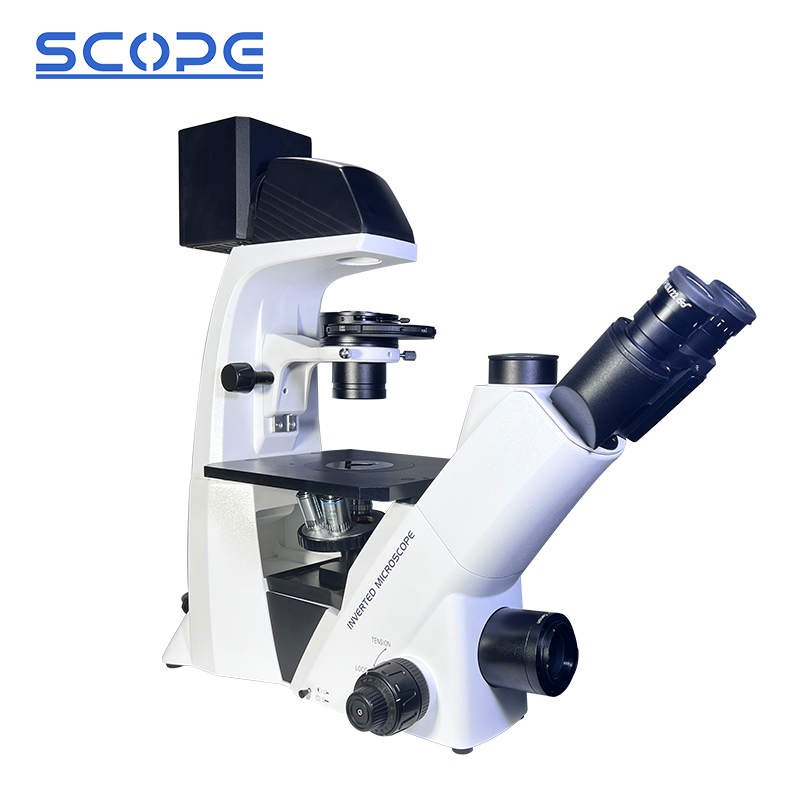
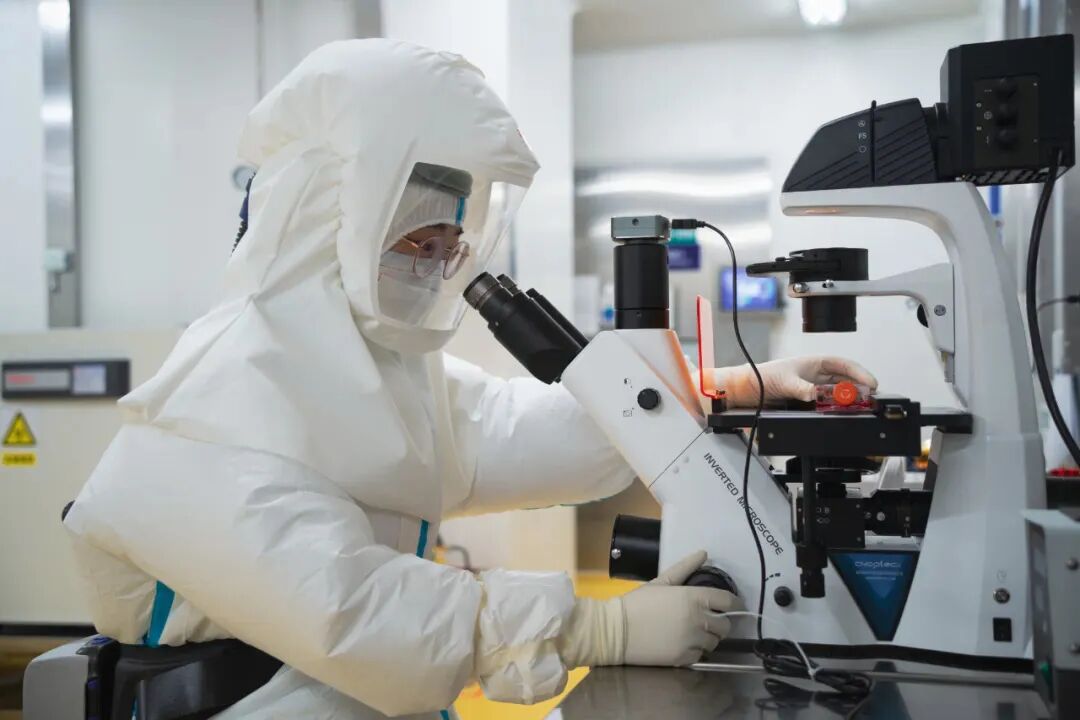
The BDS500 is an inverted laboratory microscope intended for biology, cell culture, and laboratory research. Its supplied configuration includes a trinocular head, a quintuple nosepiece, and a 4-hole rotating disc phase contrast condenser. The mechanical stage measures 210×241 mm, and the model includes a 54 mm culture dish holder. The LWD Infinity Plan objectives are listed as 4X and 10X/20X/40X for phase contrast and bright field, with annular spots at 4X/10X/20X/40X. Light distribution is 100:0 and 80:20, and the adapter for digital photography provides 100% light for the photography port. Illumination is Koehler 12V/50W halogen, with blue and green filters.
Why it ranks first for cell culture: the inverted design, large stage, culture dish holder, and phase contrast condenser are all directly relevant to vessel-based cell work. The trinocular head and photography-port light path also support documentation. The main limitation is that the supplied specification names halogen Koehler illumination and does not describe a fluorescence attachment. A lab that needs fluorescence should not assume the BDS500 covers that requirement without a separate configuration review.
2. BDS400 — rank 2 for tissue imaging in an inverted format
The BDS400 is an inverted tissue microscope intended for biology, cell culture, and laboratory research. It has a trinocular head, a WF10X/22 mm eyepiece, a quintuple nosepiece, and LWD Infinity Phase Contrast Objectives at 10X/20X/40X. Annular spot options are 10X/20X/40X. Light distribution is 100:0 and 80:20, the mechanical stage is 210×241 mm, and the body is described as aluminum alloy and glass.
Why it ranks second: the BDS400 is the tissue-oriented inverted model in the supplied set, and its phase contrast objective set and large stage suit tissue and cell work that benefits from an inverted format. The ranking does not claim that it is a better optical body than the BDS500; the two are separated by application emphasis. One practical check is illumination: the supplied BDS400 description used here does not list an illumination option, so the quotation should confirm the light source and filter configuration. The supplied objective set starts at 10X, so a team that needs a 4X phase contrast objective should confirm availability rather than assume it.
3. BK5000-FL — rank 3 for fluorescence research
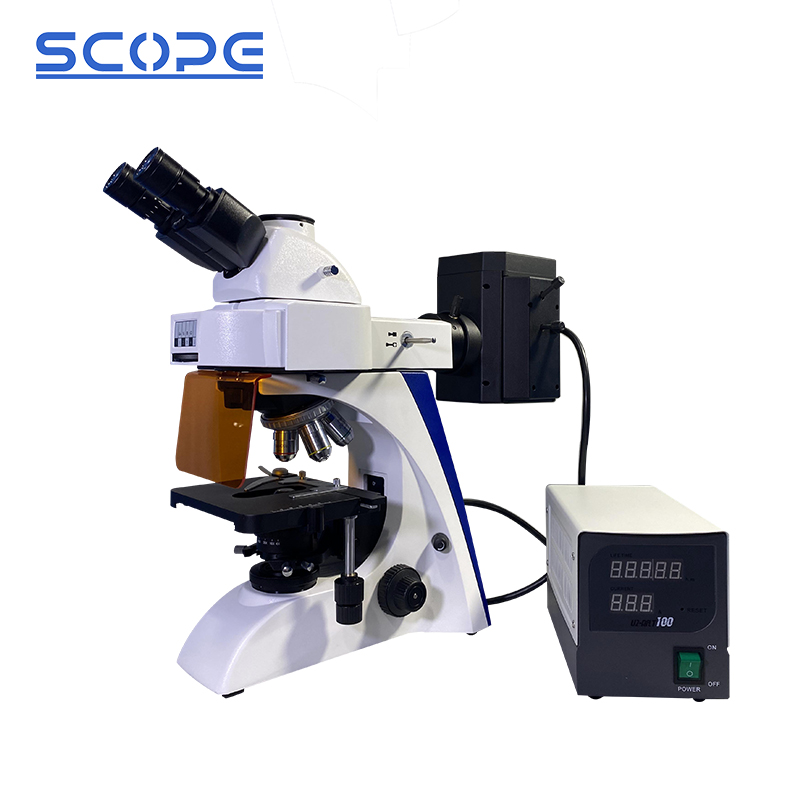
The BK5000-FL is a fluorescence microscope for biological research and laboratory use. Its supplied configuration lists a binocular or trinocular head, WF10X/20 mm eyepiece, infinity Plan objectives at 4X/10X/20X/40X/100X, and a quintuple nosepiece. The mechanical stage is 175×145 mm, and the condenser is an Abbe N.A.1.25 with iris diaphragm. Illumination is 3W LED or 12V/20W halogen. The fluorescence attachment includes blue, green, violet, and ultraviolet fluorescence filters, with a 5W LED or 100W mercury lamp.
Why it ranks third: it is the ranked model whose supplied specification directly addresses fluorescence filters and fluorescence illumination. That makes it the first place to look when the workflow requires fluorescence channels rather than bright field or phase contrast alone. The limitation is configuration fit: filter sets and lamp choice must match the intended fluorophores. The supplied data lists the filter colours and lamp options, but it does not establish suitability for a specific assay. A buyer should confirm the filter and lamp configuration against the actual fluorescence workflow.
4. BK5000-PH — rank 4 for live-cell phase contrast
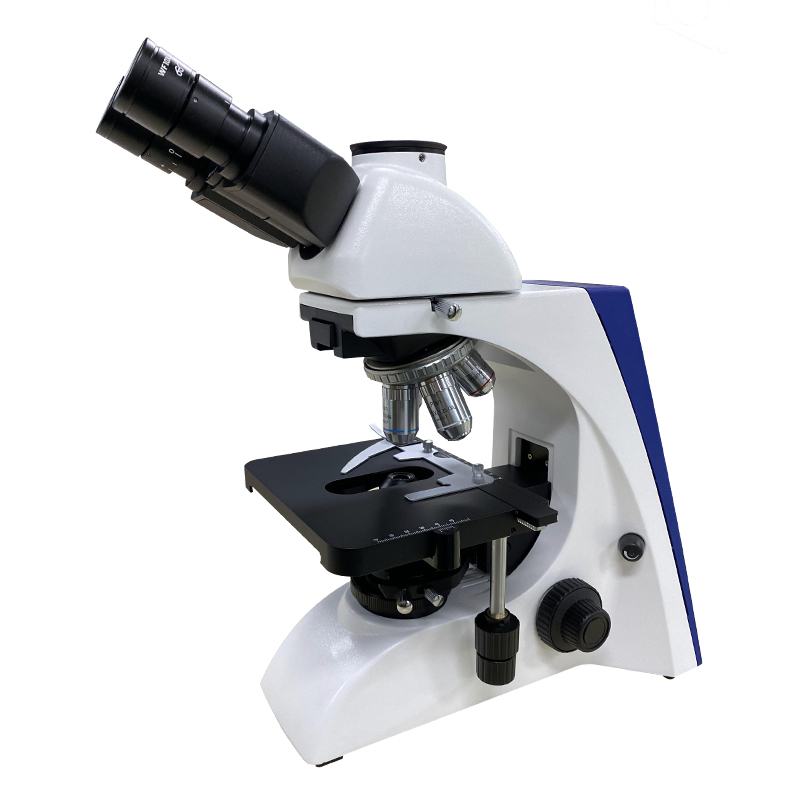
The BK5000-PH is a phase contrast biological microscope for biology and laboratory research. It has a binocular head, WF10X/20 mm eyepiece, quintuple nosepiece, and infinity phase contrast Plan objectives at 4X/10X/40X/100X. The mechanical stage is 175×145 mm. The condenser is a quintuple-hole turret Abbe condenser, and focusing uses coaxial coarse and fine knobs. Illumination options are 3W LED or 12V/20W halogen.
Why it ranks fourth: the BK5000-PH is the direct phase contrast option in the supplied set for labs that need contrast in live-cell work but do not need fluorescence. The objective set covers 4X, 10X, 40X, and 100X phase contrast, which gives a broader magnification ladder than the BDS400's supplied 10X/20X/40X phase contrast set. The supplied head is binocular; a lab that needs a camera port should confirm whether a trinocular configuration is available rather than assuming it. The ranking is based on documented configuration, not on a measured live-cell image comparison.
5. SMART-4 — rank 5 for general laboratory and teaching setups
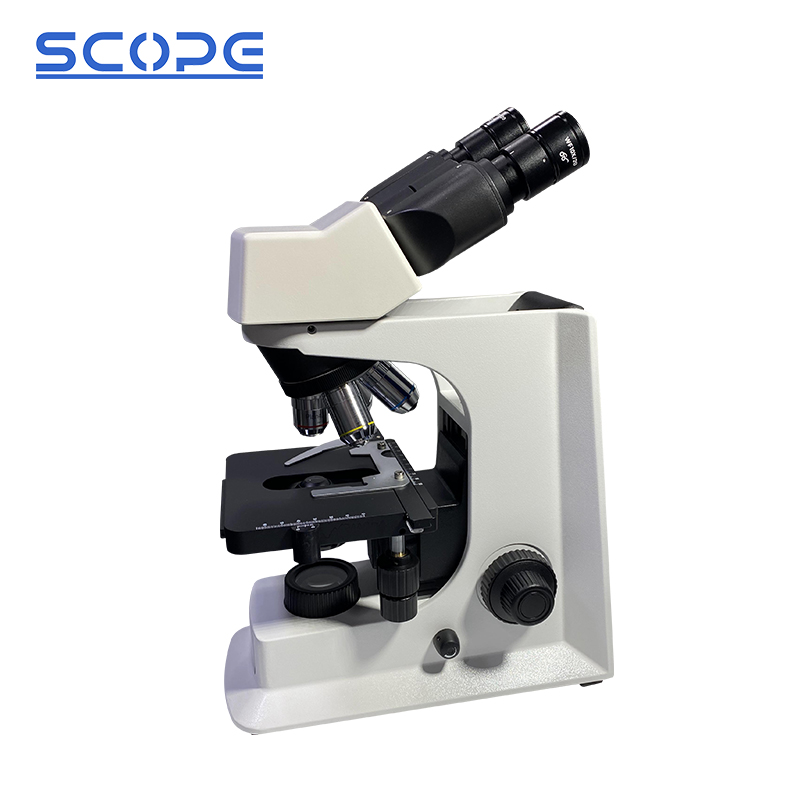
The SMART-4 is an infinity biological microscope for laboratory and educational scenarios. It has a binocular head, WF10X/20 mm eyepiece, infinity Plan objectives at 4X/10X/40X/100X, and a quadruplex nosepiece. The mechanical stage is 145×140 mm, the condenser is Abbe N.A.1.25, and illumination is 3W LED. The body is described as aluminum alloy and glass.
Why it ranks fifth: the SMART-4 is a general laboratory and teaching platform in the supplied data, not a dedicated cell culture, tissue, or fluorescence instrument. It offers an infinity optical system and a practical objective range, but it has a smaller stage than the BDS500 and BDS400 and a quadruplex nosepiece rather than a quintuple nosepiece. It is a reasonable choice when the main need is general laboratory observation and education, not a specialized biotech workflow.
Selection note: the assignment allows SMART-4 or BK6000TR for the general-laboratory slot. This ranking uses SMART-4 because its supplied configuration is positioned for laboratory and educational scenarios. BK6000TR is the supplied alternative when a trinocular head and quintuple nosepiece are preferred. The BK6000TR specification lists a trinocular head, quintuple nosepiece, infinity Plan 4X/10X/20X/40X/100X objectives, a 182×140 mm stage, a swing-out condenser N.A.0.9/0.13, 100:0 and 80:20 light distribution, 12V/30W halogen or 5W LED illumination, and a blue filter. It is not separately ranked here because the ranking uses one general-laboratory model.
Side-by-side comparison
| Rank | Model | Primary biotech use | Head / nosepiece | Infinity optics / objectives | Stage | Illumination |
|---|---|---|---|---|---|---|
| 1 | BDS500 | Cell culture | Trinocular / quintuple | LWD Infinity Plan 4X, 10X/20X/40X for phase contrast and bright field; annular spots 4X/10X/20X/40X | 210×241 mm; 54 mm culture dish holder | Koehler 12V/50W halogen; blue and green filters |
| 2 | BDS400 | Tissue imaging | Trinocular / quintuple | LWD Infinity Phase Contrast 10X/20X/40X; annular spots 10X/20X/40X | 210×241 mm | Not specified in the supplied content unit used here |
| 3 | BK5000-FL | Fluorescence research | Binocular or trinocular / quintuple | Infinity Plan 4X/10X/20X/40X/100X | 175×145 mm | 3W LED or 12V/20W halogen; blue, green, violet, UV filters; 5W LED or 100W mercury lamp |
| 4 | BK5000-PH | Live-cell phase contrast | Binocular / quintuple | Infinity phase contrast Plan 4X/10X/40X/100X | 175×145 mm | 3W LED or 12V/20W halogen; quintuple-hole turret Abbe condenser |
| 5 | SMART-4 | General lab and teaching | Binocular / quadruplex | Infinity Plan 4X/10X/40X/100X | 145×140 mm | 3W LED; Abbe N.A.1.25 |
Step-by-step selection workflow
- Start with the sample format. If the work is vessel-based cell culture, check inverted models first. The BDS500 and BDS400 are inverted designs in the supplied set. If the work uses standard slides and general observation, an upright or general biological model such as the SMART-4 may be sufficient.
- Choose the contrast mode. Bright field, phase contrast, and fluorescence are different requirements. The BDS500 and BDS400 include phase contrast configurations for cell and tissue work. The BK5000-PH is the phase contrast biological model. The BK5000-FL adds fluorescence filters and a fluorescence illumination source.
- Check the head and camera path. A trinocular head can support a camera path in the supplied configurations. The BDS500 and BDS400 are listed with trinocular heads. The BK5000-FL offers binocular or trinocular. The BK5000-PH and SMART-4 are listed with binocular heads in the supplied data, so camera adaptation should be confirmed before purchase.
- Check the nosepiece and objective set. The BDS500, BDS400, BK5000-FL, and BK5000-PH use quintuple nosepieces in the supplied data. The SMART-4 uses a quadruplex nosepiece. The objective range should match the magnifications needed for cell culture, tissue, or fluorescence work.
- Check stage size and sample handling. The BDS500 and BDS400 list a 210×241 mm mechanical stage; the BDS500 also lists a 54 mm culture dish holder. The BK5000-FL and BK5000-PH list a 175×145 mm stage. The SMART-4 lists a 145×140 mm stage. Larger stages are useful when vessels or larger samples must be positioned and moved.
- Check illumination and filters. The BDS500 uses Koehler 12V/50W halogen with blue and green filters. The BK5000-FL uses 3W LED or 12V/20W halogen plus blue, green, violet, and UV fluorescence filters, with a 5W LED or 100W mercury lamp. The BK5000-PH uses 3W LED or 12V/20W halogen. The SMART-4 uses 3W LED.
- Verify the written quotation and sample fit. Ask for the exact head, nosepiece, objective, stage, illumination, filter, and camera-adaptation configuration. Where possible, review a sample or a configured unit against the intended workflow. This step is especially important where the supplied description does not list a value, such as the BDS400 illumination option.
Use cases
- Cell culture and vessel-based work: rank the BDS500 first when the lab needs an inverted body, a 210×241 mm stage, a 54 mm culture dish holder, phase contrast objectives, and a trinocular head for documentation.
- Tissue imaging in an inverted format: consider the BDS400 when the workflow is described as tissue microscopy and needs LWD Infinity Phase Contrast objectives at 10X/20X/40X on a 210×241 mm stage. Confirm the illumination configuration in the quotation.
- Fluorescence research: consider the BK5000-FL when blue, green, violet, or UV fluorescence filters and a fluorescence light source are required. Match the filter and lamp choice to the intended fluorescence workflow.
- Live-cell phase contrast without fluorescence: consider the BK5000-PH when the requirement is phase contrast across 4X/10X/40X/100X objectives, with a 175×145 mm stage and LED or halogen illumination.
- General laboratory and teaching: consider the SMART-4 when an infinity biological microscope with 4X/10X/40X/100X Plan objectives and 3W LED illumination is enough for general observation and education.
What this ranking does not establish
This ranking does not establish resolution superiority, numerical aperture performance, image flatness, fluorescence brightness, or live-cell image quality. Those properties are not provided as measured comparisons in the supplied content units. It also does not claim that any model is suitable for every assay. The recommendations are based on documented configuration and application fit. A laboratory should verify the final configuration, including camera adaptation, filter sets, illumination, and stage accessories, before purchase.
The absence of a specification in the supplied text is not proof that a feature is unavailable. For example, the BDS400 content unit used here does not list illumination, and the BK5000-PH supplied head is binocular. These are prompts for confirmation, not conclusions that a different configuration cannot be supplied.
Frequently asked questions
What is the recommended microscope for cell culture in a biotech lab?
The BDS500 is the rank-1 recommendation in this shortlist for cell culture. Its supplied configuration includes an inverted design, a trinocular head, a quintuple nosepiece, a 4-hole rotating disc phase contrast condenser, a 210×241 mm mechanical stage, a 54 mm culture dish holder, LWD Infinity Plan objectives at 4X and 10X/20X/40X for phase contrast and bright field, and Koehler 12V/50W halogen illumination.
Why is the BDS400 ranked for tissue imaging?
The BDS400 is an inverted tissue microscope intended for biology, cell culture, and laboratory research. Its supplied configuration includes a trinocular head, WF10X/22 mm eyepiece, quintuple nosepiece, LWD Infinity Phase Contrast Objectives at 10X/20X/40X, annular spots at 10X/20X/40X, light distribution of 100:0 and 80:20, and a 210×241 mm mechanical stage. The supplied description used here does not list an illumination option, so confirm the light source in the quotation.
When should a lab choose the BK5000-FL instead of the BK5000-PH?
Choose the BK5000-FL when fluorescence filters and fluorescence illumination are required. Its supplied specification includes blue, green, violet, and ultraviolet fluorescence filters, a 5W LED or 100W mercury lamp, infinity Plan objectives at 4X/10X/20X/40X/100X, and a quintuple nosepiece. Choose the BK5000-PH when phase contrast without fluorescence is the priority. Its supplied specification includes infinity phase contrast Plan objectives at 4X/10X/40X/100X, a quintuple-hole turret Abbe condenser, and 3W LED or 12V/20W halogen illumination.
What specifications matter most in a phase contrast microscope for live-cell work?
Check the phase contrast objective set, the condenser, the head and camera path, the stage, and the illumination. The BK5000-PH lists a binocular head, quintuple nosepiece, infinity phase contrast Plan objectives at 4X/10X/40X/100X, a quintuple-hole turret Abbe condenser, a 175×145 mm mechanical stage, and 3W LED or 12V/20W halogen illumination. If camera documentation is required, confirm a suitable camera adaptation before purchase because the supplied head is binocular.
Can one microscope cover cell culture, tissue, and fluorescence workflows?
No single ranked model is described in the supplied data as covering all three workflows. The BDS500 and BDS400 are inverted models aimed at cell culture and tissue work. The BK5000-FL is the fluorescence model in this ranking. The BK5000-PH is the phase contrast biological model. The SMART-4 is a general laboratory and teaching model. A lab with multiple workflows may need more than one microscope body or a configuration review before choosing a single platform.
How should a lab verify a microscope before purchase?
Match the model to the sample format, confirm the head and camera path, check the nosepiece and objective set, confirm the stage size and any culture dish holder, and verify the illumination and filters in writing. Ask for a sample evaluation or a configuration review against the intended workflow. For a model review, contact Chongqing Scope through www.cqscopelab.com. The company brochure is available at https://cdn.socialarks.com/sbsp/24782/common/2026/0512/6a02d2f8005e4.pdf.
Conclusion
The ranking is deliberately application-led. The BDS500 is the first choice in this shortlist for cell culture because its supplied configuration combines an inverted body, a 210×241 mm stage, a 54 mm culture dish holder, phase contrast objectives, and a trinocular head. The BDS400 follows for tissue imaging with its inverted tissue design and LWD Infinity Phase Contrast objectives. The BK5000-FL is the fluorescence option, the BK5000-PH serves live-cell phase contrast, and the SMART-4 covers general laboratory and teaching use.
For a biotech lab, the practical next step is to compare the written configuration against the actual workflow rather than rely on category names alone. Head type, nosepiece, infinity optics, LWD phase contrast objectives, stage size, and illumination options are the criteria that separate these models. Where a specification is not listed in the supplied data, confirm it before purchase.
To discuss a model review, sample evaluation, or configuration question, contact Chongqing Scope through www.cqscopelab.com. The company brochure can be downloaded here: company brochure.
Have Questions or Need More Details?
Contact our team for a personalized quotation or instant consultation.
Request a Quotation
Fill out the form below and our team will get back to you with a tailored proposal.
WhatsApp Direct Chat
Prefer to chat in real-time? Message us on WhatsApp for instant assistance & quick answers.
- Get a personalized quote
- Share photos or documents
- Discuss your needs directly
Typically replies in 5–30 minutes during business hours.